
AIO, GEO, and LLMO: The New Global Ranking Strategy for AI-Driven Search
contents
- 1 From SEO Rankings to AI Recognition
- 2 What Is AIO (AI Optimization)?
- 3 What Is LLMO (Large Language Model Optimization)?
- 4 What Is GEO (Generative Engine Optimization)?
- 5 Global Ranking in an AI-First World
- 6 Frequently Asked Questions on AIO, GEO, and LLMO
- 6.1 What is AIO in digital marketing?
- 6.2 How is GEO different from traditional SEO?
- 6.3 What is LLMO, and why does it matter?
- 6.4 Why is AI optimization important for companies entering Japan?
- 6.5 Why do Japanese companies need AIO and LLMO for global expansion?
- 6.6 Can traditional SEO still work without AI optimization?
- 7 Summary
Search has changed.
For years, digital visibility meant ranking on Google. Strong technical SEO, backlinks, and keyword strategy determined who appeared at the top of search results.
Today, AI systems increasingly sit between your brand and your audience.
Instead of ten blue links, users receive AI-generated summaries, recommendations, and conversational answers. In many cases, they never click on a website at all. The question is no longer “Who ranks first?” but “Who does AI choose to reference?”
For Western companies entering Japan—and Japanese companies expanding globally—this shift demands a new framework:
- AIO (AI Optimization)
- GEO (Generative Engine Optimization)
- LLMO (Large Language Model Optimization)
Together, these define the new global ranking strategy.

From SEO Rankings to AI Recognition
Traditional SEO focused on improving visibility within search engine results pages. The objective was straightforward: rank highly for high-value keywords and capture traffic.
AI-driven search has altered the mechanics of discovery. When users now ask complex, high-intent questions—such as how to expand into Japan or which B2B agencies are credible in Tokyo—AI systems synthesize answers from multiple trusted sources.
If your brand is not clearly defined, contextually structured, and semantically strong, it may not be included in those answers at all.
Global competition has shifted from ranking positions to AI recognition.
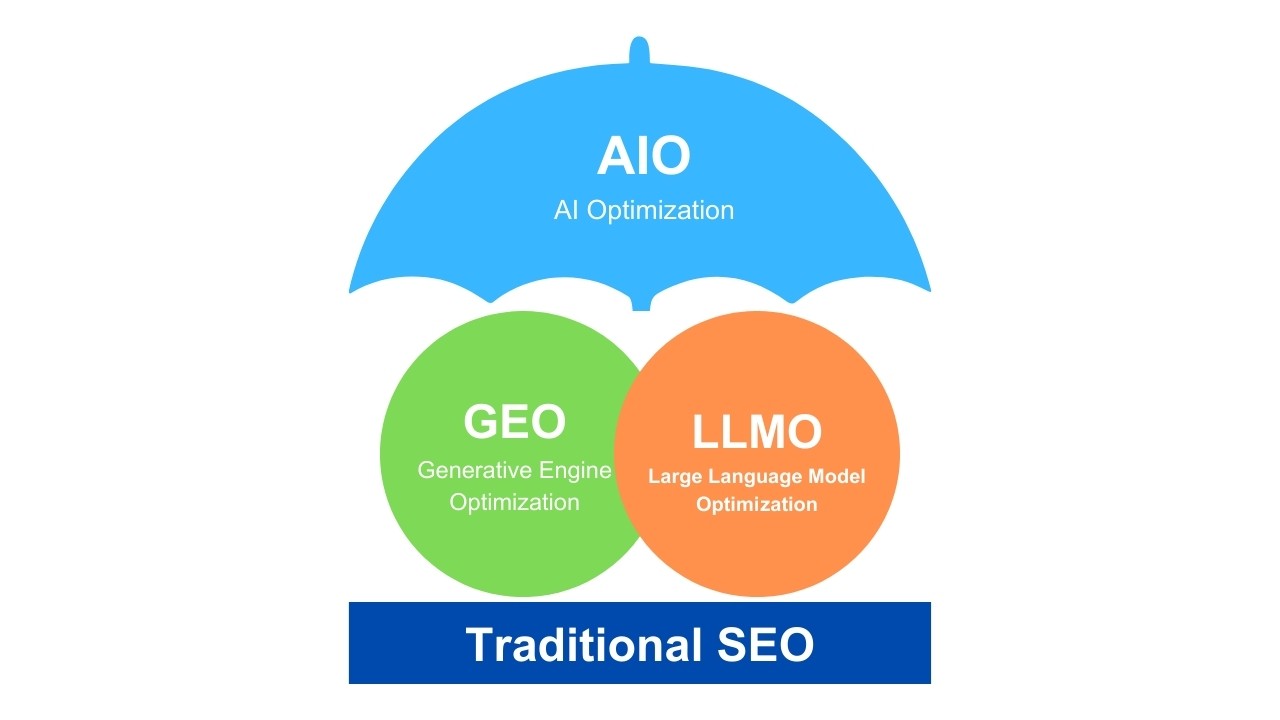
What Is AIO (AI Optimization)?
AIO is the broad strategy of optimizing your digital presence, so artificial intelligence systems can understand, categorize, and surface your brand.
Unlike traditional SEO, AIO considers how machines interpret:
- Structured data
- Entity relationships
- Topical authority
- Cross-language consistency
- Contextual signals
AIO ensures your brand is machine-readable and globally coherent.
For Western companies entering Japan, this means adapting messaging beyond literal translation. Japanese search behavior, terminology, and content structure differ significantly from Western markets. AI systems trained on Japanese-language content expect specific contextual cues.
For Japanese companies expanding internationally, AIO requires clarity. English content must define services, expertise, and market positioning in globally recognized terms. If AI systems cannot confidently classify your company, they are unlikely to recommend it.
AIO is the strategic foundation that supports both GEO and LLMO.
What Is LLMO (Large Language Model Optimization)?
LLMO focuses specifically on optimizing for large language models such as ChatGPT, Gemini, Claude, and other AI copilots.
When a user asks a question, these models generate answers based on patterns learned from structured, authoritative, and widely referenced information.
LLMO ensures that:
- Your expertise is clearly defined
- Your brand is associated with specific industry topics
- Your content is citation-friendly
- Your messaging is consistent across platforms and languages
For cross-border companies, this is especially critical.
A Western SaaS company entering Japan may have strong global authority but weak Japanese-language signals. Conversely, a Japanese enterprise may have deep domestic credibility but insufficient English-language presence for global AI systems to recognize.
LLMO reduces misrepresentation and increases the likelihood that AI systems accurately describe your company in generated responses.
What Is GEO (Generative Engine Optimization)?
GEO targets generative AI search experiences and answer engines.
Rather than optimizing for ranking positions, GEO optimizes for inclusion within AI-generated answers.
When an AI engine provides a summarized recommendation list, GEO determines whether your brand appears in that list.
This requires strong authority signals, consistent entity definitions, structured content, and credible third-party validation.
For Western firms entering Japan, GEO often requires local authority building. AI systems rely on trusted Japanese sources to validate credibility.
For Japanese companies expanding globally, GEO demands English-language thought leadership, international citations, and structured content that aligns with global search behavior.
GEO is not about being visible in search results. It is about being included in the answer itself.
Global Ranking in an AI-First World
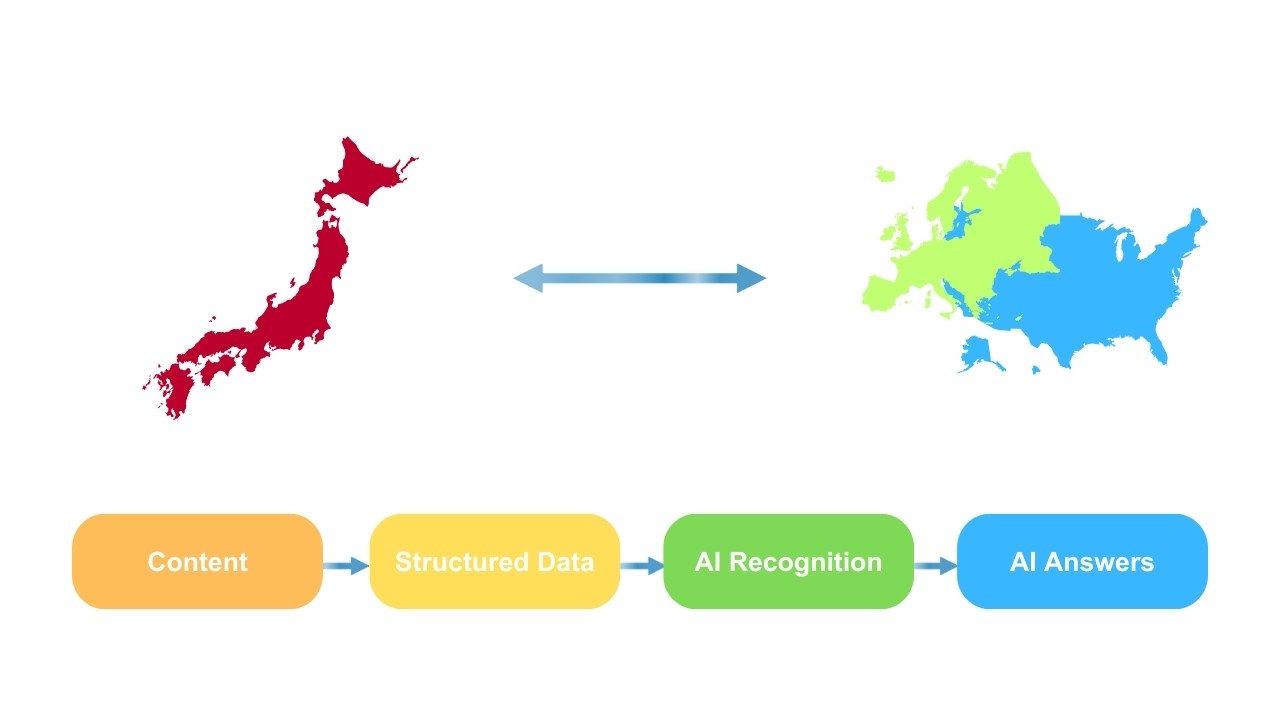
Global ranking once depended on domain strength, backlinks, and country-specific optimization.
In an AI-first ecosystem, ranking is increasingly determined by:
- Entity authority
- Semantic clarity
- Cross-language alignment
- Structured knowledge signals
AI systems compare information across languages and sources. Inconsistencies weaken trust. Clear, consistent positioning strengthens it.
This is particularly important between Japan and Western markets, where language nuance, business categorization, and digital behavior differ significantly.
Companies that align SEO, localization, and AI optimization into a unified strategy gain disproportionate visibility.
Frequently Asked Questions on AIO, GEO, and LLMO
What is AIO in digital marketing?
AIO (AI Optimization) optimizes content and digital assets so artificial intelligence systems can understand, classify, and surface a brand accurately in AI-generated search results and recommendations. It extends beyond traditional SEO by focusing on semantic structure, entity clarity, and cross-language consistency.
How is GEO different from traditional SEO?
Traditional SEO focuses on ranking within search engine results pages. GEO (Generative Engine Optimization) focuses on ensuring a brand is included in AI-generated summaries and answers. Instead of optimizing for position, GEO optimizes for inclusion within generative search outputs.
What is LLMO, and why does it matter?
LLMO (Large Language Model Optimization) ensures that large language models such as ChatGPT and Gemini correctly interpret and reference a brand. It matters because users increasingly rely on AI-generated answers for research and decision-making, reducing reliance on traditional search clicks.
Why is AI optimization important for companies entering Japan?
Japan has distinct search behavior, language nuances, and digital ecosystems. Without AI-aware localization, Western companies may fail to appear in AI-generated answers. AI optimization ensures semantic alignment with Japanese-language content and local authority signals.
Why do Japanese companies need AIO and LLMO for global expansion?
Japanese companies expanding internationally often rely on translated content that lacks global semantic clarity. AIO and LLMO ensure English-language content is structured, authoritative, and easily understood by global AI systems, increasing international visibility.
Can traditional SEO still work without AI optimization?
Traditional SEO remains important, but without AI optimization, brands risk losing visibility in AI-generated summaries. Modern digital strategy requires integrating SEO with AIO, GEO, and LLMO to maintain a competitive advantage.
Summary
Search has evolved from ranking pages to generating answers.
In this AI-first environment, global visibility is no longer determined solely by traditional SEO performance. Instead, brands must ensure they are clearly understood, structurally defined, and contextually trusted by artificial intelligence systems.
AIO provides the strategic foundation by making your brand machine-readable and semantically consistent across languages. LLMO ensures large language models accurately interpret and reference your expertise.GEO increases the likelihood that your company is included in AI-generated recommendations and summaries.
For Western companies entering Japan, this means moving beyond translation toward structured, AI-aware localization. For Japanese companies expanding internationally, it means redefining digital authority in globally recognized terms.
AI optimization for global expansion is not a future trend—it is already shaping how buyers discover, evaluate, and select partners.
In an ecosystem where AI increasingly decides what users see first, the competitive advantage belongs to companies that machines can understand, classify, and confidently recommend.
Author Profile

Originally from Seattle, Washington, she earned a Master’s degree in Digital Marketing from Western Governors University. After moving to Japan in 2020 and working in the international education sector, she now works in digital marketing consulting, specializing in social media and content strategy. At Admano, in addition to creating English content, she also provides consulting on SEO and digital marketing strategies for the Western markets.