
Google vs. Yahoo Japan: How Search Behavior Actually Differs in Japan
contents
In Western countries, Google’s search share hovers around 80-90%, and Western companies entering the Japanese market often make the mistake of thinking, “For Japanese web marketing, we only need to focus on Google.” While Google’s search share is certainly high in Japan, search engines like Yahoo! and Bing are also used on a daily basis. In particular, Yahoo!’s search share for mobile searches hovers around 10%.
On the other hand, Japanese is often considered one of the most difficult natural languages to learn. The reason for this is that Japanese is a complex language made up of multiple characters, including hiragana, katakana, and kanji. Furthermore, search behavior in Japan differs in many ways from that of Western countries.
In this article, we will explain two important aspects for Western companies when implementing SEO in Japan: the characteristics of the search engines used in Japan and Japanese search behavior.

In Western countries, the use of the Google search engine is extremely high, and SEO measures are emphasized in web marketing. In particular, in the United States and Germany, Google’s share of search engines remains high, at 80 to 90 percent.
Meanwhile, in Japan, the Google search engine is deeply rooted in daily life, and SEO measures are considered an important web strategy. Looking at the search engine market share in Japan as of December 2025, Google is in first place (73.52%), followed by Bing (15.62%) and Yahoo! (9.05%).
| Country | Search Engine | Market Share (Dec 2025) |
|---|---|---|
| United States | 84.48% | |
| Bing | 9.63% | |
| Yahoo! | 3.02% | |
| Germany | 90.18% | |
| Bing | 4.79% | |
| Yahoo! | 1.37% | |
| Japan | 73.52% | |
| Bing | 15.62% | |
| Yahoo! | 9.05% |
*The table is compiled by Tokyo SEO Maker from data surveyed by statcounter.
One difference between the search engine situation in Japan and the United States and Germany is the high market share of Bing and Yahoo Search. When comparing the market share of Yahoo Search by country, it hovers between 1-3% in the United States and Germany, while in Japan, it stands at 9%. In particular, Yahoo Search has a significant presence in mobile searches in Japan, with a market share of 13%. Therefore, SEO measures for Yahoo Search are essential for Western companies conducting web marketing in Japan.
| Country | Mobile Search Engine | Market Share (Dec 2025) |
|---|---|---|
| United States | 92.75% | |
| Yahoo! | 2.37% | |
| DuckDuckGo | 2.27% | |
| Germany | 96.24% | |
| Yandex | 1.31% | |
| Ecosia | 0.87% | |
| Japan | 83.67% | |
| Yahoo! | 13.46% | |
| Bing | 0.74% |
*The table is compiled by Tokyo SEO Maker from data surveyed by statcounter.
Differences Between Google Search and Yahoo Search in Japan
Both Google Search and Yahoo Search are services that originated in the United States. However, Japan’s Yahoo Search (Yahoo! JAPAN) is unique in that it offers its own unique service.
First of all, Google Japan, which operates Google Search in Japan, is a group company of Google LLC. On the other hand, Yahoo! JAPAN is operated by LINE Yahoo Corporation, a SoftBank Group company, and has no capital relationship with Yahoo! Inc. For these reasons, Yahoo! JAPAN is increasingly pursuing its own independent path.
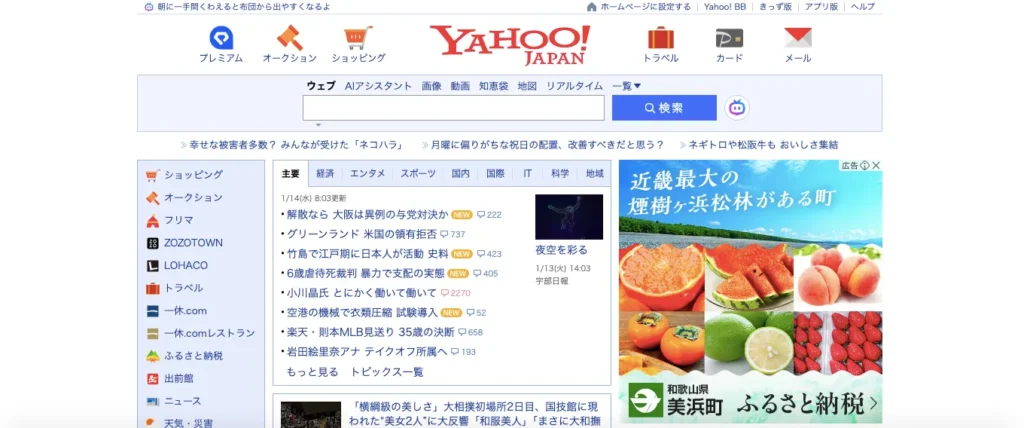
Yahoo! JAPAN not only provides search services, but also a variety of original content such as Yahoo! Shopping, Yahoo! Auctions, and Yahoo! Answers.
Also, speaking specifically about Yahoo Search, we partnered with Google in 2010 and introduced Google Search technology. As of December 2025, this partnership continues. Therefore, some people say that “taking measures for Google Search will directly lead to measures for Yahoo Search.” Because Google Search and Yahoo Search use the same search algorithm, almost identical page links are displayed in organic searches (search rankings).
However, there are clear differences between Google Search and Yahoo Search in terms of the behavior of the search result screen (SERPs) and the suggestion function. First of all, each search result has the following characteristics.
- Google search organic results are prone to change based on search history, etc.
- Original content is prioritized in Yahoo search
- Yahoo search tends to reflect real-time results
Also, due to these differences in characteristics, the user demographics of Yahoo Search are as follows:
- The Yahoo search volume zone is 50 to 64 years old
In addition, there are differences in the following features between Google Search and Yahoo Search:
- Suggestion function
- AI function
Characteristics of Google Search
In the case of Google Search, personalized search significantly changes organic search results for each search user. Personalized search is a feature that displays search results based on personal information such as the search user’s search history, page viewing history, and location information. This feature analyzes the web pages the search user is looking for and displays the most appropriate search results.
Yahoo! Search also uses personalized search, but the unique content is prominent in the search results.
Yahoo Search Features
Yahoo! JAPAN’s search results tend to prioritize unique content. One of the major features of Yahoo! JAPAN is that it offers a wide variety of content. Some of its most popular services are listed below.
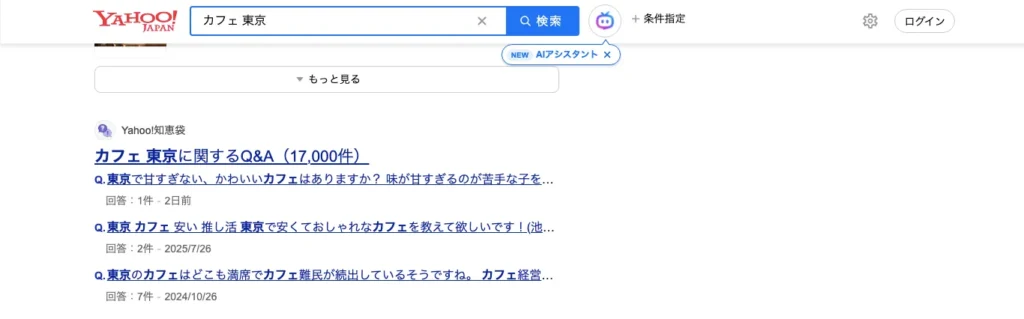
Yahoo! JAPAN content is often displayed as a rich result in Yahoo! Search search results.
Characteristics of Yahoo Search
Yahoo! JAPAN offers a service called Yahoo! Real-time Search, which allows users to search for posts by X. Furthermore, in September 2025, they will begin offering a new feature called SNS Buzz Summary, in which generative AI summarizes trending information for X.
In this way, Yahoo! JAPAN has introduced real-time information, and real-time information is now more easily reflected on Yahoo! Search.
Yahoo Search Age Group
Looking at the user demographics of Yahoo! JAPAN, it is used by a wide range of people, both male and female, and across all ages. The largest group is those aged 50-64 (26% of the total).
| Category | Group | Percentage |
|---|---|---|
| Sex | Male | 51% |
| Female | 49% | |
| Age | 13–29 years | 19% |
| 30–39 years | 15% | |
| 40–49 years | 20% | |
| 50–64 years | 26% | |
| 65 years and over | 20% |
For these reasons, it can be said that for companies targeting seniors and the elderly generation as customers, strategies for Yahoo! JAPAN’s search engine are highly important.
Suggested Keywords Behave Differently
There are differences in the suggested keywords between Google Search and Yahoo Search.
In the first place, the suggestion function is a function that predicts and picks out keywords that are often entered together when you enter a word in the search box.
The example image is an example of suggestions displayed for the keyword “Hakone Ekiden” in Yahoo Search (as of January 2, 2026).
Of these, Yahoo! Search suggestions are called keyword input assistance functions. And just like search results, they use a unique algorithm, which means that they tend to quickly reflect keywords related to topics featured on Yahoo! News and social media. Therefore, Yahoo! Search suggestions have a higher exposure rate for current keywords compared to Google Search.
In other words, when site owners take measures to improve their Yahoo search suggestions, the following measures are effective in generating buzz and encouraging coverage in the news.
- Press release distribution
- SNS account management
Differences in Generative AI Functionality
There are differences between Google and Yahoo in the functions of the generative AI they implement. While Google Search has implemented a chat-type generative AI, Yahoo Search is focusing on generative AI that works with original content, such as Yahoo! Shopping.
| Platform | AI Generation / Features |
|---|---|
| AI Mode, AI Overviews | |
| Yahoo! | AI assistant, Shopping AI assistant, AI answer function (Yahoo! Answers), etc. |
Of these, Google’s generative AI uses Gemini as a large-scale language model (LLM).
On the other hand, Yahoo’s generative AI is characterized by its diversity. For example, the Yahoo Search AI assistant uses Google’s AI building platform called Vertex AI. The Shopping AI assistant also uses information from My Best Co., Ltd.’s popular recommendation rankings. Additionally, Yahoo! Answers’ AI answering function combines GPT-4 and Claude3 to generate diverse answers.
As such, Yahoo’s generated AI uses a wide range of LLMs and databases. Therefore, when taking measures against LLMOs against Yahoo’s generated AI, measures must be tailored to the content on your site that you want to increase exposure for.
Japanese Search Behavior
Search behavior in Japanese is more complex than in other natural languages. First of all, Japanese is said to be one of the most difficult natural languages to learn. The biggest reason for this is the large number of different characters used.
- There are many types of characters in Japanese
Therefore, search behavior using Japanese has the following characteristics:
- Search using a combination of four characters: hiragana, katakana, kanji, and romaji
Additionally, as part of Japanese culture, it has the following characteristics, including the frequent use of unique phrases and abbreviations.
- Searching for unique abbreviations
- Search for multiple words separated
Search Using a Combination of Four Characters: Hiragana, Katakana, Kanji, and Roman letters
In Japan, searches are performed using a combination of multiple characters.
First of all, Japanese characters are divided into four types: hiragana, katakana, kanji, and romaji. When expressing Japanese in print, sentences are mainly created by combining these three types of characters: hiragana, katakana, and kanji. The same is true for search queries. For example, when referring to the fruit “strawberry,” there are three types of characters:
- いちご(Hiragana)
- イチゴ(katakana)
- 苺(Kanji)
If we look at the search results and search volume for each, we can see the following differences.
| Search Query | Search Volume | Types of Search Results Shown |
|---|---|---|
| いちご | 165,000 searches |
Strawberry sales e-commerce page / Strawberry picking information page / Explanatory article |
| イチゴ | 165,000 searches |
Strawberry sales e-commerce page / Comedy talent profile page / Commentary article |
| 苺 | 165,000 searches |
Strawberry sales e-commerce page / Explanatory article |
*Search volume is for November 2025 alone, and search results are as of January 2026.
First, looking at the search volume, there isn’t much difference between the search queries. This is because search engines consider “いちご,” “イチゴ,” and “苺” to be words with roughly the same meaning (similar meanings), and add up the number of searches for each.
However, there are some discrepancies in organic search. First, looking at the commonality, we can see that e-commerce pages selling strawberries have a high exposure rate. This is because all search queries include the search intent of “I want to buy strawberries.”
On the other hand, in the results for “strawberry,” information pages for strawberry picking services are ranked highly. The reason for this is presumably because the service name is often written as “strawberry picking,” so it tends to appear at the top of search queries written in hiragana.
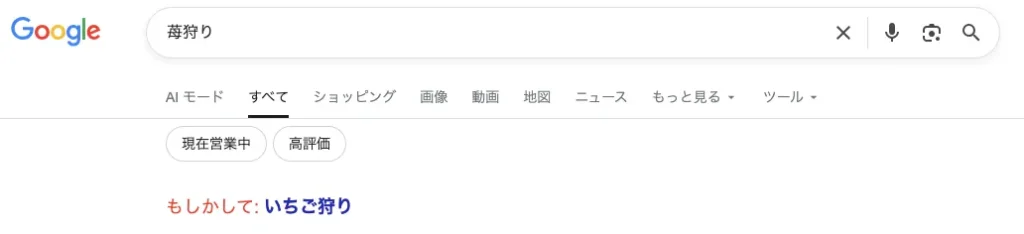
If you actually search for the keyword “苺狩り(ichigo picking),” you will see a message pointing out the spelling variation: “Maybe: いちご狩り.”
Similarly, when searching for “Ichigo,” the profile page of the comedy duo Ichigo (affiliated with Yoshimoto Kogyo) is displayed at the top of the search results. As you can see, Japanese has many words that have the same pronunciation but whose meaning changes depending on how they are written. For this reason, when targeting Japanese keywords, it is important to use the most appropriate writing system.
Unique Abbreviation Searches
In Japan, there are many cases where people search using unique abbreviations. Typical examples include the following words:
- Smartphone
- Convenience store (convenience store)
- Part-time job (baito)
And here’s a look at the search volume for each:
| Search Query | Search Volume |
|---|---|
| convenience store | 24,900,000 |
| convenience store | 5,000,000 |
| byte | 201,000 |
| part-time job | 90,500 |
| smartphone | 368,000 |
| Smartphone | 74,000 |
*Search volume figures are for November 2025 alone.
Similar trends can be seen in English and German, but in both languages, there is a high demand for abbreviations. This means that when taking measures for Japanese keywords, it is important to focus on familiar abbreviations.
Searching for Multiple Words
In Japan, it is customary to separate words with spaces and combine multiple keywords when searching. Furthermore, there is a strong tendency for search demand to be high for compound keywords. This search culture using spaces is also common in English. For example, if you want to know a bread recipe, you would separate words in Japanese and English as follows:
- “パン レシピ” (Japanese search)
- “bread recipes” (English search)
On the other hand, in German, it is often treated as one long word. For example, if you want to know a bread recipe, you would search like this in German:
- “Brotrezepte” (German search)
In this case, one keyword, “Brotrezepte,” will be targeted. However, in Japanese SEO, two keywords, “bread” and “recipe,” will need to be targeted. As such, depending on the characteristics of natural language, careful attention may be required when targeting keywords.
Frequently Asked Questions About the Difference Between Google Search and Yahoo Search
Here are some frequently asked questions about the differences between Google Search and Yahoo Search.
Q: What search engines are used in Japan?
In December 2025, the search engine market share in Japan will be Google in first place (73.52%), followed by Bing in second place (15.62%) and Yahoo! in third place (9.05%).
Q: Is SEO for Yahoo Search required in Japan?
In Japan’s search engine market, Yahoo Search has a market share of nearly 10%. In particular, Yahoo Search has a market share of around 3% in the United States and around 1% in Germany. For this reason, when Western companies conduct web marketing in Japan, they tend to neglect Yahoo Search strategies, so be careful.
Q: What is the most important thing in SEO for Yahoo search?
It is important to recognize the differences between Yahoo search and Google search and implement measures that suit your company’s objectives.
Yahoo! JAPAN offers a wide range of original content. One of its major features is that it links its content with Yahoo! Search. For example, e-commerce site owners can take advantage of Yahoo! Shopping to increase the visibility of their products.
Q:What if my Japanese SEO strategies aren’t working?
Please consult a specialist web marketing company that has expertise in overseas SEO measures.
Tokyo SEO Maker provides specialized SEO services for businesses operating in Japan. To date, we have provided web marketing support services to over 2,000 companies, both domestic and international. We are particularly strong in overseas SEO, and have a long track record of supporting overseas companies looking to enter the Japanese market. To get started, please contact us via the page linked below.
Summary
In Japan, in addition to Google Search, Yahoo Search and Bing are also widely used. Of these, Yahoo Search has been popular since the dawn of the Internet in Japan, and as of 2025, it still maintains a market share of around 10%. It also has a strong presence in mobile searches. Furthermore, the Japanese language is composed of multiple characters, which makes search behavior more complex. Understanding this Japanese culture is an important point for Western companies to succeed in web marketing in Japan.
Author Profile

A trilingual professional in English, Thai, and Japanese, she has numerous achievements in international SEO. She studied the latest IT technologies at Assumption International University, Thailand, and majored in International Business at the University of Greenwich, UK. Following her tenure at ExxonMobil’s Thai branch, she became a key member of Admano from its establishment.