

Technical SEO and UX for Japanese Websites: Why Western Sites Often Fail
contents
- 1 The Technical SEO Foundations for Japanese Websites
- 2 Cultural UX Differences That Affect Website Performance
- 3 Why Western Websites Often Fail in Japan
- 4 Building a Website That Works in the Japanese Market
- 5 Frequently Asked Questions on Japanese Websites
- 5.1 Why do many Western websites struggle to rank in Japan?
- 5.2 Is translating a website enough to succeed in the Japanese market?
- 5.3 Do websites targeting Japan need to be hosted in Japan?
- 5.4 What is the best URL structure for Japanese websites?
- 5.5 Why do Japanese websites often contain more information than Western websites?
- 5.6 What trust signals are important for Japanese websites?
- 5.7 Should Western companies redesign their entire website for Japan?
- 5.8 What is the most common mistake foreign companies make with Japanese websites?
- 6 Summary

For many Western companies expanding into Japan, launching a localized website seems straightforward. Translate the English content into Japanese, add a language toggle, and publish the new pages. Yet the results are often disappointing.
Traffic remains low. Rankings fail to materialize. Japanese users visit the site but leave quickly. Leads never arrive. This pattern appears frequently when overseas companies enter the Japanese market. The website may work perfectly in the United States or Europe, but the same approach rarely translates successfully to Japan.
The reason is not simply language. Websites built for Western audiences are usually designed around different assumptions about user behavior, information presentation, and technical implementation. Japanese users interact with websites differently, and search engines evaluate localized content within a different competitive landscape. A website targeting Japan must address both technical search requirements and cultural expectations. When either is ignored, performance suffers.
This article explores the most common reasons Western websites fail in Japan. It explains how companies can avoid these pitfalls by combining strong technical SEO foundations with a localized user experience.

The Technical SEO Foundations for Japanese Websites
Before addressing design or messaging, a Japanese website must first function correctly at a technical level. Many international websites contain configuration mistakes that prevent search engines from properly indexing Japanese pages or delivering them to the right audience.
These problems are often invisible to users but can significantly limit visibility.
Character Encoding and Japanese Text Handling
One of the most fundamental requirements for any Japanese website is proper text encoding. Japanese uses combination of writing systems, including kanji, hiragana, and katakana, and these characters require appropriate encoding standards to display correctly.
Most modern websites use UTF-8 encoding, which supports a wide range of global character sets. however, encoding issues can still occur during localization if a site was orginally built with different assumptions about character handling.
Encoding problems may cause characters to display incorrectly or appear as unreadable symbols. Even when no visible errors are present, inconsistent encoding can affect how search engines process Japanese text during indexing.
Because Japanese search queries often contain complex character and mixed scripts, ensuring clean encoding across every page is essential. Developers should confirm that both the HTML configuration and the database structure fully support UTF-8 encoding throughout the site.
When encoding is implemented correctly, Japanese content remains readable for both users and search engines.
URL Structures for Japanese Content
URL architecture is another area where international websites frequently encounter confusion.
When creating Japanese pages, companies must decide whether URLs should use Japanese characters, romanized words, or English terms. Each approach has advantages and disadvantages, and the best choice often depends on the broader site structure.
The most common URL strategies include the following:
| URL Structure | Example | Advantages | Considerations |
|---|---|---|---|
| Language subdirectory | example.com/ja/ | Simple to manage, clear language targeting | Requires hreflang implementation |
| Country subdirectory | example.com/jp/ | Signals geographic targeting | Less precise for language |
| Japanese characters | example.com/検索エンジン最適化 | Keyword relevance for Japanese users | Harder for international teams to manage |
| Romanized Japanese | example.com/nihon-seo | Easier technically | Less intuitive for native users |
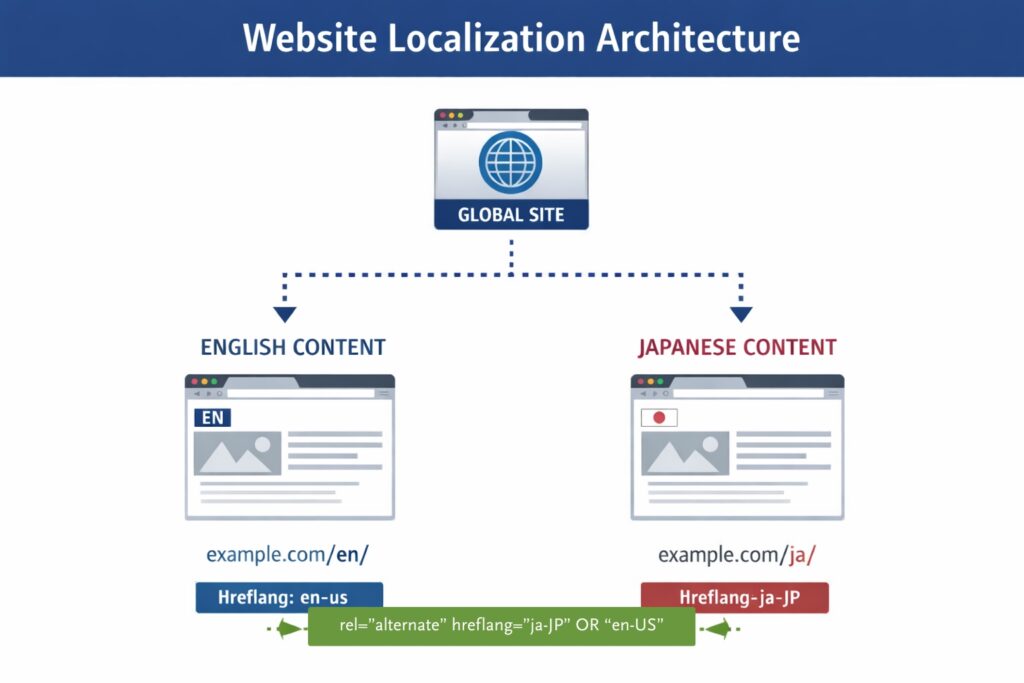
Many international sites choose a /ja/ or /jp/ subdirectory structure because it integrates easily with existing global websites while still signaling localization to search engines.
Using Japanese characters in URLs can sometimes improve keyword relevance, but it introduces operational complexity for teams unfamiliar with Japanese scripts. For many organizations, the benefits of readability and maintainability outweigh the potential SEO advantage.
Regardless of the format chosen, the most important factor is consistency. Clear and logical URL hierarchies help search engines understand site structure and improve crawl efficiency.
Hreflang Implementation for International Websites
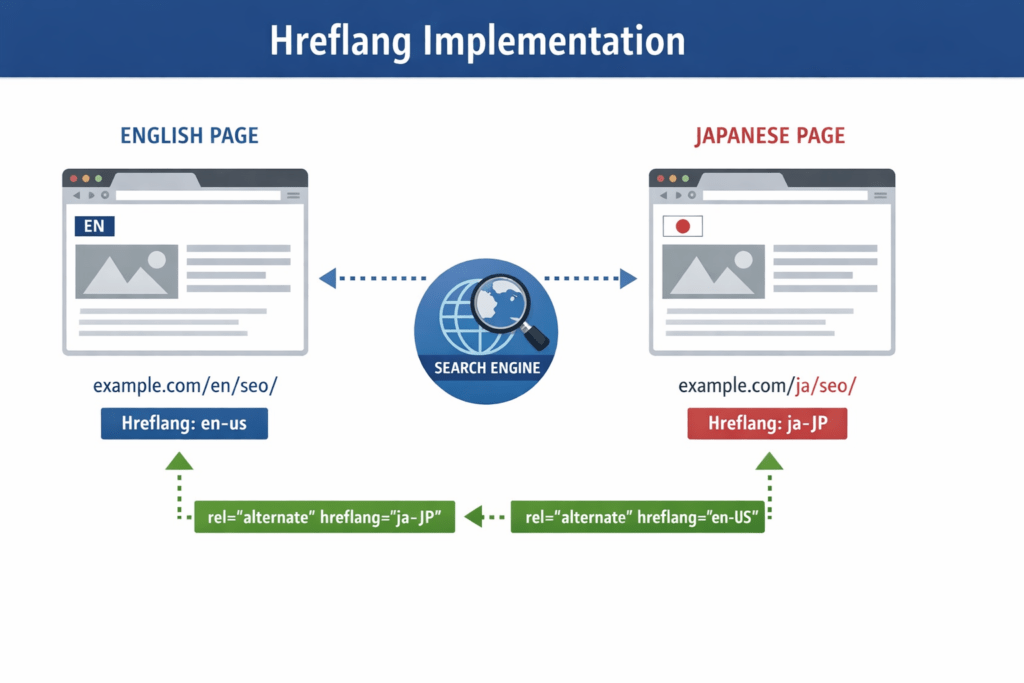
When a website serves multiple languages or regions, search engines rely on hreflang tags to determine which version of a page should appear in search results.
Hreflang signals are especially important for companies that offer both English and Japanese content on the same domain. Without proper implementation, search engines may display the wrong language to users.
For example, an English-language page might appear in Japanese search results, while the Japanese version remains hidden.
Hreflang tags clarify these relationships by specifying the intended language and region for each page. For instance, a site might designate separate versions for English, Japanese, and other languages using structured tags within the page code.
Incorrect hreflang configuration is surprisingly common. Pages may reference incorrect URLs, omit reciprocal links, or point to nonexistent language versions. These errors prevent search engines from understanding how localized content should be indexed.
Because Japan has a distinct language environment, accurate hreflang signals play a critical role in ensuring Japanese users see the correct pages.
The Hosting Location Myth
A long-standing belief in international SEO suggests that websites targeting Japan must be hosted within the country to rank well in search results.
In reality, the hosting location is far less important today than it was in earlier internet infrastructure environments.
Modern content delivery networks distribute website content across multiple geographic locations, allowing users to access pages quickly regardless of where the original server resides. As long as a site loads efficiently in Japan, hosting it in another region rarely affects rankings.
Instead of focusing on server location, companies should prioritize overall performance and reliability. A well-configured global hosting infrastructure often performs just as effectively as a local server.
There are situations where Japanese hosting may still be desirable, particularly for companies that must comply with local regulations or enterprise security requirements. However, from a pure SEO perspective, page speed and accessibility matter more than physical server location.
Page Speed Expectations in Japan
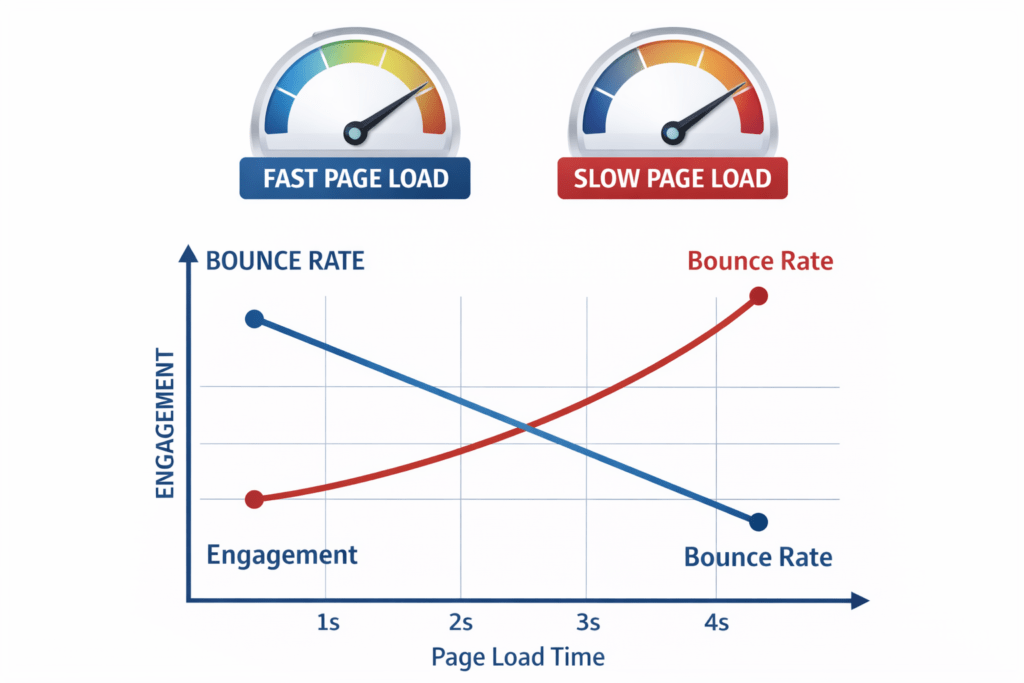
Page speed remains one of the most important technical factors affecting both user experience and search visibility.
Japan has some of the fastest internet infrastructure in the world, particularly in urban areas. Users are accustomed to rapid page loading and responsive websites. If a site loads slowly, visitors may abandon it quickly and search for alternatives.
International websites often experience performance issues when localizing content for Japan. Images may not be optimized, external scripts may create latency, and translation plugins may introduce unnecessary code.
Improving performance requires careful attention to asset optimization, caching, and content delivery networks. Compressing images, minimizing scripts, and reducing unnecessary page elements can significantly improve load times.
Faster websites benefit both search engines and users. They also signal technical quality, which indirectly supports credibility.
Cultural UX Differences That Affect Website Performance
Even when technical SEO is implemented correctly, Western websites can still struggle in Japan if the user experience does not align with local expectations.
Japanese web design has evolved in ways that differ noticeably from Western trends. Understanding these differences is essential for companies that want their sites to feel trustworthy and familiar to Japanese users.
Design Expectations in Japanese Websites
Western web design in recent years has favored minimalist layouts, large images, and limited navigation. While this approach can create visually appealing pages, it does not always align with Japanese browsing habits.
Japanese websites frequently contain significantly more information on each page. Navigation menus may include numerous links, banners, and category options. Rather than appearing cluttered, these layouts are often perceived as helpful because they provide quick access to detailed information.
The contrast between Western and Japanese design philosophies can be summarized clearly.
| Design Characteristic | Western Websites | Japanese Websites |
|---|---|---|
| Layout style | Minimalist | Information-rich |
| Navigation | Limited menus | Extensive navigation options |
| Content density | Short sections | Detailed explanations |
| Visual elements | Large imagery | Multiple banners and links |
When a Western website is translated into Japanese without adjusting its layout, it can appear sparse or incomplete. Users may interpret the lack of information as a lack of credibility.
Adapting the design to provide more visible detail often improves both engagement and trust.
Information Density and Decision-Making
Japanese consumers and businesses frequently conduct extensive research before making decisions. Websites are expected to provide thorough explanations, detailed specifications, and supporting information that help users evaluate products or services.
For this reason, Japanese websites often include significantly more written content than their Western counterparts.
A single product page may contain technical specifications, usage instructions, frequently asked questions, testimonials, and links to additional resources. These elements allow users to build confidence before contacting the company or making a purchase.
Western websites sometimes prioritize brevity and simplicity, but in Japan, insufficient detail can create uncertainty. When users cannot find the information they need, they may assume the company lacks experience or transparency.
Providing deeper content helps address these concerns and aligns the website with local research behavior.
Trust Signals Japanese Users Expect
Trust is a central element of online interactions in Japan. Users often look for clear signals that a company is legitimate and reliable before engaging further.
These signals typically include visible corporate information and accessible contact details. Japanese websites frequently display the company’s physical address, phone number, and organizational background prominently within the site.
Foreign companies sometimes overlook these elements, especially if their original websites rely primarily on online forms or email contact. However, Japanese users often expect a more transparent presentation of company information.
Showing tangible details about the organization reassures visitors that the company is real and accountable.
Corporate Credibility Pages
One feature that stands out on many Japanese websites is the depth of corporate information available.
It is common for companies to dedicate entire sections of their website to explaining the organization itself. These pages may include corporate philosophy statements, executive biographies, office locations, and historical timelines.
Such pages help establish credibility by demonstrating stability and openness.
For overseas companies entering Japan, creating comprehensive corporate information pages can significantly strengthen users confidence. Providing clear insight into the company’s background reduces uncertainty and shows respect for local expectations around transparency.
Why Western Websites Often Fail in Japan
When technical and cultural factors combine, the challenges faced by Western websites in Japan become clearer.
Many companies approach localization as a translation project rather than a strategic adaptation process. The existing site is translated into Japanese, but the underlying structure, design philosophy, and information architecture remain unchanged.
As a result, the site may technically function, but fails to resonate with Japanese users. Several common patterns emerge.
First, websites may implement Japanese language pages without properly configuring technical SEO elements such as hreflang tags or localized URLs. This prevents search engines from clearly understanding how the content should be indexed.
Second, minimalist Western design styles may create pages that appear incomplete compared to local competitors. When users expect detailed information but encounter sparse content, they may quickly leave the site.
Third, corporate credibility signals may be insufficient. Without detailed company information or transparent contact details, visitors may hesitate to engage with an unfamiliar overseas brand.
Finally, the overall information structure may not match Japanese research behavior. Users who want detailed explanations may struggle to find the information they need.
Together, these issues reduce both search visibility and user engagement, making it difficult for Western websites to gain traction in Japan.
Building a Website That Works in the Japanese Market
Companies that succeed in Japan typically approach website localization as part of a broader market strategy rather than a simple translation exercise.
Technical SEO should be integrated into the site architecture from the beginning. Proper encoding, clear URL structures, and accurate hreflang implementation ensure that Japanese content can be discovered by search engines.
Equally important is adapting the user experience to local expectations. Providing detailed information, expanding navigation options, and presenting corporate transparency signals can make the site feel more credible to Japanese audiences.
Localization should also consider how Japanese users research and evaluate products or services. Supporting pages, FAQs, and detailed explanations help guide users through the decision-making process.
When technical infrastructure and cultural design considerations are aligned, the website becomes a stronger platform for market entry.
Frequently Asked Questions on Japanese Websites
Why do many Western websites struggle to rank in Japan?
Western websites often struggle in Japan because they are designed for different user behaviors and search environments. many companies simply translate their English website into Japanese users typically expect more detailed information, stronger trust signals, and clearer corporate transparency. When those elements are missing , both search visibility and user engagement tend to suffer.
Is translating a website enough to succeed in the Japanese market?
Translation alone is rarely enough. Successful websites in Japan require localization, which includes adapting technical SEO, user experience, design expectations, and information architecture. Japanese audiences often look for detailed explanations, corporate information pages, and visible trust indicators. Without these adjustments, even well-translated content may feel incomplete or unfamiliar to local users.
Do websites targeting Japan need to be hosted in Japan?
Not necessarily. While this was once a common recommendation, modern infrastructure, such as content delivery networks, allows websites to load quickly for users regardless of server location. Search engines prioritize accessibility and page speed more than physical hosting location. As long as a website loads quickly for users in Japan, hosting outside the country typically does not affect rankings.
What is the best URL structure for Japanese websites?
Many international websites use a language-based subdirectory, such as /ja/, to separate Japanese content from other languages. This structure keeps the site organized while clearly signaling language targeting search engines. Some companies also use /jp/ to represent Japan specifically. The most important factor is maintaining a consistent structure that works well with hreflang tags and internal linking.
Why do Japanese websites often contain more information than Western websites?
Japanese users tend to conduct thorough research before making decisions, whether they are evaluating products, services, or business partners. Websites often reflect this behavior by providing detailed explanations, specifications, FAQs, and supporting information. A page that appears simple and concise by Western standards may seem incomplete to Japanese users.
What trust signals are important for Japanese websites?
Trust signals are particularly important when introducing a foreign brand to the Japanese market. Users often expect to see visible contact details, company addresses, and corporate information. Many Japanese websites include extensive company profile sections, executive information, and corporate philosophy pages. These elements help demonstrate legitimacy and transparency.
Should Western companies redesign their entire website for Japan?
Not always, but some adaptation is usually necessary. In many cases, companies can retain their core brand identity while adjusting layout structure, navigation depth, and information density for Japanese audiences. The goal is to create a website that feels familiar and trustworthy to local users while maintaining global brand consistency.
What is the most common mistake foreign companies make with Japanese websites?
The most common mistake is treating localization as a simple translation project. Successful websites in Japan require adjustments to technical SEO, user experience, content depth, and trust signals. Companies that approach localization strategically tend to perform far better than those that only translate their existing website.
Summary
Entering the Japanese market offers significant opportunities, but success requires more than translating an existing website.
Technical SEO factors such as character encoding, URL structure, hreflang configuration, and page speed provide the foundation for search visibility. At the same time, cultural expectations around design, information density, and corporate transparency shape how users perceive and interact with a website.
Western websites often struggle in Japan because they overlook one of these dimensions. When localization focuses only on language without adapting technical and structural elements, the result is a site that neither ranks well nor earns user trust.
Companies that approach localization strategically—combining strong technical SEO with a user experience designed for Japanese audiences—are far more likely to build credibility, visibility, and long-term growth in the market.
Author Profile

Originally from Seattle, Washington, she earned a Master’s degree in Digital Marketing from Western Governors University. After moving to Japan in 2020 and working in the international education sector, she now works in digital marketing consulting, specializing in social media and content strategy. At Admano, in addition to creating English content, she also provides consulting on SEO and digital marketing strategies for the Western markets.