
Cross-Border Link Building: How Backlinks and Digital PR Actually Work Between Japan and Western Markets

A company builds a genuinely strong piece of content — original research, a well-produced guide, a useful tool — and applies the link-building playbook that works at home. Outreach emails go out. Nothing happens. Weeks pass. A handful of low-quality directory links trickle in. The content is good. The strategy is the problem.
This happens in both directions. A Western SaaS company emailing Japanese tech blogs with a standard English-language pitch template gets silence, because the entire premise of the outreach — a cold email asking a stranger to link to your content — does not match how authority and trust are built in the Japanese media and web ecosystem. A Japanese manufacturer’s PR team, accustomed to working through long-standing Keiretsu-style media relationships and press club submissions, finds that the same approach produces almost nothing in the more open, pitch-driven American trade press ecosystem — not because the approach is wrong, but because it’s the wrong approach for that market.
Every guide on this site that touches link building — our complete Japan SEO guide, our reverse localization guide — flags this as a persistent pain point without fully unpacking it. This guide does that: how backlinks and digital PR actually function in Japan versus the West, why the same tactics produce opposite results depending on direction, and a practical, sequenced approach for building authority in a market that is not your own.

1. Why Link Building Is Not a Portable Skill
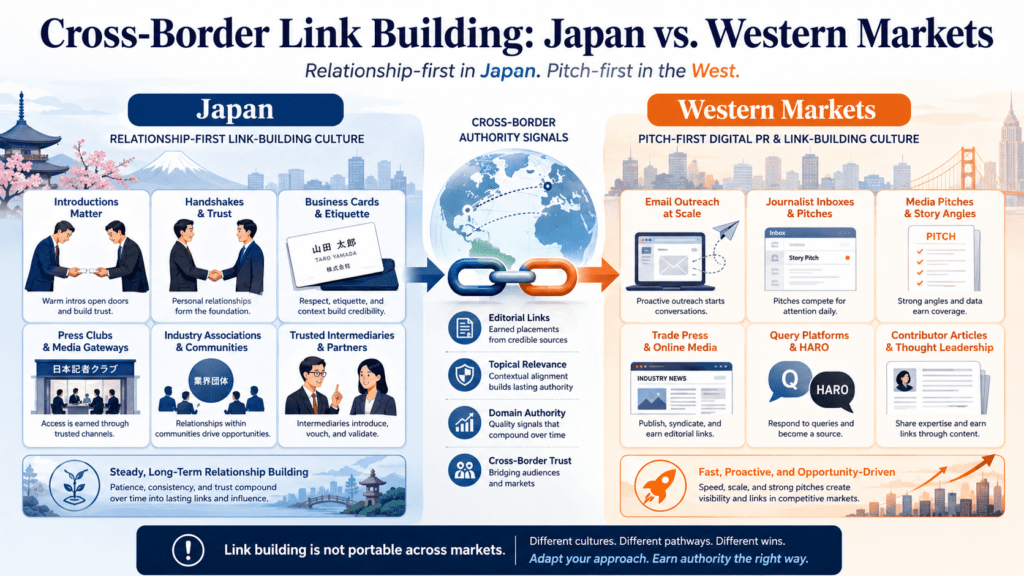
Link building is often treated as a universal SEO discipline: find relevant sites, pitch your content, earn a link, repeat. The mechanics of how that exchange happens, however, are deeply shaped by local media culture, journalistic norms, social trust structures, and even legal conventions around endorsement and advertising disclosure. None of that transfers automatically across a language and culture boundary.
Three structural differences explain most of the friction Western and Japanese companies encounter when attempting to build links in the other market.
Relationship-first versus pitch-first media cultures
Japanese media and corporate web culture are comparatively relationship-driven. Journalists, bloggers, and even corporate communications teams are more cautious about linking to or covering an unfamiliar entity without an existing relationship, an introduction through a trusted intermediary, or a long history of interaction. Cold outreach — emailing a journalist you’ve never spoken to with a request to cover or link to your content — has a measurably lower success rate in Japan than in the US, where pitch-first, transactional media relationships are the norm and journalists routinely build stories from unsolicited pitches, data releases, and HARO-style query responses.
This is not a matter of Japanese journalists being unresponsive in general — Japanese business media produce enormous volumes of content. It is a matter of the on-ramp being different: introductions, press club membership, and sustained presence matter more than a single well-crafted pitch.
Differing thresholds for external linking
Japanese corporate and media websites link externally less frequently than their Western counterparts, independent of outreach quality. This is partly a legacy of older web conventions (many large Japanese corporate sites still treat outbound links as something to be minimized, reflecting an SEO philosophy that predates current best practices). Partly a function of risk aversion — an external link is implicitly an endorsement, and Japanese organizational culture tends to be more conservative about issuing endorsements without senior sign-off. A piece of content that would earn a quick contextual link from a US blog might require months of internal approval at an equivalent Japanese organization, if it happens at all.
Different definitions of “authoritative”
The source types that confer the most SEO and reputational value differ structurally between markets:
| Source Type | Authority Weight in Japan | Authority Weight in Western Markets |
|---|---|---|
| National newspaper coverage (Nikkei, Yomiuri / NYT, WSJ) | Very high | Very high |
| Trade and vertical industry press | High | High |
| Government and public-sector mentions (.go.jp / .gov) | Very high | High |
| University and research institution links | High | High |
| Industry association membership directories | Moderate-high | Moderate |
| Q&A and forum platforms (Yahoo! Chiebukuro / Reddit, Quora) | Low direct SEO value, high discovery value | Low direct SEO value, high discovery value |
| Influencer and blogger coverage | Growing but historically lower than the US | Very high, especially in consumer categories |
| Press release wire distribution | Moderate | Low-moderate (often no-follow, limited standalone SEO value) |
| Guest-contributed bylined articles | Lower frequency, higher trust when secured | Common and actively pursued by competitors |
The practical takeaway: a link-building campaign designed around Western tactics — guest posting, influencer seeding, journalist query platforms — will underperform in Japan, not because the tactics are bad, but because the supply of opportunities and the willingness to engage with cold outreach is structurally lower. The inverse is equally true: Japanese companies relying on relationship-based PR alone will miss the large, pitch-receptive Western trade press ecosystem that rewards exactly the kind of proactive, data-driven outreach that feels aggressive by Japanese standards.
2. Link Building From the West Into Japan
For Western companies trying to build backlinks and a digital PR presence in the Japanese market, the standard Western playbook needs substantial adaptation.
What doesn’t transfer
Cold guest-post outreach at scale, journalist query platforms (Japan has no widely adopted direct equivalent to HARO/Connectively), and SEO-motivated guest contribution pitches sent in English to Japanese publications all see minimal response rates. English-language pitches are themselves a significant barrier — even Japanese journalists and editors who read English will frequently deprioritize an English pitch in a market where Japanese-language correspondence is the baseline professional expectation.
What works instead
Original research and data releases, localized
Japanese media — particularly the business press — actively seek citable original data, and this is one of the few link-building mechanisms that performs comparably well in both markets. The requirement for Japan is that the research must be presented in Japanese, framed around a Japan-specific angle (not just a global study with Japan included as one data point), and ideally released through a recognized Japanese press release distribution service (PR Times and @Press are the two dominant platforms) rather than a Western wire service.
Industry association membership
Japanese industry associations (gyokai dantai) maintain member directories that often include backlinks, and membership itself confers a credibility signal that compounds beyond the direct SEO value. For foreign companies, joining the relevant Japanese industry association — even as an associate or international member — is a comparatively underused tactic that produces both a durable, high-trust backlink and ongoing access to the kind of relationship network that makes future media coverage more accessible.
Localized digital PR agencies with existing journalist relationships
Because cold outreach underperforms, the highest-leverage investment for Western companies is a Japan-based PR agency or an in-house Japan PR hire who already has standing relationships with relevant trade journalists. This channel demands more relationships and often costs more than Western companies typically budget. However, it consistently achieves better results than attempts to mimic Western-style scaled outreach using translated pitches.
Government and university partnership content
Co-authored research, white papers, or case studies produced in partnership with a Japanese university lab or a government-affiliated research body carry outsized authority and are realistic targets for foreign companies with genuine R&D or academic collaboration angles — particularly in manufacturing, life sciences, and technology categories.
Sponsorship and event-based links
Sponsoring a recognized Japanese industry conference, trade show, or research symposium produces a durable backlink from the event’s website (frequently a high-authority domain) and creates a natural, low-friction opening for media coverage and association membership simultaneously.
A note on directories and reciprocal linking
Older-style Japanese SEO practices — link exchanges between local businesses, broad-spectrum directory submissions — persist more in Japan than they do in most Western markets, where Google’s algorithm updates have made these tactics largely ineffective and occasionally penalized. Foreign companies should treat these with the same caution they would apply in any market: a few genuinely relevant, curated industry directories can be worthwhile, but link exchange schemes and mass directory submission carry real risk and minimal reward in 2026’s search landscape, regardless of market.
3. Link Building From Japan Into Western Markets
For Japanese companies building authority in Western markets, the friction runs in the opposite direction: the available channels are more abundant and more pitch-receptive than what Japanese teams are typically resourced or culturally inclined to pursue aggressively.
What doesn’t transfer
Relying exclusively on existing Japanese PR agency relationships, press club submissions, or wire distribution through Japan-based services produces close to zero Western pickup. Western trade journalists do not monitor Japanese press club channels, and a press release distributed only through a Japan-based wire service will not reach the Western outlets that matter for an English-language SEO and authority-building campaign.
What works instead
Journalist queries response platforms
Western markets — especially the US — have a mature ecosystem of platforms connecting journalists seeking expert sources with companies willing to provide commentary (Connectively, formerly HARO, being the best known, alongside several competitor platforms and dedicated PR software features). This channel is high-volume, comparatively low-cost, and almost entirely unused by Japanese companies entering Western markets, representing one of the highest-leverage gaps available. It requires an English-speaking spokesperson able to respond quickly and substantively to journalists’ queries — a resourcing requirement, not a strategic obstacle.
Bylined contributor articles in trade press
Western trade publications, especially in B2B, manufacturing, technology, and finance verticals, actively solicit guest contributions from credible industry executives. This is a significantly underused channel for Japanese companies relative to how aggressively Western competitors pursue the same placements. A Japanese executive with genuine subject-matter expertise, paired with strong English editing support, is a realistic and high-value candidate for this kind of placement.
Original research positioned for Western news cycles
As in the reverse direction, original data is one of the most portable digital PR assets — but the framing needs to shift. Western trade journalists respond to research framed around a clear, quotable finding and a Western-market angle, not a translated version of a study originally designed for Japanese domestic relevance. A Japanese company with genuinely interesting proprietary data (manufacturing benchmarks, consumer behavior data, technology adoption rates) should commission a Western-market-specific framing and release, not a translation of the Japanese-language version.
Active digital PR agency engagement in the target market
Just as Western companies need Japan-based PR relationships to access the Japanese media ecosystem, Japanese companies need a Western-market PR partner — not an extension of their existing Japanese agency relationship, but a dedicated Western-market hire or agency partnership with standing relationships in the relevant trade press.
Conference speaking and award submissions
Western industry conferences and trade awards are, on balance, more open to international submissions and more actively promoted by the organizations behind them than Japanese equivalents, and they generate both direct backlinks (speaker pages, award winner pages) and follow-on press coverage that is difficult to access through cold outreach alone.
4. A Side-by-Side Comparison of Channel Effectiveness
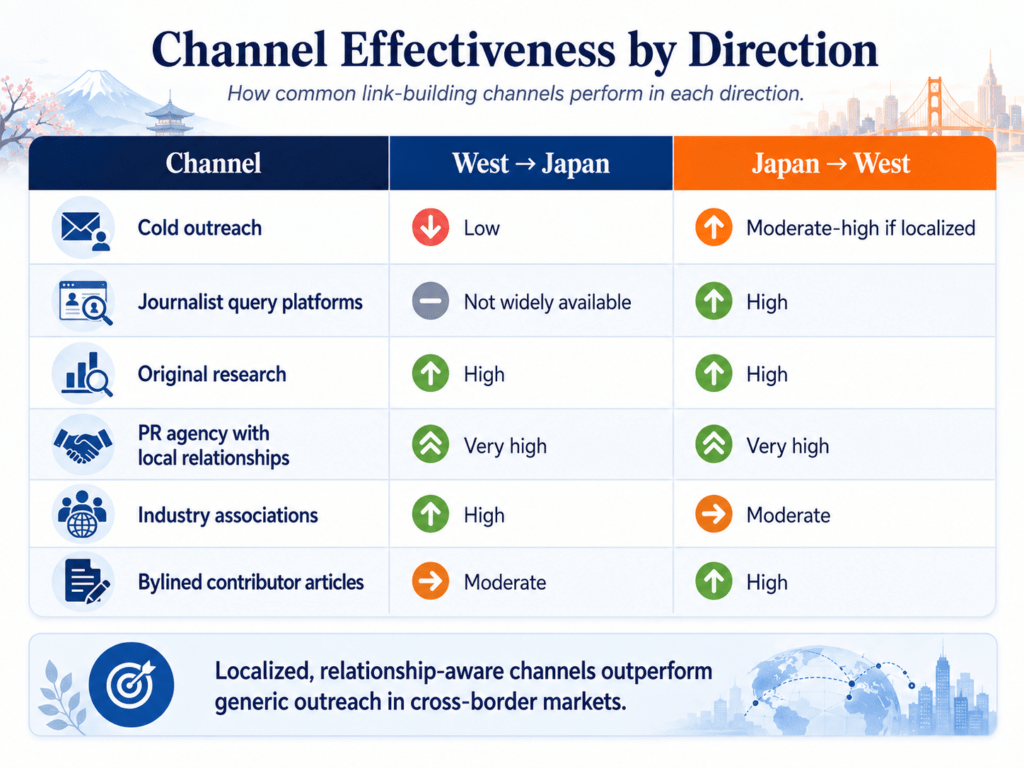
The following summarizes the relative effectiveness of common link-building channels by direction, based on the structural patterns described above.
| Channel | Effectiveness: West → Japan | Effectiveness: Japan → West |
|---|---|---|
| Cold email outreach (untranslated/unlocalized) | Very low | Low-moderate |
| Cold outreach (properly localized, native-language) | Moderate | Moderate-high |
| Journalist query platforms (HARO-style) | Not widely available | High |
| Original research/data release | High (if Japan-specific framing) | High (if Western-specific framing) |
| Industry association membership | High | Moderate |
| Bylined contributor articles | Moderate (slower placement cycle) | High |
| PR agency with local relationships | Very high | Very high |
| Conference sponsorship/speaking | High | High |
| Government/university partnership | High | Moderate |
| Wire service press release distribution | Moderate (use PR Times / @Press) | Low-moderate (limited standalone SEO value in either market) |
| Directory submission/link exchange | Low-moderate, declining | Low, ineffective |
The pattern that emerges: channels requiring an existing relationship, or a properly localized, market-specific framing, perform reasonably well in both directions. Channels relying on scaled, low-touch outreach — the default tactic in most domestic Western link-building campaigns — consistently underperform when exported into Japan without adaptation, while Japan’s relationship-based default underperforms when exported into the more pitch-receptive Western press ecosystem without addition of the proactive outreach Western media expects.
5. Original Research as the Universal Bridge Asset
Across both directions, one tactic consistently outperforms the others: original, citable research. This deserves separate treatment because it is the rare link-building asset that works in both Japan and the West — provided it is reframed, not simply translated, for each market.
The mechanism is straightforward: journalists and content creators in both markets need data to support stories, and a company that produces genuinely original data (a market survey, a benchmark study, an analysis of proprietary operational data) gives them a citable source that doesn’t exist anywhere else.
The execution requirements differ by destination market:
For Japan-bound research: Present findings in Japanese with Japan-specific framing. A global survey with a small Japanese sample size will be deprioritized by Japanese journalists in favor of a study explicitly designed around Japanese market conditions, even if the underlying sample size is similar. Distribute through PR Times or @Press rather than a Western wire service. Include comparisons to relevant Japanese industry benchmarks where possible — Japanese trade press strongly prefers content that situates findings within the domestic context rather than a global average.
For Western-bound research: Present findings with a clear, quotable headline statistic — Western trade journalists, especially in the US, build stories around a single striking number more readily than a comprehensive data set. Avoid excessive methodological caveats in the press-facing summary (save the rigor for a linked methodology page). Time the release to align with a relevant news cycle or industry event, where possible; Western journalists are more responsive to research that connects to something already in the news.
| Element | Japan-Bound Research Release | Western-Bound Research Release |
|---|---|---|
| Language | Japanese (primary), English (secondary, if relevant) | English |
| Distribution | PR Times, @Press, Japanese trade press direct pitch | Direct journalist pitch, wire service (PRNewswire/Business Wire), journalist query platforms |
| Framing | Domestic Japanese market context, comparison to local benchmarks | Single quotable statistic, connection to the current news cycle |
| Sample requirement | Japan-specific sample, not a subset of a global study | Western-market-specific sample or clearly segmented data |
| Visual assets | Charts with Japanese labels, conservative design conventions | Charts and a clean one-page summary graphic that Western outlets can embed |
6. A Practical Cross-Border Link-Building Roadmap
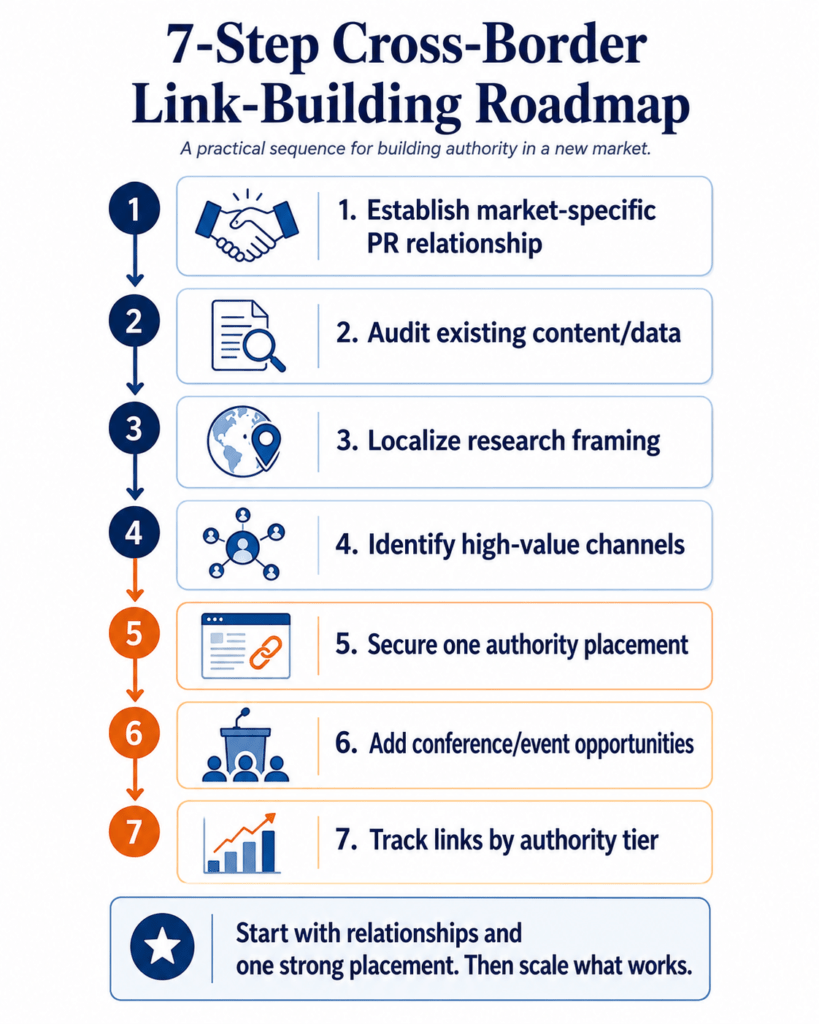
For companies building authority in the opposite market, the following sequence reflects a realistic order of operations.
- Establish market-specific PR relationships before producing content. Whether hiring locally, partnering with a market-specific agency, or training an internal team member, this is the highest-leverage single investment and should precede large content production efforts.
- Audit existing content for one strong original-research candidate. Most companies already have data — sales patterns, product usage, survey responses — that can be reframed as original research for the target market, rather than commissioning something from scratch.
- Localize the research framing for the destination market, following the distinctions in Section 5, rather than translating a single press release for both markets.
- Identify the two or three highest-value relationship-based channels for the destination market — for Japan, this typically means one or two industry associations and a short list of trade publications; for the West, this typically means a journalist query platform subscription and two or three trade publications open to contributor content.
- Pursue one durable, high-authority placement before scaling outreach. A single placement in a recognized trade publication or a single industry association membership creates downstream credibility that makes subsequent outreach easier — link building compounds, and the first credible placement is disproportionately valuable.
- Layer in conference and event-based opportunities once foundational placements exist, since speaker selection committees and award judges frequently look for existing credibility markers before extending an invitation.
- Track link acquisition by source type, not just volume, distinguishing between high-authority editorial placements, association/directory links, and lower-value sources — a few of the former outperform numerous the latter in both markets, but particularly in Japan, where domain-level trust signals carry comparatively more algorithmic and reputational weight.
7. Cross-Border Link Building Readiness Checklist
Strategy and Resourcing
- A market-specific PR relationship (agency or in-house) exists for the destination market, not borrowed from the home-market team.
- Outreach materials are written natively for the destination market, not translated from home-market templates.
- At least one original-research asset has been identified or is in development.
- The team has identified two to three realistic, relationship-accessible channels for the destination market.
For Western Companies Targeting Japan
- Japanese-language press materials prepared, not English-only
- Distribution planned through PR Times or @Press, not Western wire services alone
- Relevant Japanese industry association(s) identified for potential membership
- Research findings reframed around the Japan-specific context, not extracted from a global study
For Japanese Companies Targeting Western Markets
- A journalist’s query platform (e.g., Connectively) subscription is active with a responsive English-speaking spokesperson.
- Two to three target trade publications identified for contributor article pitches
- Research findings were reframed around a single quotable statistic for the Western press.
- Conference speaking and award submission calendars are tracked for the relevant industry vertical.
Measurement
- Links tracked by source authority tier, not raw volume
- Domestic press club/wire service placements are not being counted as cross-border wins
- Quarterly review of which channel types are producing placements, with budget reallocated toward what is actually working in that specific direction
Summary
Link building is not a portable skill — the mechanics of how authority and trust translate into backlinks differ structurally between Japan and Western markets, and tactics that work well in one direction frequently fail in the other.
Japanese media and corporate web culture are comparatively relationship-driven and cautious about external linking; Western media, particularly in the US, is comparatively pitch-receptive and built around scaled outreach and journalist query platforms.
For Western companies targeting Japan, the highest-leverage channels are localized original research, industry association membership, and a Japan-based PR relationship — not translated cold outreach at scale. For Japanese companies targeting Western markets, the highest-leverage and most underused channels are journalist query platforms and bylined contributor articles — channels that reward exactly the kind of proactive, pitch-first behavior that Japanese PR culture tends to underutilize.
Original research is the rare asset that performs well in both directions, provided it is reframed — not simply translated — for the destination market’s journalistic conventions and news cycle expectations. A single durable, high-authority placement is disproportionately valuable as a foundation; link building compounds, and the first credible placement makes every subsequent outreach effort easier. Track link acquisition by source authority, not volume, and resist counting domestic-market PR wins as cross-border progress.
Frequently Asked Questions
How long does it typically take to see results from cross-border digital PR?
Relationship-based channels — PR agency engagement, industry association membership — typically take three to six months to produce the first placement, reflecting the time needed to build the relationship itself. Journalist query platforms can produce results faster, sometimes within the first month, because they don’t require a pre-existing relationship, only a responsive and substantive source. Original research releases typically take one to two months from data collection to placement, accounting for production, localization, and pitch timing.
Is it worth using a Western PR agency’s Japan office, or should we hire a dedicated Japan-based agency?
A genuinely staffed Japan office with Japanese-speaking, Japan-based team members who hold their own local media relationships can work well. The risk is agencies that offer a “Japan service” primarily staffed by the home-market team with translation support — this tends to replicate the cold-outreach failure pattern described in this guide, just executed by a vendor instead of in-house. Ask specifically about the nationality, location, and existing media relationships of the team that would handle the account before committing.
Can AI-generated or AI-assisted press materials work for cross-border PR?
AI tools can meaningfully accelerate drafting, translation review, and research synthesis, but a native speaker with market-specific media experience should review and refine the journalist-facing pitch before distribution. Journalists in both markets — particularly in Japan, where formality and correctness carry real weight — are quick to deprioritize material that reads as generic or imperfectly localized, and AI-assisted drafts that skip native review are a common source of exactly that problem.
Does this guide apply to smaller companies without a dedicated PR budget?
Yes, with adjusted expectations. Smaller companies should prioritize the lowest-cost, high-relationship-leverage channels first: journalist query platforms (low cost, requires time investment) for Western-bound efforts, and industry association membership (often a modest annual fee) for Japan-bound efforts. Producing original research at low cost uses existing operational or customer data instead of commissioning recent survey work. A dedicated agency relationship becomes more valuable as the program scales, but it is not a prerequisite for early-stage cross-border link building.
How does this interact with the trust signals and case study recommendations in your other guides?
Closely. The case studies and quantified outcomes recommended in our reverse localization guide are themselves strong original research and pitch material for Western-bound digital PR — a well-documented case study is both a conversion asset on your own site and a citable source for trade press coverage. Similarly, the certifications and association memberships recommended as trust signals for Japan-bound websites in our landing page localization guide double as link-building assets when the association maintains a member directory. We should plan trust-signal development and link-building strategy together, rather than as separate workstreams.
Tokyo SEO Maker is a web marketing consultancy based in Tokyo, Japan, specializing in SEO strategy and digital market entry for businesses entering and competing in both the Japanese and Western markets. Contact us for a free consultation.