
Content Strategy and Topic Clusters: A Guide for Japan and Western Markets
Keyword research gives international marketing teams a view of what customers are searching for. The next decision is how to organize those findings into useful pages, credible resources, and a publishing program that supports commercial growth. That decision becomes more complex when a company serves Japan and one or more Western markets, because buyers may ask different questions, consult different sources, and expect different forms of proof before contacting a supplier.
A successful international content strategy connects search demand to the buyer journey, assigns a clear role to each page, and establishes a repeatable process for localization and review. It also gives regional teams room to reflect the conditions of their own market. A Japanese manufacturer expanding into the United States may need application-focused comparisons and technical integration resources, while a Western software provider entering Japan may need implementation details, security documentation, and locally relevant adoption examples. These are planning hypotheses to validate through local interviews and search results, rather than assumptions that apply to every industry.
This white paper explains how to build topic clusters, select content formats, organize multilingual production, and measure outcomes across Japan and Western markets. It follows our guide to keyword research and search intent and assumes that the team has already created an initial keyword-to-URL map. The methods below show how to turn that map into an editorial system that can be maintained and improved over time.

1. From Keyword Maps to a Content Portfolio
A keyword map records which search terms belong to which pages. A content portfolio adds the business context: who the page serves, what decision it supports, how it connects to other pages, and what evidence will make its claims credible. Without this second layer, an editorial calendar can become a queue of isolated articles whose combined contribution to market entry is difficult to assess.
Begin with three linked planning units. The market plan defines priority countries, audience segments, offers, and conversion routes. The topic plan groups related customer problems into areas in which the company can contribute expertise. The page plan specifies the intent, format, owner, and evidence required for each URL. Decisions should flow from market plan to topic plan to page plan, with performance data feeding back into all three.
Consider a business-to-business inventory software provider active in Japan, the United States, and Germany. Its top-level topic may be inventory control, but the regional plans can diverge. Japanese buyers may need materials that clarify implementation responsibilities and integration with domestic systems. US operations teams may prioritize integration documentation and cost-of-ownership comparisons. German prospects may require German-language workflows and relevant local compliance information. Every difference should be confirmed by buyer interviews and regional search analysis before the team commits production resources.
2. A Topic Cluster Model for International SEO
A topic cluster is a coordinated set of pages covering a recognizable subject from multiple angles. A central resource, often called a hub or pillar page, establishes the subject and guides readers toward more specific resources. Supporting articles answer narrower questions and link back to the hub where relevant. Product, solution, pricing, and contact pages connect the educational material to the next step of the buyer journey.
The model helps editorial teams avoid overlapping pages and gives readers logical routes through complex subjects. Internal links also help search engines discover related pages and understand their context; Google recommends using descriptive, crawlable links in its Search Essentials guidance. A cluster is an information architecture and editorial framework, however, and its existence does not guarantee rankings.
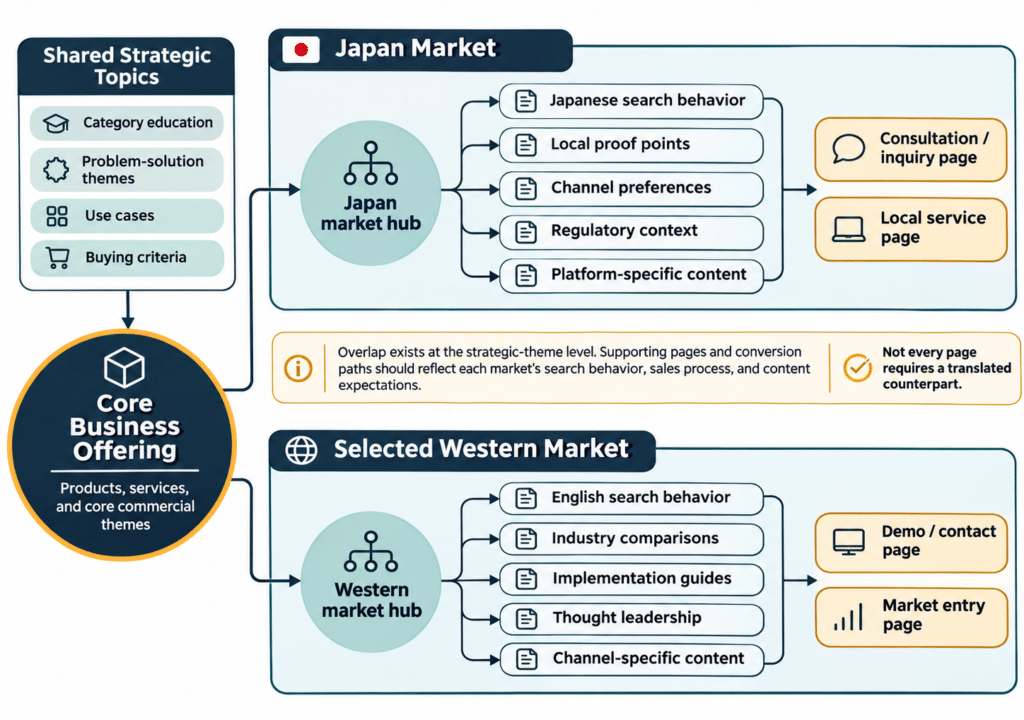
One global topic does not require an identical page set in every language. The global team can maintain a shared taxonomy of buyer problems, while local teams decide which topics merit a dedicated page, which belong inside another article, and which have little relevance to their market. A topic can therefore appear as a standalone Japanese guide and as a shorter section within an English comparison page, provided each locale serves its audience coherently.
| Page role | Reader need | Primary editorial task | Possible next step |
|---|---|---|---|
| Hub guide | Understand a category and navigate related issues | Explain fundamentals and link to detailed resources | Read a specialized guide |
| Problem guide | Diagnose a business or technical challenge | Describe symptoms, causes, and solution criteria | Explore a solution page |
| Comparison resource | Evaluate competing approaches | Define fair criteria, limitations, and trade-offs | Request a demonstration or quotation |
| Implementation guide | Assess operational feasibility | Document requirements, timelines, and responsibilities | Contact a technical specialist |
| Case study | Assess evidence and credibility | Explain a verified customer problem and outcome | Review a relevant solution |
| Conversion page | Evaluate an offer or begin procurement | Make scope, process, and next action clear | Submit an inquiry or request materials |
3. Decide What to Share and What to Localize
Multilingual content programs benefit from shared systems, but shared systems should support local editorial judgment. The company can use one framework for product specifications, approved claims, brand terminology, analytics definitions, and publication quality. Regional teams should own the examples, search language, competitive references, and calls to action that reflect how buyers in their markets make decisions.
Three content treatments provide a practical decision framework. Directly adapted content works when the underlying task and evidence are similar across markets, as with a technical explanation of an established standard. Substantially localized content is useful when the core subject is shared but the relevant objections, examples, and decision criteria differ. Market-original content serves a demand that exists primarily in one region, such as a guide to a local procurement process or a country-specific distribution arrangement.
| Treatment | Appropriate circumstances | Required review |
|---|---|---|
| Adapt | Technical facts and reader tasks are substantially the same | Native editing, terminology, links, illustrations, and local conversion path |
| Rebuild locally | Core topic is shared, but buyer questions or proof requirements differ | New outline, local search validation, expert review, and revised examples |
| Create locally | Distinct market problem, platform, regulation, or buying process | Local research, local subject-matter expertise, and regional approval |
These decisions must also respect technical site structure. Google recommends separate URLs for language versions and supports hreflang annotations that help identify appropriate alternatives. Its multilingual and multi-regional site guidance provides the technical principles, while our international site architecture and hreflang white paper covers the implementation choices. Editorial equivalents and technical alternate-language relationships should be reviewed together, especially when two versions address different search intents.
4. Japan and Western Markets: Plan Around Buyer Questions
Editorial strategy should begin with what buyers need to establish confidence in a purchase. In both Japan and Western markets, procurement complexity, industry regulation, company size, and product risk can influence the depth of research. Country-based stereotypes offer a poor substitute for observing actual buying behavior. Teams should therefore study relevant search results, sales objections, partner feedback, and conversion paths in each target segment.
Japan-facing B2B content may benefit from clearly documenting implementation steps, support arrangements, evidence of local deployments, and downloadable product materials where those needs appear in research. A Western-market program may need country-specific pricing terminology, integration examples, comparison frameworks, or self-service demonstrations. The United States, United Kingdom, Germany, and France should be treated as distinct target markets when budgets and research resources allow.
| Planning dimension | Japan-facing research prompts | Western-market research prompts |
|---|---|---|
| Trust evidence | Do buyers look for Japanese customer cases, support hours, and documented implementation processes? | Which references, certifications, independent reviews, or integration cases influence evaluation? |
| Comparison format | Which attributes appear in local comparison pages and requests for proposals? | Do buyers expect feature matrices, alternatives pages, transparent pricing, or total-cost models? |
| Conversion action | Does the audience prefer 資料請求, a consultation, a trial, or a quotation? | Is a demo, trial, sales call, procurement document, or reseller contact most useful? |
| Editorial voice | Which level of detail and terminology is credible to the intended industry segment? | Which country-specific vocabulary and degree of technical specificity are required? |
| Decision timing | How do the buyer’s fiscal year, holidays, and approval process affect research? | How do national holidays, sector budgets, and purchasing cycles affect demand? |
Sales and service teams should provide evidence about recurring customer questions, including the wording customers use and the stage at which each question arises. Review at least a small sample of relevant conversations for each market and compare those findings against local search results. Our article on cross-border keyword research explains how to interpret the search language, while our research on SEO in Japan provides additional context for Japanese content and user experience.
5. Build a Market-Specific Cluster: A Worked B2B Example
Imagine a mid-sized inventory software company selling to manufacturers and distributors. Its English-language website already has product pages, a general inventory management guide, and several technical articles. The company now wants to enter Japan while strengthening visibility in the United States. The first planning task is to define common subject areas and identify which decisions are local.
The team could organize content around four categories: inventory fundamentals, system integration, solution evaluation, and implementation. Within each category, it would use the search intent map and direct buyer feedback to choose local topics. The example below is illustrative; neither the example queries nor their popularity should be treated as validated search-volume data.
| Cluster | Japan-focused asset | US-focused asset | Business role |
|---|---|---|---|
| Fundamentals | 在庫管理システムとは: core functions and deployment considerations | Inventory management software: workflows and use cases | Establish shared category understanding |
| Integration | 基幹システム連携: integration requirements and evaluation checklist | ERP and warehouse management integration checklist | Resolve technical feasibility questions |
| Evaluation | 在庫管理システム 比較: selection criteria with supported evidence | Inventory management software comparison criteria and total cost | Support vendor shortlisting |
| Implementation | 導入までの流れ: roles, milestones, training, and support | Inventory software implementation plan and change management | Reduce perceived operational risk |
| Proof | Verified local customer case with approved quotations | Verified sector-specific case with relevant metrics | Support confidence and sales conversations |
The editorial teams can share product facts, architecture diagrams, and approved claims while developing different introductions and sections. A Japanese implementation article might provide a structured checklist for stakeholder approvals and local support escalation. Its US counterpart might place greater emphasis on interoperability and operational outcomes, depending on what local interviews reveal. Both versions should link naturally to an appropriate solution page and conversion route.
Missing evidence can change the publishing sequence. If there is no permission to publish a Japanese customer story, the company should avoid manufacturing one or presenting an overseas case as a domestic deployment. A transparent technical guide or an accurately labeled international case study can serve readers while the company develops local references. This protects credibility and keeps content aligned with Google’s people-first content guidance, which emphasizes originality, expertise, accuracy, and clear sourcing.
6. Prevent Overlap and Cannibalization Across Pages
Large multilingual programs can produce multiple URLs addressing the same question, even when different teams write the content. Before approving an article, the editor should inspect the existing site, the local results page, and the keyword-to-URL map. The goal is to understand whether a new URL will serve a distinct intent and offer enough substance to merit its own place in the portfolio.
A proposed article about inventory software pricing may overlap with an existing product pricing page. If users want a quotation, the product page could remain the primary destination, while an informational guide explains cost components and links to it. If local search results show substantial demand for independent cost comparisons, a dedicated analysis may be warranted. The decision depends on reader needs, content depth, and current page performance rather than a fixed rule about exact keyword matches.
Maintain a content register with one row per URL and fields for market, language, primary intent, associated cluster, target reader, owner, canonical URL, related locale versions, and last review. During each editorial meeting, identify candidate pages that should be updated, merged, redirected, or kept separate. Cross-language pages should not be merged merely because they discuss the same topic; local value and appropriate international annotations remain important.
7. Write Briefs That Connect Search Intent to Editorial Evidence
The content brief is the handoff between research and production. It should tell a writer what the reader needs to accomplish, which claims require evidence, and which business action the article can support. A heading list alone leaves important decisions unresolved and creates inconsistent results when writers, translators, and subject specialists work in different locations.
| Field | What the brief should specify |
|---|---|
| Audience and market | Country, language, industry, role, and level of familiarity with the topic |
| Reader outcome | The decision or task the reader should be able to complete |
| Intent and SERP review | Primary intent, representative queries, current page types, and gaps in existing answers |
| Evidence plan | Internal expertise, product documentation, original interviews, and authoritative external sources |
| Article architecture | Working title, section logic, tables, illustrations, and useful cross-links |
| Local adaptation | Terminology, examples, legal review needs, currency, units, and conversion language |
| Governance | Responsible editor, subject-matter reviewer, local reviewer, and refresh date |
| Measurement | Target query group, engagement signals, conversion events, and reporting segment |
Useful briefs also define what the article should leave out. A guide about implementation should avoid turning into a broad explanation of every possible inventory software feature; it can link to the appropriate hub instead. Explicit boundaries reduce repetition across a cluster and allow each page to become a useful reference in its own right.
8. Produce Credible Content Across Languages
Content quality depends on the information behind the prose. Writers should have access to approved product facts, examples from real operations, and subject-matter experts who can correct ambiguous claims. For technical and regulated categories, an expert review should occur before the regional language review. Local editors then assess terminology, logic, examples, visual labels, and whether the article leads to a realistic next step in that market.
Translation tools can accelerate drafting and terminology management, but every high-value market-facing page needs human assessment for relevance and accuracy. Product names, standards, contractual terms, and region-specific procedures deserve particular attention. The most effective workflow separates factual approval from editorial localization: subject specialists validate the substance, while native editors validate the way that substance is presented.
Google’s guidance on helpful and reliable content encourages creators to make authorship and expertise clear and to contribute original information. Companies can apply that guidance through named or appropriately attributed authors, documented reviewers, references for important claims, and a visible revision process. Credentials and customer results should be stated only when they can be substantiated.
Ownership matters after publication as well. Establish a quarterly review for high-priority conversion and comparison pages, with longer review intervals for stable foundational topics unless laws, standards, product specifications, or search behavior change. An article that becomes outdated can undermine a buyer’s confidence even if it continues to attract search traffic.
9. Design Internal Links and Conversion Paths
Internal links should help readers continue their work. A foundational guide may link to a comparison page when the reader is ready to evaluate options; the comparison page may link to an implementation checklist; the checklist may link to a product consultation page. These pathways connect informational demand to commercial decisions without forcing every article to lead directly to a sales form.
Use descriptive link text that makes the destination clear and review the path from mobile devices as well as desktop screens. Related-article blocks can complement contextual links within a paragraph, but should reflect topic relevance rather than a rigid quota. The most important pages also need navigational links from suitable category hubs so that users and crawlers can discover them.
Calls to action should fit the market and the stage of the buying journey. A Japan-facing B2B article may offer a Japanese-language product document or consultation when research supports that choice. A US article may offer a technical demo or integration call. For a more detailed analysis of how regional expectations influence post-click actions, see our article on search intent and our market-entry coverage of Japanese SEO, content, and conversion strategy.
10. Plan Production Capacity and Editorial Investment
Publishing volume should reflect the team’s ability to supply evidence, review claims, and maintain pages once they are live. A plan calling for twenty translated articles per month may be less effective than a smaller program with strong subject expertise and clear market relevance. The correct cadence depends on the existing library, competition, sales cycle, and the availability of reviewers in each language.
An illustrative allocation for an early market-entry editorial program assigns 35 percent of production effort to evaluation and solution content, 30 percent to foundational and problem-solving guides, 20 percent to implementation and proof assets, and 15 percent to maintenance and improvement. These percentages describe a planning scenario, not measured industry benchmarks. Companies with established organic visibility or a long procurement cycle may need a different mix.
- Evaluation and solution content — 35%
- Foundational and problem-solving guides — 30%
- Implementation and proof assets — 20%
- Maintenance and improvement — 15%
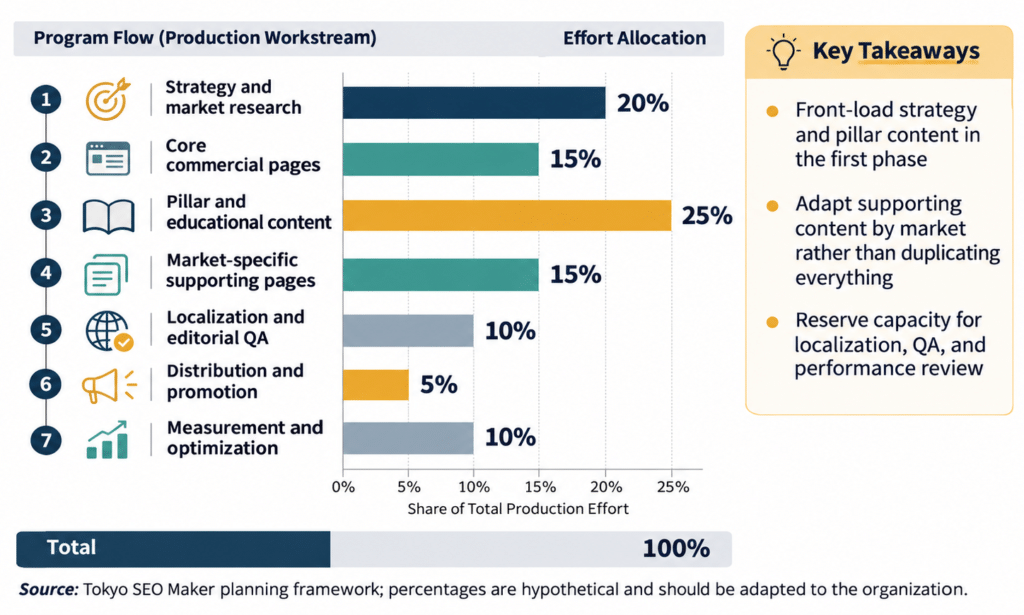
Editorial cost also includes research, expert interviews, design, localization, legal or compliance review, publishing, and subsequent updates. Budgeting only for writing encourages shortcuts that weaken content quality. Where resources are limited, prioritize pages linked to an identifiable customer need and a credible commercial next step, then expand the cluster as evidence and capacity improve.
11. Create an International Editorial Calendar
A global calendar provides visibility into dependencies; regional calendars provide the flexibility to respond to local opportunities. Teams should share topic status, publication dates, owner assignments, reviewer availability, and planned updates in one system. Market-specific decisions, including which article to publish first and how to phrase the offer, can remain with local editors subject to agreed quality standards.
Seasonality should be validated for the product category rather than inferred from national holidays alone. Japan’s Golden Week, Obon period, and the fiscal-year cycle of many companies can affect business operations and editorial review capacity. Western markets have their own holiday periods and sector-specific buying rhythms. For Japan-specific timing considerations, consult our guide to seasonal SEO in Japan.
| Month | Shared program | Japan editorial focus | Western-market focus |
|---|---|---|---|
| 1 | Audit existing URLs and approve topic taxonomy | Validate local buyer concerns and terminology | Validate country-specific search intent and competitors |
| 2 | Publish or improve category hub | Publish localized foundational guide | Publish core workflow or application guide |
| 3 | Connect hub and supporting articles | Develop implementation and support resource | Develop comparison or integration resource |
| 4 | Produce verified evidence assets | Publish approved case or technical proof | Publish sector-specific case or demonstration |
| 5 | Review queries and reader journeys | Improve local conversion page and links | Improve commercial page and links |
| 6 | Refresh gaps and approve next cluster | Extend high-value Japanese subtopics | Extend subtopics for each priority country |
12. Measure Content Quality and Commercial Contribution
Cross-border reporting should separate market performance from global totals. Search Console can show impressions, clicks, and queries by page and country, while analytics and customer relationship management systems can connect relevant landing pages to inquiry and sales outcomes. Measurement definitions should be consistent across markets, even when the conversion actions differ.
Use a layered scorecard. Discoverability describes whether relevant pages receive impressions and organic traffic. Engagement indicates whether readers continue to related material or complete useful actions. Commercial contribution connects target pages and journeys to qualified inquiries, opportunities, and revenue where attribution is available. Editorial health monitors review coverage, factual freshness, broken links, and pages competing for the same local intent.
| Layer | Example measures | Recommended interpretation |
|---|---|---|
| Search visibility | Local non-brand clicks, relevant impressions, landing-page coverage | Assess whether the cluster is reaching the intended market |
| Reader progression | Relevant internal-link clicks, engaged sessions, resource use | Identify whether the content helps readers move to the next question |
| Commercial outcomes | Qualified leads, demo requests, document requests, influenced pipeline | Compare against business value and sales quality |
| Content health | Pages reviewed on schedule, outdated claims, broken links, overlap | Prioritize updates and editorial maintenance |
Direct country comparisons need caution. A high inquiry rate in one market and a lower rate in another may reflect different acquisition channels, sales qualification practices, privacy settings, or conversion definitions. Evaluate local trends first, then compare normalized measures and commercial outcomes where the data supports such comparisons. Our broader keyword research framework can help organize query groups for this reporting.
13. A 90-Day Implementation Roadmap
Teams can launch a focused international cluster within ninety days if they limit the pilot to one commercial subject and one or two target markets. This approach provides a controlled test of editorial governance, localization quality, and measurement before the program expands to additional languages or product lines.
| Period | Priority actions | Decision gate |
|---|---|---|
| Days 1–15 | Audit content, confirm market priorities, interview local sales and support teams, and select a pilot cluster | Approve audience, topic scope, and business outcome |
| Days 16–30 | Complete local SERP analysis, map proposed URLs, identify source evidence, and choose localization treatments | Approve briefs and identify missing proof |
| Days 31–55 | Draft hub and supporting pages, produce tables and diagrams, and conduct expert and native reviews | Sign off on factual and local editorial quality |
| Days 56–70 | Publish pages, verify internal links, check localized navigation, and confirm analytics events and URL annotations | Confirm technical quality and conversion paths |
| Days 71–90 | Inspect early indexing and search data, interview sales teams, fix usability issues, and plan the next production cycle | Decide whether to expand, revise, or consolidate |
Early search performance may be limited, especially for a new domain or a competitive subject. Ninety days should be treated as a process-validation period rather than a deadline for organic search success. The strongest early evidence may be clearer page ownership, better buyer feedback, functioning conversion routes, and fewer gaps in the information available to prospective customers.
14. Risks That Can Undermine an International Content Program
One common risk is allowing production targets to override evidence. When the program rewards word count and article volume, teams may publish repetitive pages, weakly sourced comparisons, and examples that do not match local customer needs. A formal editorial review and a clear rule for when to update an existing URL can reduce this risk.
Another risk is centralizing every editorial decision. Global coordination improves consistency, but local teams need authority to challenge a translated topic, reject an irrelevant example, and recommend a different conversion action. The responsibility framework should identify which choices are fixed by the company and which are decided through regional evidence.
Fragmented measurement creates a third risk. Country reports that use different lead definitions, attribution windows, or naming conventions can mislead management. Establish common definitions at the start, document unavoidable local differences, and review business outcomes alongside search metrics. Finally, plan for ongoing maintenance; content that describes old product functionality or inaccurate procurement processes creates operational and reputational costs.
Conclusion: Build a Portfolio That Can Learn From Each Market
Cross-border content strategy turns a keyword list into a structured set of resources that support real customer decisions. Topic clusters help readers navigate complex subjects, while market-specific briefs ensure that the pages answer relevant questions and reflect the evidence buyers need. Shared governance gives organizations consistency, and local editorial authority allows the work to remain credible in each country.
For Western businesses entering Japan, the next step is to validate the information Japanese buyers need before evaluation and contact, then build pages and conversion pathways around those findings. For Japanese businesses expanding into Western markets, the priority is to research each target country, adapt evidence and terminology to its buyers, and connect specialized content to relevant commercial pages. Both directions benefit from a small, measurable pilot that improves through feedback rather than a large launch of loosely connected articles.
Tokyo SEO Maker supports international search planning, content development, and market-focused optimization. Companies preparing a Japan–Western content program can explore our related research or visit Tokyo SEO Maker to review our services and consultation options.
Frequently Asked Questions
What is the difference between a topic cluster and a keyword map?
A keyword map assigns search terms and intents to URLs. A topic cluster organizes those pages into an understandable subject area, defines how they support one another, and links relevant educational resources to evaluation and conversion steps. Both are useful in cross-border SEO because the same subject may require different page structures in different markets.
Should every Japanese article have an English equivalent?
No. The editorial plan should follow demonstrated demand in each market. Shared subjects may justify localized equivalents, while local buying processes, technical requirements, or category terminology may justify original pages in a single language. When equivalent locale pages exist, review the corresponding URL and hreflang setup.
How many articles should a new international topic cluster contain?
There is no required number. A useful pilot can begin with one strong hub, several supporting resources that address distinct buyer questions, and appropriate links to existing solution or conversion pages. Expand the cluster when research identifies meaningful unanswered questions and the team can maintain the additional content.
Who should approve localized articles?
Responsibility should be shared between a subject-matter reviewer who validates the facts and a qualified local editor who validates relevance, language, and buyer expectations. Legal, product, and compliance specialists may also need to approve claims that concern regulated or technical subjects.
When should teams update existing content rather than create a new page?
Update the existing page when the proposed article would satisfy the same reader need and overlap heavily with a URL that already serves the market. Create a separate page when the new topic has a distinct intent, substantial evidence, and a clear role in the cluster. Review local results pages and current performance before making the decision.
How soon can an international content strategy show results?
Operational improvements, such as clearer briefs and better conversion journeys, can be evaluated during the first production cycle. Organic search outcomes depend on site history, competition, content quality, and how quickly pages are discovered and evaluated. Teams should use the first ninety days to validate the operating model and continue tracking search and commercial outcomes over a longer period.