
B2B Customer Advocacy in Japan and Western Markets: How to Turn Customer Success Into Reviews, Referrals, References, and New Revenue
 Winning a B2B customer in a new international market is difficult. Turning that customer into proof that helps win the next one is where market entry compounds. A company may spend months building visibility, translating its website, creating localized content, generating leads, navigating procurement, answering technical questions, coordinating stakeholders, and establishing enough trust for a customer to sign. Then something important happens. The customer achieves a positive result. Yet many companies do almost nothing with it.
The success remains trapped inside the account. There is no case study, testimonial, reference process, review, referral, introduction to another division, customer interview, webinar, or usable quote for sales. Sometimes marketing does not even know that the result happened. This is costly during international expansion.
When your company is unfamiliar in a new market, every successful customer can become evidence that reduces the perceived risk of choosing you. That evidence can help marketing generate stronger leads, help sales overcome objections, help procurement justify a decision, and help other potential customers believe that your company can deliver locally. But customer advocacy does not work exactly the same way in Japan and Western markets.
A Western company entering Japan may discover that a satisfied Japanese customer is willing to recommend the company privately but reluctant to appear publicly in a named case study. A Japanese company entering the United States, United Kingdom, or Europe may have decades of strong customer relationships yet find that Western prospects still ask:
- Who else uses this?
- Where are the case studies?
- What measurable results did customers achieve?
- Can I read independent reviews?
- Can I speak to a reference?
- Which companies have implemented this successfully?
The quality of the product has not changed. The evidence expected by the market has. Customer advocacy therefore needs localization just as much as SEO, content, advertising, sales, and customer success. This guide explains how companies entering Japan—and Japanese companies entering Western markets—can build a customer advocacy system that turns successful relationships into sustainable market credibility.

1. Customer Advocacy Is the Next Stage of Market Entry
International expansion is often imagined as a linear process:
Market research → Localization → Marketing → Leads → Sales → Customers
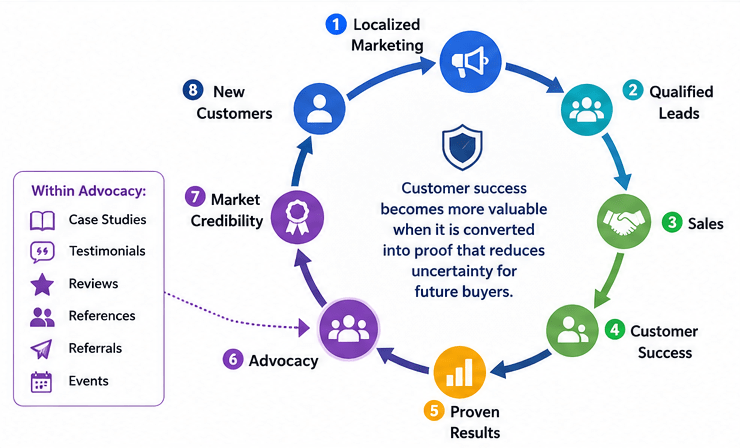
But successful market entry should eventually become a loop:
Marketing → Leads → Sales → Customers → Success → Advocacy → Stronger Marketing → Better Leads
The second model is much more powerful. Initially, a company entering a new country has to explain why prospects should trust it. Later, customers begin doing part of that work.
A successful customer can provide:
- A case study
- A testimonial
- A private reference
- A referral
- A public review
- A quote
- A logo
- An event appearance
- A joint webinar
- A partner introduction
- A customer interview
- Product feedback
- An introduction to another department or subsidiary
These assets reduce the amount of trust the company has to manufacture from scratch. This is especially important in B2B markets where perceived implementation risk is high.
A prospect is rarely evaluating only whether the product itself is good. They are also asking whether another company has trusted the supplier, whether implementation will actually work, whether the vendor understands businesses like theirs, and whether choosing that vendor could create internal risk.
A strong B2B case study begins to answer those questions. A reference customer answers them more strongly. A referral can bypass some of them entirely.
That is why customer advocacy should be viewed as a market-entry growth system, not merely a marketing activity.
2. A Case Study and Customer Advocacy Are Not the Same Thing
A case study is an advocacy asset. It is not the entire advocacy strategy.
Companies frequently finish a case study and assume the customer-proof problem has been solved. In reality, different prospects need different forms of reassurance.
A case study says:
Here is what happened when another organization used our product.
A testimonial says:
Here is what one customer says about working with us.
A review says:
Here is what customers say about us on an independent platform.
A reference says:
You can speak directly with somebody who has worked with us.
A referral says:
Someone you already trust believes you should speak with us.
These have different levels of credibility, availability, sensitivity, and customer effort. A strong advocacy strategy creates multiple options rather than repeatedly asking every customer for the same thing.
3. The Customer Advocacy Ladder
Customer advocacy is easier to manage if it is viewed as a ladder of progressively greater customer participation.
Level 1: Internal Feedback
This requires the lowest level of customer commitment.
- Customer satisfaction interview
- Feedback meeting
- Internal success story
- Product feedback
- Customer quote not approved for publication
This information can still improve sales and marketing even when nothing can be published.
Level 2: Anonymous Proof
The customer agrees that results can be discussed but does not want to be named.
For example:
A Japanese industrial equipment manufacturer reduced manual reporting time by approximately 40% after implementation.
The customer identity remains protected while the story still provides industry, problem, solution, and outcome context.
Level 3: Approved Testimonial
The customer approves a quote that can appear on:
- Landing pages
- Sales presentations
- Service pages
- Product pages
- Proposal documents
- Event materials
Level 4: Named Case Study
The customer’s company, challenge, implementation, and results are publicly documented.
Level 5: Public Review
The customer publishes feedback on a relevant third-party platform.
Level 6: Reference Customer
The customer agrees to speak privately with qualified prospects.
This can be particularly valuable for high-value B2B sales where implementation risk matters more than marketing copy.
Level 7: Public Advocacy
- Joint webinars
- Conference appearances
- Video interviews
- Press releases
- Podcasts
- Customer panels
- Joint research
Level 8: Active Referral
The customer actively introduces another company, business unit, subsidiary, partner, or professional contact. This is one of the strongest advocacy signals because the customer is effectively lending the vendor part of their own reputation.
Customer Advocacy Ladder
The following is a strategic model rather than survey data. It illustrates how customer effort and the strength of the trust signal generally increase as advocacy becomes more public and personal.
| Advocacy Type | Customer Effort | Public Exposure | Trust Signal |
|---|---|---|---|
| Internal feedback | Low | Very Low | Low |
| Anonymous case | Low | Low | Moderate |
| Testimonial | Low–Moderate | Moderate | Moderate |
| Named case study | Moderate | High | High |
| Third-party review | Moderate | High | High |
| Private reference | High | Low | Very High |
| Public appearance | High | Very High | Very High |
| Direct referral | High | Variable | Very High |
4. Why Advocacy Matters Differently During International Expansion
Established companies already possess credibility in their home markets. The problem is that credibility does not always cross borders automatically. A Japanese manufacturing company may be widely respected domestically but virtually unknown to a purchasing team in Germany. A US SaaS company may have hundreds of American customers but no recognizable Japanese customer logos. A British consulting company may have impressive global references but no evidence that it understands Japanese organizations.
This creates a credibility transfer problem. Your company knows its global experience matters. The prospect is trying to determine how much of that experience applies to them. The closer the proof is to the prospect’s own situation, the stronger it becomes.
- Global customer: useful.
- Customer in my country: more useful.
- Customer in my industry: more useful.
- Customer in my country and industry: stronger still.
- Customer with the same problem and measurable outcome: extremely useful.
This does not mean international case studies are worthless. It means companies should gradually build market-proximate proof as they establish themselves.
5. The Market-Proximity Principle
A useful way to evaluate advocacy assets is to ask how closely the proof resembles the prospect evaluating it.
Geographic Proximity
- Global?
- In Asia?
- In Japan?
- In North America?
- In Europe?
- In the prospect’s specific country?
Industry Proximity
- The same broad sector?
- The same industry?
- The same niche?
- A similar regulatory environment?
Company Proximity
- Similar company size?
- Similar organizational complexity?
- Similar business model?
Problem Proximity
- The same operational problem?
- The same technical requirement?
- The same commercial objective?
- The same market-entry challenge?
Outcome Proximity
- Lower costs
- Higher conversion
- Faster implementation
- Increased traffic
- Better quality
- Reduced risk
- Improved productivity
- Increased revenue
The more dimensions that overlap, the easier it becomes for the prospect to think: This may work for us too.
Relative Relevance of Customer Proof
| Customer Proof | Typical Prospect Reaction |
|---|---|
| “We have 5,000 customers worldwide.” | The company appears established. |
| “We work with manufacturers.” | The company has some industry familiarity. |
| “We work with automotive manufacturers.” | More relevant. |
| “We work with automotive manufacturers in Japan.” | Strong local relevance for a Japanese prospect. |
| “We helped a Japanese automotive supplier solve the same problem.” | Stronger problem relevance. |
| “We helped them reduce inspection time by 32%.” | Concrete evidence of outcome. |
| “Their production manager is available as a reference.” | Very strong reassurance for a qualified prospect. |
The goal is not simply to accumulate more logos. It is to accumulate more relevant proof.
6. Why Customer Advocacy Can Be More Difficult in Japan
Western companies entering Japan often discover something confusing. Customers may be very satisfied. Renewals are strong. Feedback is positive. Yet requests for case studies or public testimonials receive polite hesitation. This does not necessarily mean the relationship is weak.
Approval Can Be Organizational Rather Than Individual
Your contact may personally support the case study but lack authority to approve:
- Company-name usage
- Logo usage
- Performance figures
- Employee quotations
- Photography
- Public endorsements
Requests may therefore require review by management, legal, public relations, corporate communications, procurement, compliance, or information security. The customer advocate is not necessarily saying no. They may simply be considering the amount of internal approval required.
Public Endorsement Creates Responsibility
Giving a private recommendation is different from attaching your name and company to a vendor’s marketing. The more public the endorsement becomes, the more internal justification may be required.
Quantified Results May Be Sensitive
The strongest case studies often contain numbers, but figures involving revenue, cost savings, production, error rates, conversion, efficiency, customer volume, or internal processes may be considered commercially sensitive.
Logo Usage May Require Separate Permission
Do not assume that permission to mention a company name automatically provides permission to use its logo.
The Customer May Prefer a Lower-Visibility Form of Advocacy
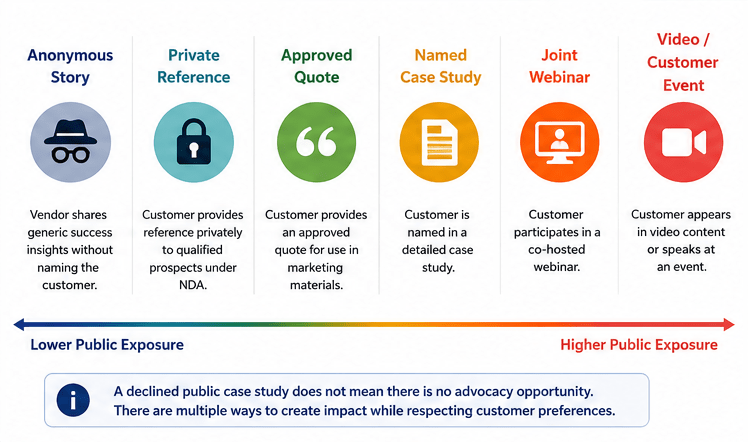
A customer who declines a public case study may still accept:
- An anonymous case study
- A private reference
- A confidential sales call
- A non-attributed quote
- A joint seminar with limited distribution
- An introduction to another company
This is why binary thinking—“case study or nothing”—wastes valuable customer relationships.
7. Build a Japanese Advocacy Menu Instead of Making One Big Request
Instead of asking only whether a customer will participate in a full public case study, offer several participation levels.
Option A: Anonymous Case Study
Industry and results are disclosed without identifying the organization.
Option B: Named Case Study Without Metrics
The customer name may be used, but sensitive performance figures remain private.
Option C: Approved Quote
A short comment from the customer appears on your website.
Option D: Private Reference
The customer speaks only with carefully selected prospects.
Option E: Joint Seminar
The customer contributes expertise in an educational format rather than appearing to directly advertise the vendor.
Option F: Full Public Case Study
Company name, interview, challenge, implementation, and results are published. Giving customers control can dramatically reduce the perceived size of the request.
8. Japanese Companies Entering Western Markets Face the Opposite Problem
Japanese companies frequently possess something Western startups would love to have:
- Long customer relationships
- High product quality
- Deep technical expertise
- Major corporate customers
- Strong repeat business
- Years or decades of delivery experience
Yet international prospects may see very little of it. The English-language website may say: We provide high-quality solutions based on many years of experience. That sounds respectable. But a Western B2B buyer may still want evidence.
- Recognizable customer names
- Customer logos
- Detailed case studies
- Quantified results
- Testimonials
- Product reviews
- Independent media coverage
- Named experts
- LinkedIn activity
- Video interviews
- Public customer stories
A Japanese company can therefore be highly credible but digitally under-proven. Domestic reputation is not automatically visible to an international buyer conducting research online. This is one reason companies should think beyond simple translation and apply a broader reverse localization strategy when entering Western markets.
9. Western B2B Buyers Often Expect Proof to Be More Explicit
Consider two ways of presenting the same result.
Understated Version
Our solution has been adopted by customers in a variety of manufacturing environments and has contributed to improved efficiency.
Evidence-Led Version
A Tier 1 automotive supplier reduced manual inspection time by 28% within six months of implementing the system.
The second version gives the reader substantially more information.
It identifies:
- Customer category
- Use case
- Result
- Magnitude
- Time period
This does not require exaggerated marketing. It requires specificity.
One mistake Japanese companies make when localizing for Western markets is assuming that understated communication will automatically be interpreted as credibility. Sometimes it is simply interpreted as a lack of evidence.
10. Quantification Is Particularly Valuable in Western-Facing Case Studies
When available and approved, quantify the outcome.
Time
- Implementation time
- Time saved
- Lead time reduction
- Response speed
- Production cycle improvement
Financial Impact
- Cost reduction
- Revenue increase
- Customer acquisition cost
- Return on investment
Operational Impact
- Productivity
- Error reduction
- Automation
- Output
- Downtime
- Defect reduction
Marketing Impact
- Organic traffic
- Leads
- Conversion rate
- Search ranking
- Pipeline
- Customer acquisition
Customer Experience
- Satisfaction
- Response time
- Retention
- Ticket volume
- Adoption
The objective is not to manufacture a dramatic number. A modest verified result is more persuasive than an impressive but unsupported claim.
11. Use Ranges When Exact Numbers Cannot Be Published
Commercial sensitivity does not always require abandoning quantification.
Instead of:
Revenue increased by ¥187,420,000.
the customer may approve:
The initiative generated more than ¥150 million in incremental annual revenue.
Instead of:
Production time fell from 8.7 hours to 5.1 hours.
you might say:
Production time was reduced by more than one-third.
This can preserve useful evidence while protecting sensitive detail. The wording must still be approved by the customer.
12. Build a Customer Proof Portfolio, Not One Universal Case Study
Different buyers need different evidence. Imagine a software company selling to financial services, manufacturing, retail, and professional services. A single retailer case study may prove that the software works. But a bank still wonders whether it works in financial services. A manufacturer still wonders whether it can integrate into its environment. The larger the sales target, the more valuable it becomes to create a portfolio of proof.
| Dimension | Proof Assets to Build |
|---|---|
| Geography | Japan, US, UK, EU, APAC or other priority markets |
| Industry | Case study for each priority vertical |
| Company Size | Enterprise, mid-market, SME |
| Use Case | Different customer problems or applications |
| Product | Major product/service categories |
| Buyer Role | Technical, operational, marketing, management, procurement |
| Result | Revenue, cost, risk, speed, quality, productivity |
| Format | Written, video, quote, reference, review, webinar |
A mature advocacy program should eventually allow sales to choose the most relevant evidence for each opportunity.
13. Case Studies Should Become Sales Enablement Assets
Publishing a case study on the website is only the first step.
Ask:
Where else could this proof remove uncertainty?
Website
- Homepage
- Service pages
- Product pages
- Landing pages
- Industry pages
- Contact pages
Sales
- Proposal documents
- Sales decks
- Follow-up emails
- Procurement materials
- Objection-handling documents
- Account-based marketing campaigns
Lead Nurturing
Someone downloads a technical guide.
Instead of sending another general marketing email, send a relevant customer example:
See how a company in your industry approached this problem.
This aligns naturally with a localized email marketing and lead nurturing strategy.
Advertising
Strong customer outcomes can become campaign proof points where permissions allow.
Events
- Presentations
- Seminars
- Trade shows
- Webinars
- Workshops
Public Relations
A sufficiently strong customer success story may support press coverage, joint announcements, or industry media outreach. One customer story can therefore produce dozens of useful touchpoints.
14. Create Case-Study Variants for Different Funnel Stages
Not every prospect wants to read 2,000 words. Turn a major customer story into multiple formats.
10-Second Version
How Company X reduced onboarding time by 41%.
30-Second Version
Challenge: Complex manual onboarding
Solution: Localized workflow automation
Result: 41% reduction in onboarding time
Two-Minute Version
A one-page PDF.
Five-Minute Version
Full website case study.
Ten-Minute Version
Video customer interview.
Deep-Evaluation Version
Private reference call. The underlying proof remains consistent. The format changes depending on buyer intent and the stage of the B2B buyer journey.
15. Reviews Matter More in Some Western B2B Categories
Customer advocacy is not limited to your own website. In many Western B2B categories—particularly software and technology—buyers may investigate independent platforms before contacting sales.
Depending on the market, these can include:
- G2
- Capterra
- TrustRadius
- Gartner Peer Insights
- Industry-specific directories and marketplaces
The appropriate platform depends heavily on the product and audience. A profile with no reviews, old information, no screenshots, or unanswered feedback can weaken confidence even when the company’s own website looks excellent. The opposite is also true. A credible body of detailed reviews provides evidence that does not come directly from the vendor.
16. Do Not Copy the Western Review Strategy Directly Into Japan
Japan has its own review, comparison, directory, and industry ecosystems. More importantly, the role of review platforms varies by industry. Research where Japanese buyers actually evaluate your category rather than assuming that the dominant Western platform has equivalent influence.
Potential proof channels may include:
- Japanese comparison platforms
- Industry directories
- Partner networks
- Trade associations
- Domestic media
- Japanese case-study portals
- Marketplace reviews
- Existing customer introductions
- Seminars and industry events
For some Japanese B2B categories, an introduction from a trusted business relationship may be considerably more influential than accumulating public star ratings. The channel should follow the buying process.
17. Private References Are an Underused B2B Asset
Some customers will never approve a public case study.
They may still be excellent reference customers.
A reference program allows qualified prospects to speak directly with existing customers about:
- Implementation
- Reliability
- Support
- Working relationship
- Integration
- Results
- Challenges
- Expectations
This can be particularly powerful late in a complex sales cycle.
Marketing tells the prospect:
We are reliable.
A customer tells the prospect:
We were concerned about implementation too. Here is what actually happened.
Those are not equivalent trust signals.
18. Protect Reference Customers From Overuse
A good reference customer is valuable precisely because they are credible. Do not exhaust that goodwill.
Create rules.
- Only qualified late-stage opportunities receive reference access
- Sales explains why the conversation is necessary
- The reference customer’s industry should match where possible
- Calls have a defined purpose
- The customer can decline individual requests
- Frequency is monitored
- Customers are thanked appropriately
- Feedback is recorded afterward
If one customer receives fifteen reference requests in three months, the advocacy program is failing. Build a portfolio. Do not turn your best customer into an unpaid salesperson.
19. Referrals Are Stronger Than Leads Because Trust Arrives First
A normal prospect starts with little trust. Marketing gradually creates it. A referral changes the starting position.
The conversation may begin with:
Tanaka-san suggested that we speak with you.
or:
Our partner in Germany recommended your company.
The referred prospect has already received a trust signal from somebody they know. That does not eliminate evaluation. But it can substantially change how the relationship begins.
20. Referral Systems Should Still Be Localized
Western referral programs sometimes use explicit incentives such as:
- Account credit
- Commission
- Gift cards
- Referral bonuses
- Discounts
Depending on the market, industry, corporate policy, and relationship, that approach may be inappropriate. In Japanese B2B environments, referrals are often better understood relationally.
Instead of:
Refer someone and receive $500.
a professional B2B conversation might be:
If there are other companies or teams facing a similar issue, we would be happy to share what we have learned with them.
The goal is not to pressure the customer. It is to make the possibility of introduction easy when genuine relevance exists.
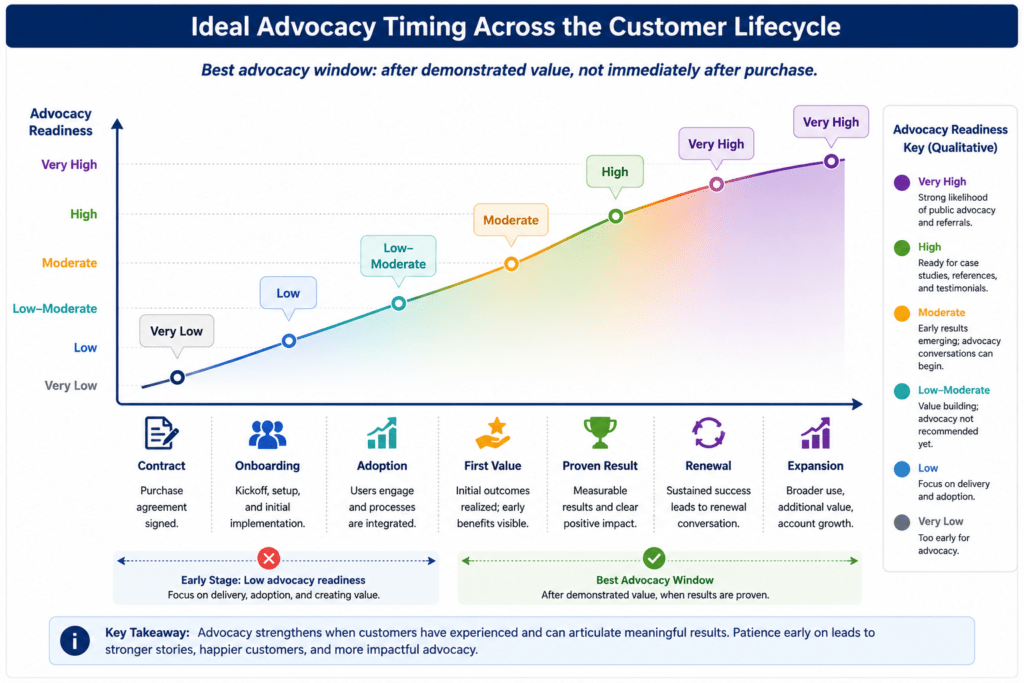
21. The Best Time to Ask for Advocacy Is After Value Has Become Visible
Timing matters. A customer signs a contract.
Thirty days later, marketing asks:
Would you be willing to do a case study?
The customer has barely started. There is no meaningful story. The request serves the vendor more than the customer.
Better triggers include:
- Successful launch
- Major milestone completed
- Strong performance result
- Positive business review
- Customer renewal
- Expansion
- Unsolicited praise
- Support problem successfully resolved
- Award or recognition
- Major anniversary
- Successful event
- Positive executive feedback
Advocacy should follow evidence.
22. Customer Success Should Identify Advocacy Candidates
Marketing should not have to randomly ask account managers whether any customers might participate in a case study. Advocacy should be built into the customer-success process.
Business Result
Has the customer achieved measurable value?
Relationship Strength
Is the relationship positive?
Customer Health
Is adoption strong?
Executive Support
Does someone senior support the relationship?
Public-Sensitivity Level
Can the customer name be disclosed?
Story Quality
Is there a clear Challenge → Decision → Implementation → Outcome narrative?
Market Relevance
Would the story help win customers in a strategic market, vertical, or segment? A customer can then move into an advocacy pipeline.
Advocacy Candidate Scorecard
| Criteria | Question | Score |
|---|---|---|
| Result | Has meaningful value been demonstrated? | 1–5 |
| Satisfaction | Is the customer clearly satisfied? | 1–5 |
| Relationship | Is there a strong internal champion? | 1–5 |
| Story | Is there a clear problem-solution-result narrative? | 1–5 |
| Strategic relevance | Does the story match priority prospects? | 1–5 |
| Approval feasibility | Is public participation realistically possible? | 1–5 |
| Expansion potential | Could advocacy damage an active commercial discussion? | 1–5 |
| Reference suitability | Would this customer communicate well with prospects? | 1–5 |
23. Build Advocacy Into the Sales-to-Customer-Success Handoff
The groundwork for future advocacy can begin before the customer is ready to advocate.
During the handoff, record:
- Why the customer purchased
- Original problem
- Expected outcome
- Baseline metrics
- Key stakeholders
- Success criteria
- Implementation milestones
- Strategic importance
Without this information, six months later marketing asks what changed, and nobody knows. Good case studies depend on knowing the before state. This is why the process should connect directly with a structured marketing-to-sales handoff and customer-success workflow.
24. Capture Customer Language, Not Just Customer Metrics
Numbers tell part of the story. Words often reveal why the story matters.
During customer reviews, listen for statements such as:
We expected implementation to take much longer.
Our internal team no longer has to do this manually.
Support was much easier than we expected from an overseas supplier.
This gave management the visibility they were asking for.
These statements reveal:
- Fears
- Objections
- Value drivers
- Decision criteria
- Unexpected benefits
That language can improve case studies, landing pages, sales materials, FAQs, email nurturing, advertising, and product positioning. The customer’s words can become market research.
25. Japanese Customer Interviews May Require a Different Interview Style
A case-study interview designed for a Western executive may not always transfer directly. Questions such as “Why are we better than our competitors?” may produce discomfort or generic answers.
A more productive structure may be:
Context
What was happening before the project?
Challenge
What operational or business issue needed to be addressed?
Evaluation
What factors were important when considering possible solutions?
Implementation
How was the project introduced?
Experience
What worked well during implementation?
Change
What became easier, faster, clearer, or more effective?
Result
What measurable or observable improvement followed?
Future
How do you expect the relationship or solution to develop?
The interviewer should seek specificity without forcing exaggerated praise.
26. Western Interviews Often Benefit From More Direct Result Questions
For Western-facing case studies, stronger questions can include:
- What was the measurable baseline?
- What changed after implementation?
- How quickly did you see results?
- What surprised you?
- What alternatives did you consider?
- What would have happened if the problem remained unresolved?
- What would you tell another company considering the solution?
- What specific metric best demonstrates the value?
- What did implementation require from your team?
This often creates a more commercially useful story than simply asking whether the customer is happy with the service.
27. Advocacy Does Not Mean Removing the Difficult Parts
Overly polished case studies can become less credible. Every implementation appears effortless. Every customer is delighted. Every chart moves upward. Every challenge disappears. Experienced buyers know real projects are rarely that simple.
Where appropriate, discuss:
- Implementation complexity
- Initial hesitation
- Internal coordination
- Technical constraints
- Adjustments
- Lessons learned
For example:
Initial deployment required additional data cleaning, which extended the first phase by two weeks. Once the revised workflow was established, subsequent sites were deployed according to schedule.
That can be more convincing than pretending nothing went wrong. Credibility frequently comes from controlled imperfection.
28. Create a Proof Matrix for Your Priority Markets
International companies should audit existing proof against target-market needs.
| Proof Asset | Japan | US | UK/EU | Priority Gap |
|---|---|---|---|---|
| Named customer case studies | ✓ | ✓ | △ | UK/EU |
| Industry-specific case studies | ✓ | △ | △ | Western markets |
| Quantified results | △ | ✓ | ✓ | Japan |
| Video testimonials | △ | ✓ | △ | Japan/EU |
| Independent reviews | △ | ✓ | △ | Market dependent |
| Private references | ✓ | ✓ | ✓ | Maintain |
| Local customer logos | ✓ | △ | △ | US/EU |
| Local-language interviews | ✓ | ✓ | △ | Europe |
| Referral process | △ | ✓ | △ | Japan/EU |
Legend: ✓ = strong coverage, △ = partial coverage
The values above are an example of how to structure the audit, not recommended scores for every company.
29. Do Not Wait Until Marketing Needs a Case Study
A reactive advocacy process sounds like this:
We are launching a campaign next month. Can someone find a customer willing to give us a quote?
That creates pressure. A better system runs continuously.
Monthly
Customer success identifies potential success stories.
Quarterly
Marketing and sales review advocacy gaps.
After Major Milestones
Appropriate customers are approached.
After Approval
Assets are created.
After Publication
Sales and marketing distribution begins.
Later
The relationship may progress from case study to reference, event, or referral.
30. Build an Advocacy Asset Library
Create one central repository.
For every approved asset, record:
- Customer name
- Geography
- Industry
- Company size
- Product
- Use case
- Challenge
- Result
- Metrics
- Approved quote
- Approved logo
- Case-study URL
- Language
- Video
- Presentation slides
- Reference availability
- Restrictions
- Approval expiration if applicable
- Account owner
- Last verification date
Sales should be able to search for something like:
Manufacturing + Japan + implementation + enterprise
and immediately find the best proof.
If proof exists but nobody can find it, it has limited commercial value.
31. Get Approval for Specific Uses
Customer permission should not be vague.
Clarify whether approval covers:
- Company name
- Logo
- Employee name
- Job title
- Photograph
- Quote
- Performance metrics
- Website
- Social media
- Advertising
- Press release
- Sales presentations
- Events
- Video
- Translation into other languages
A customer may approve a written web case study while declining paid advertising using its logo. Respect the boundary.
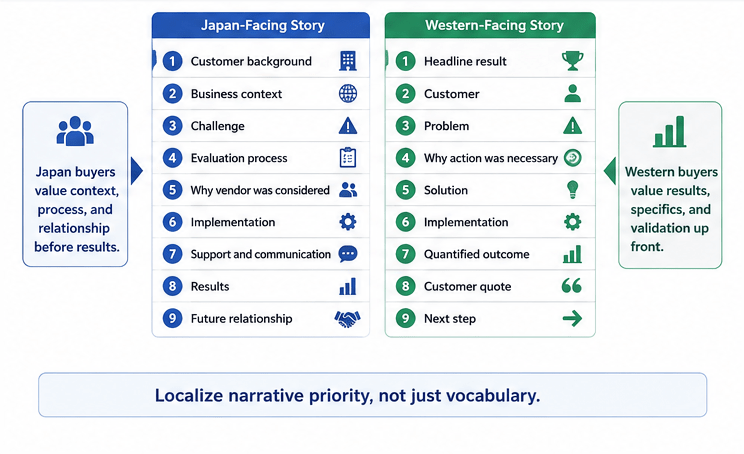
32. Translate the Story, Not Just the Case Study
Suppose a Japanese customer story is translated for the US market. The English may be accurate. But ask whether the story itself is structured for the new audience.
A Western reader may want:
Problem → Solution → Measurable Result
more quickly.
A Japanese version may benefit from more context around:
- Company background
- Selection process
- Implementation reliability
- Support
- Relationship
- Internal coordination
Neither structure is universally correct. The important point is that case-study localization should consider information priority, not only language.
33. Advocacy Should Help Internal Champions
Customer proof does not only convince the prospect who receives it.
It gives that person evidence to use internally.
This is particularly important in complex B2B decisions.
Your contact may need to persuade:
- Management
- Procurement
- Finance
- IT
- Legal
- Security
- Operations
- Engineering
- End users
A strong case study becomes internal sales material.
The prospect can forward it and say:
Another company like ours already implemented this.
That reduces the amount of explanation your internal champion has to create alone.
34. Create Proof for Different Stakeholders
| Stakeholder | Proof They May Value |
|---|---|
| Executive | Business outcome, strategic impact, ROI |
| Finance | Cost reduction, payback, financial risk |
| Procurement | Vendor reliability, references, stability |
| IT | Integration, security, implementation |
| Engineering | Technical performance, specifications |
| Operations | Efficiency, usability, workflow |
| Marketing | Leads, conversion, brand impact |
| Customer Success | Adoption, retention, satisfaction |
One case study can contain multiple proof points. Sales should surface the right one for the stakeholder.
35. Customer Advocacy Can Improve SEO and AI Visibility Too
Strong customer stories are primarily trust and conversion assets. But they can also strengthen digital visibility.
High-quality case studies naturally contain:
- Industry terminology
- Product terminology
- Use cases
- Problems
- Solutions
- Outcomes
- Company entities
- Expert quotations
- Specific contextual detail
These are useful signals for search users trying to understand whether a provider has relevant experience. Customer stories may also attract links, brand mentions, social sharing, industry citations, and partner references. As search increasingly includes AI-generated answers and recommendation experiences, clear and verifiable evidence about who a company serves, what it does, and what outcomes it has produced becomes increasingly useful. Do not manufacture case studies for SEO. Use SEO to make genuine customer evidence easier to discover.
36. Measure Advocacy Beyond Number of Case Studies
Publishing twelve case studies is not automatically better than publishing four. Measure whether customer proof affects the business.
Production
- Advocacy candidates identified
- Customer requests made
- Approval rate
- Case studies published
- Reviews generated
- References available
Engagement
- Case-study page visits
- Video views
- PDF downloads
- Case-study engagement from target accounts
Sales Usage
- Opportunities receiving case studies
- Reference calls conducted
- Proposals using customer proof
- Case studies used by sales team
Pipeline
- Leads influenced by proof assets
- Opportunities influenced
- Referral opportunities
- Referral-generated pipeline
Revenue
- Referral-sourced customers
- Advocacy-influenced revenue
- Expansion from advocate accounts
The objective is not advocacy volume. It is trust converted into growth.
37. Separate Japan and Western Market Performance
Do not combine all customer advocacy metrics into one global dashboard. Track by market.
Japan May Show
- Fewer public case studies
- More private references
- More partner introductions
- Higher use of seminars
Western Markets May Show
- More named cases
- More public reviews
- Greater usage of quantitative outcomes
- More inbound engagement with proof assets
That does not automatically mean one market has stronger customers. It may mean customers express advocacy differently. Measure the forms that matter locally.
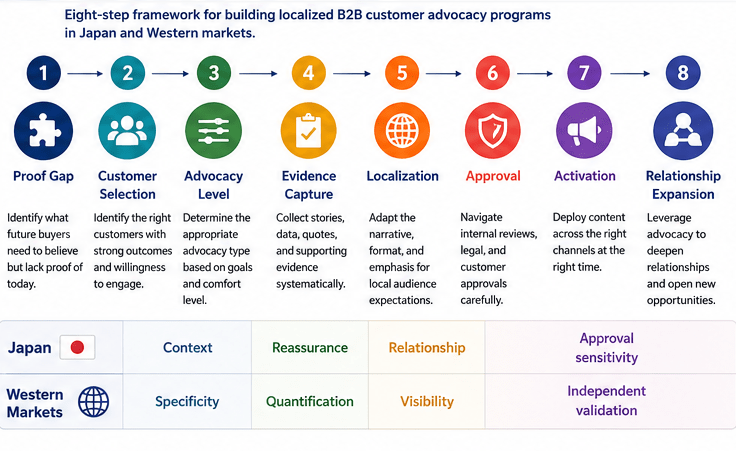
38. A Practical Cross-Border Customer Advocacy Framework
A repeatable advocacy system can be organized into eight stages.
Stage 1: Define the Proof Gaps
Identify which markets, industries, customer sizes, use cases, and products lack credible customer evidence.
Stage 2: Identify Successful Customers
Work with customer success and sales to find accounts with strong results and relationships.
Stage 3: Match the Advocacy Level
- Anonymous
- Testimonial
- Named case
- Review
- Reference
- Event
- Referral
Stage 4: Capture Evidence
- Baseline
- Challenge
- Selection criteria
- Implementation
- Results
- Customer language
Stage 5: Localize the Story
Adapt structure, level of detail, metrics, format, and language for the target market.
Stage 6: Approve Carefully
Confirm exactly what may be published and where.
Stage 7: Activate the Asset
- SEO
- Sales
- Advertising
- Events
- PR
- Account-based marketing
Stage 8: Deepen the Relationship
When appropriate, progress from:
Customer → Advocate → Reference → Referral → Strategic Partner
39. Customer Advocacy Checklist for Companies Entering Japan
Customer Selection
- Has the customer achieved meaningful value?
- Is the relationship strong?
- Is there an internal champion?
- Is the story relevant to future Japanese prospects?
Request
- Are multiple participation options available?
- Can an anonymous story be offered?
- Can a private reference substitute for public endorsement?
- Is the request being made after demonstrated success?
Approval
- Has the customer’s internal approval process been discussed?
- Is logo permission separate where necessary?
- Have metrics been approved?
- Have named quotes been approved?
- Are usage channels clearly defined?
Story
- Does the story provide enough business context?
- Does it explain why the customer evaluated the solution?
- Does it reduce implementation concerns?
- Does it discuss support and working relationship where relevant?
- Are results specific without revealing sensitive information?
Activation
- Is the case study used by sales?
- Is it linked from relevant service pages?
- Is it used in lead nurturing?
- Can it support events or seminars?
- Is the customer protected from excessive reference requests?
40. Customer Advocacy Checklist for Japanese Companies Entering Western Markets
Proof Availability
- Are customer stories available in English?
- Do priority industries have relevant examples?
- Are local Western customer stories being developed?
- Are results quantified where possible?
Digital Trust
- Are customer logos visible with permission?
- Are testimonials specific?
- Are relevant third-party review profiles active?
- Are case studies easy to find?
- Are executives and experts visible?
Case-Study Structure
- Does the headline communicate the result?
- Is the problem clear immediately?
- Are measurable results highlighted?
- Is implementation explained?
- Is there a credible named customer quote where possible?
Sales Enablement
- Can sales filter case studies by industry?
- Are one-page versions available?
- Can qualified prospects speak with reference customers?
- Can proof be inserted into proposals?
- Are customer stories incorporated into nurture sequences?
Distribution
- Are case studies promoted through LinkedIn?
- Are relevant stories linked from product pages?
- Are customer outcomes used in webinars?
- Can strong stories support industry PR?
- Are referral opportunities systematically identified?
41. The Customer Advocacy Maturity Model
Stage 1 — Accidental
Customer proof exists only when somebody happens to request a testimonial.
- No process
- Few documented results
- Customer success disconnected from marketing
Stage 2 — Reactive
Marketing produces case studies when campaigns or sales teams request them.
- Some case studies
- No systematic customer identification
- Limited distribution
Stage 3 — Structured
Customer success regularly identifies advocates.
- Defined approval process
- Case-study templates
- Advocacy database
- Reference program
Stage 4 — Localized
Advocacy is adapted by country and audience.
- Japan-specific proof
- Western-market proof
- Local review strategy
- Localized case-study formats
Stage 5 — Compounding
Customer advocacy actively generates pipeline.
- Referral system
- Customer events
- Strategic references
- Advocacy measurement
- Proof integrated throughout marketing and sales
42. Make Every Successful Customer Increase the Probability of Winning the Next One
The first customer in a new market is difficult. You may have no local case study. No familiar logo. No review history. No references. No local advocate. The second customer should be slightly easier. Then the third. Then the tenth. If customer acquisition remains equally difficult after dozens of successful implementations, the organization is failing to capture the credibility it has earned. A mature market-entry strategy creates accumulated proof.
Customer 1 creates insight.
Customer 2 creates evidence.
Customer 5 creates patterns.
Customer 10 creates category credibility.
Eventually prospects no longer ask:
Can this foreign company really deliver here?
They encounter enough evidence that the question begins to answer itself. That is the compounding effect of customer advocacy.
Conclusion: Turn Customer Success Into Market Credibility
International marketing often focuses heavily on everything that happens before a customer signs. SEO creates visibility. Localized content creates relevance. Lead nurturing develops interest. Sales turns interest into an opportunity. Customer retention and customer success deliver and preserve value.
But value that remains invisible helps only the existing customer. Customer advocacy allows that success to influence the next buying decision.
For Western companies entering Japan, this requires recognizing that advocacy may not always take the highly public form common in Western marketing. A customer who will not appear in a promotional video may still become a powerful private reference, anonymous case study, seminar participant, or source of trusted introductions.
For Japanese companies entering Western markets, the challenge is often the reverse. Long-standing customer relationships and exceptional delivery histories may need to become more explicit, measurable, discoverable, and public before Western prospects recognize their significance.
The objective is not to force every customer into a testimonial. It is to create a flexible system that allows satisfied customers to advocate at the level appropriate to the relationship and the market.
The core principles are straightforward:
- Treat advocacy as a continuation of customer success.
- Ask after value has been demonstrated.
- Give customers different participation options.
- Build proof for specific markets, industries, and use cases.
- Capture measurable outcomes wherever appropriate.
- Recognize that private references can be as valuable as public case studies.
- Protect customers from overuse.
- Localize the structure of customer stories rather than merely translating them.
- Make customer proof available throughout marketing and sales.
- Measure referrals and advocacy-influenced pipeline, not just published assets.
- Keep Japan and Western advocacy strategies separate enough to respect different expectations.
- Feed successful customer relationships back into market acquisition.
A company entering a new market initially has to borrow credibility from its global reputation, partners, expertise, and brand. Over time, it should build credibility locally.
Case studies are part of that process. Reviews strengthen it. References deepen it. Referrals accelerate it. Eventually, customer success becomes more than an outcome of market entry.
It becomes the engine that makes continued market entry easier.
Frequently Asked Questions
What is B2B customer advocacy?
B2B customer advocacy is the process of enabling satisfied customers to provide credible evidence that helps other prospects evaluate a company. Advocacy can include case studies, testimonials, reviews, private reference calls, webinars, customer interviews, referrals, and introductions.
Are case studies important for entering the Japanese market?
Yes. Case studies can reduce uncertainty by demonstrating that a company has successfully delivered for other organizations. Japan-facing case studies can be particularly useful when they provide relevant industry context, explain implementation, and demonstrate that the vendor understands local business requirements.
What should we do if a Japanese customer will not approve a public case study?
Offer lower-exposure alternatives. These can include an anonymous case study, private reference call, approved quote, confidential customer conversation, or educational seminar. A customer declining public exposure does not necessarily mean they are unwilling to advocate.
Do Western B2B buyers expect quantified case studies?
Quantified outcomes can make a case study considerably more useful because they help prospects understand the scale of the result. When exact figures are sensitive, approved ranges or percentage improvements may still provide meaningful evidence.
When should we ask a customer for a testimonial or case study?
The best time is usually after a meaningful success event, such as successful implementation, demonstrated business results, positive business review, renewal, or expansion. Asking immediately after contract signing often produces weak stories because value has not yet been demonstrated.
Should every customer be asked for a case study?
No. Customers differ in satisfaction, strategic relevance, public-relations policies, confidentiality requirements, and willingness to participate. Build multiple advocacy options and identify the customers whose experiences can genuinely help future buyers.
Are customer references useful in Japanese B2B sales?
They can be extremely useful, especially in high-value or complex purchases. A private conversation with an existing customer can address implementation, reliability, support, and relationship concerns that marketing materials cannot answer with the same level of credibility.
How should Japanese companies adapt case studies for Western markets?
Lead with a clear problem and outcome, use specific evidence, quantify results where possible, explain implementation, include direct customer quotations when approved, and make case studies easy to discover from product, service, and industry pages. Do not rely only on general statements about quality or experience.
How can customer advocacy support SEO?
Detailed customer stories naturally contain information about industries, use cases, problems, solutions, products, and outcomes. They can also generate links, mentions, and engagement. Their primary purpose should remain demonstrating real customer experience rather than creating artificial SEO content.
What is the difference between a reference and a referral?
A reference agrees to speak with a prospect about their experience with a vendor. A referral actively introduces or recommends the vendor to another potential customer. Both are valuable, but a referral generally carries an additional trust signal because the customer initiates or supports the connection.
How should we measure customer advocacy?
Track both advocacy production and commercial impact. Useful indicators include approved advocates, case studies, reviews, reference calls, referral opportunities, case-study engagement, opportunities using customer proof, referral-sourced pipeline, and advocacy-influenced revenue.
What should come after building a customer advocacy program?
The next stage is integrating customer proof systematically into demand generation, account-based marketing, sales enablement, partnerships, events, SEO, and market expansion. The objective is to create a closed growth loop in which successful customer relationships make future acquisition easier.