
Reputation Management: How Brands Build, Protect, and Recover Trust in Japan and Western Markets

A company can control its advertising.
It can control its website, its landing pages, its product descriptions, its sales presentation, and most of what appears on its own social media accounts. Its reputation is different.
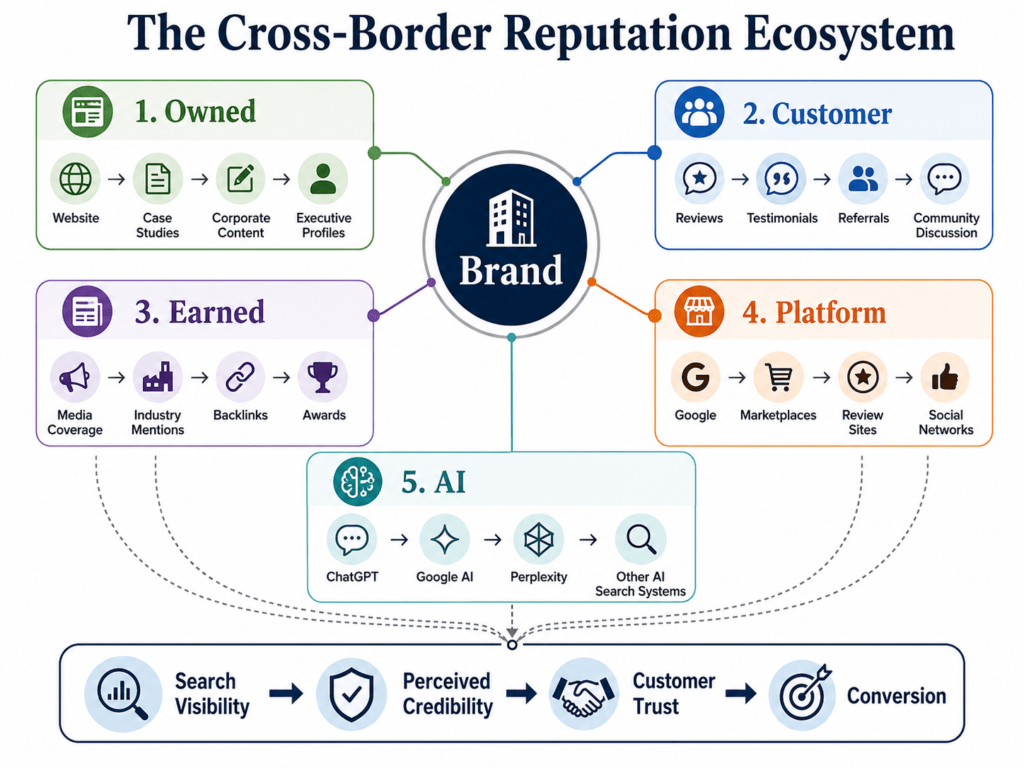
Reputation is created partly by the company and partly by everyone else.
It lives in:
- Customer reviews
- Search results
- Social media discussions
- Reddit threads and online communities
- Comparison websites
- Marketplace ratings
- Case studies
- Press coverage
- Employee commentary
- Partner recommendations
- Word of mouth
- AI-generated answers about the brand
For companies expanding internationally, this creates an important complication. The reputation that helped build credibility in the home market may not travel with the brand.
A Western company entering Japan may have thousands of reviews, strong press coverage, recognizable customers, and years of market credibility in the United States or Europe. Japanese prospects may still search for the company and find very little evidence that it can be trusted in Japan.
A Japanese company entering Western markets can face the reverse problem. It may have an excellent reputation domestically, decades of history, strong customer relationships, and significant technical expertise. Yet Western customers searching the company name may find a thin English-language website, few independent reviews, no visible customer stories, limited executive presence, and almost no discussion of the company outside its own domain.
This is why international reputation management cannot be treated simply as PR or review monitoring. It is part of market entry.
This guide explains how reputation is formed differently across Japan and Western markets, how businesses can build a credible cross-border reputation, how to respond when something goes wrong, and how SEO, customer experience, PR, reviews, community discussion, and AI search increasingly fit into the same reputation system.

1. Reputation Is the Layer Between Awareness and Trust
Traditional marketing models often describe a customer journey such as:
Awareness → Consideration → Conversion → Purchase → Retention → Advocacy
But another process happens in parallel:
Discovery → Verification → Trust → Decision
A potential customer may discover you through advertising, SEO, an event, social media, a distributor, a recommendation, or an AI assistant.
Before acting, they often verify what they have been told.
They:
- Search the company name.
- Search the product name.
- look for reviews.
- Check who else uses the product.
- Inspect the company website.
- Look for negative experiences.
They may search:
- [brand] reviews
- [brand] reputation
- [brand] complaints
- [brand] Reddit
- [brand] Japan
- [brand] case study
- [brand] vs [competitor]
- Is [brand] reliable?
- Is [brand] legitimate?
The exact queries vary by industry and market, but the behavior is universal: people don’t evaluate brands based only on what brands say about themselves. This matters especially during international expansion because an established reputation often partially resets when a company enters a new market.
2. Your Domestic Reputation Does Not Automatically Transfer Overseas
One of the most dangerous assumptions in international expansion is:
People know who we are. They may know who you are at home. That does not mean the target market does.
Imagine a Japanese industrial manufacturer with:
- 50 years of operating history
- Hundreds of Japanese customers
- Strong relationships with major manufacturers
- Industry certifications
- A respected domestic brand
Now imagine a procurement manager in Chicago encountering that company for the first time.
The buyer searches the brand in English and finds:
- A translated corporate homepage
- A distributor listing
- A small LinkedIn page
- No English case studies
- No recognizable reviews
- No meaningful media coverage
- No detailed leadership profiles
From the buyer’s perspective, the company’s domestic reputation is largely invisible. The same problem occurs when Western companies enter Japan.
A software company may have:
- Thousands of Western users
- Hundreds of reviews
- Excellent G2 ratings
- Strong US media coverage
- Prominent Silicon Valley investors
Yet the Japanese prospect may still ask:
- Does it have Japanese customers?
- Is Japanese-language support available?
- Does it understand local requirements?
- Will the company remain committed to Japan?
- Can another Japanese organization confirm that it works?
Your international reputation therefore has to be reconstructed in locally meaningful forms.
This mirrors a broader principle discussed in our guide to Japanese localization: localization is not simply changing the language. The surrounding evidence, structure, and trust signals must also make sense within the target market.
3. Reputation Signals Are Not Weighted Equally Across Markets
Trust is important everywhere.
The signals people use to establish it are not identical.
| Reputation Signal | Typical Importance in Japan | Typical Importance in Western Markets |
|---|---|---|
| Domestic customer examples | Very high, particularly when entering Japan as an unfamiliar foreign company | High, although international examples may transfer more easily in some categories |
| Company history and stability | Often highly reassuring | Useful, but usually secondary to demonstrated outcomes |
| Named case studies | Powerful but sometimes difficult to secure publicly | Extremely valuable, particularly in B2B |
| Quantified outcomes | Important when credible and relevant | Frequently expected |
| Third-party reviews | Important, with platform relevance varying greatly by category | Often central to evaluation |
| Executive visibility | Useful but category-dependent | Often important in B2B, startups and professional services |
| Corporate information | Often examined closely | Usually expected but rarely sufficient by itself |
| Media coverage | Strong credibility signal when locally relevant | Strong credibility and authority signal |
| Community discussion | Increasingly relevant but category-dependent | Frequently important, particularly through Reddit and specialist communities |
| Fast public complaint responses | Should be careful, polite and appropriate to the situation | Often expected relatively quickly |
These are tendencies rather than fixed cultural rules.
The correct reputation strategy depends on:
- Industry
- Customer type
- Age group
- Price point
- Purchase risk
- Platform
- Brand familiarity
- B2B versus B2C context
A fashion buyer, SaaS administrator, automotive engineer, restaurant customer, and hospital procurement manager will not use identical trust signals simply because they live in the same country. Market-level differences matter, but category-level research matters just as much.
4. Think in Terms of a Reputation Stack
A strong international reputation rarely comes from one spectacular signal. It comes from multiple independent signals agreeing with each other.
Consider the following two companies.
Company A
- Says it provides excellent service
- Claims industry-leading quality
- Calls itself a trusted provider
Company B
- Explains what it does clearly
- Shows named customers
- Publishes detailed case studies
- Has independent reviews
- Receives relevant industry coverage
- Shows knowledgeable employees publicly
- Appears positively in third-party discussions
- Has accessible support information
- Responds professionally when complaints occur
Company B does not merely claim credibility. Its credibility is corroborated. This is the essence of a reputation stack.
| Layer | Examples | Question It Answers |
|---|---|---|
| Identity | Company information, offices, leadership, history | Who are you? |
| Capability | Products, expertise, certifications, technical content | Can you do what you claim? |
| Customer Proof | Reviews, testimonials, customer logos, case studies | Has it worked for anyone else? |
| Independent Proof | Press, associations, analyst mentions, third-party coverage | Does anyone independent recognize you? |
| Behavior | Support responses, complaint handling, social interactions | What happens when something goes wrong? |
| Consistency | Similar information across search, website, reviews and social profiles | Does everything about this company add up? |
5. Customer Advocacy Creates Reputation Assets
Customer advocacy and reputation management are closely connected, but they are not the same thing. Advocacy creates evidence. Reputation management determines how that evidence becomes visible, discoverable, credible, and sustainable.
A successful customer relationship might produce:
Customer success → Testimonial → Case study → Review → Referral → Press story → Search visibility → AI citation → New customer
That makes advocacy considerably more valuable than a one-off marketing activity.
A detailed case study can support:
- Sales conversations
- Landing pages
- SEO
- Social media
- Digital PR
- Trade-show materials
- Email marketing
- Partner enablement
- AI-readable brand evidence
This is why the customer lifecycle described in our customer retention guide should not end at renewal. Successful customers can become part of the infrastructure that makes the next customer easier to acquire.
6. Reviews Matter, but the Right Review Ecosystem Depends on the Market
Businesses sometimes approach review strategy with a simple objective:
We need more reviews.
A better question is:
Where do customers in this market and category actually look for reassurance?
The answer can include:
- Google reviews
- Industry-specific review platforms
- Software marketplaces
- E-commerce marketplaces
- Travel platforms
- Restaurant platforms
- Recruitment sites
- App stores
- Comparison sites
- Social networks
- Online communities
Do not mechanically reproduce your domestic review strategy overseas. For example, a review platform central to software evaluation in North America may have limited influence on the same buying process in Japan. Likewise, Japanese consumers in some categories rely on domestic comparison, commerce, beauty, food, or travel ecosystems that a foreign marketing team may barely know exist. Review-platform research should therefore be part of market research.
A Practical Review-Platform Audit
Search your target market using queries such as:
- best [product category]
- [product category] reviews
- [brand] reviews
- [competitor] reviews
- [product] comparison
- [category] ranking
- [category] recommendation
Then record which websites repeatedly appear.
| Platform | Appears for Category Searches? | Competitors Present? | Our Brand Present? | Review Volume | Priority |
|---|---|---|---|---|---|
| Platform A | Yes | Yes | No | High | High |
| Platform B | Yes | Yes | Yes | Low | High |
| Platform C | No | Some | No | Medium | Low |
This gives the business something more useful than a generic list of “important review sites.” It creates a market-specific reputation map.
7. Japan Often Requires Local Proof, Not Merely Global Proof
For a new entrant to Japan, one of the most useful credibility assets is often a Japanese customer success story.
Suppose your homepage says:
Trusted by more than 10,000 businesses worldwide.
That is useful.
Now compare it with:
Used by more than 10,000 businesses worldwide, including Japanese manufacturers in automotive, electronics and industrial equipment.
The second statement answers another question:
Does this actually work here?
Better still is a specific customer story explaining:
- Who the Japanese customer is, if disclosure is permitted
- What problem existed
- What implementation required
- What concerns were addressed
- How support worked
- What changed
- What measurable result followed
For this reason, companies entering Japan should identify their first credible local success stories as strategic assets, not simply customer-service wins.
8. Western Markets Often Demand More Visible and Specific Proof
Japanese companies moving in the opposite direction frequently face another challenge. They possess evidence but do not publish it.
Domestic marketing may rely heavily on:
- Company history
- Technical credibility
- Manufacturing expertise
- Quality standards
- Long customer relationships
These are genuine strengths. Western audiences may nevertheless want them translated into more explicit proof.
| Weak International Version | Stronger Western-Facing Version |
|---|---|
| High quality | Specific quality metric, certification or performance evidence |
| Trusted for many years | Operating since 1988 and supplying customers across X markets |
| Excellent customer service | Support model, response standard and customer evidence |
| Advanced technology | Explanation of the technical advantage and evidence supporting it |
| Many successful projects | Named or appropriately anonymized case studies with measurable outcomes |
This principle is explored more broadly in our reverse localization guide for Japanese companies entering Western markets. The issue is not that Japanese companies lack credibility. They often fail to make their existing credibility sufficiently visible to a buyer who does not already know their reputation.
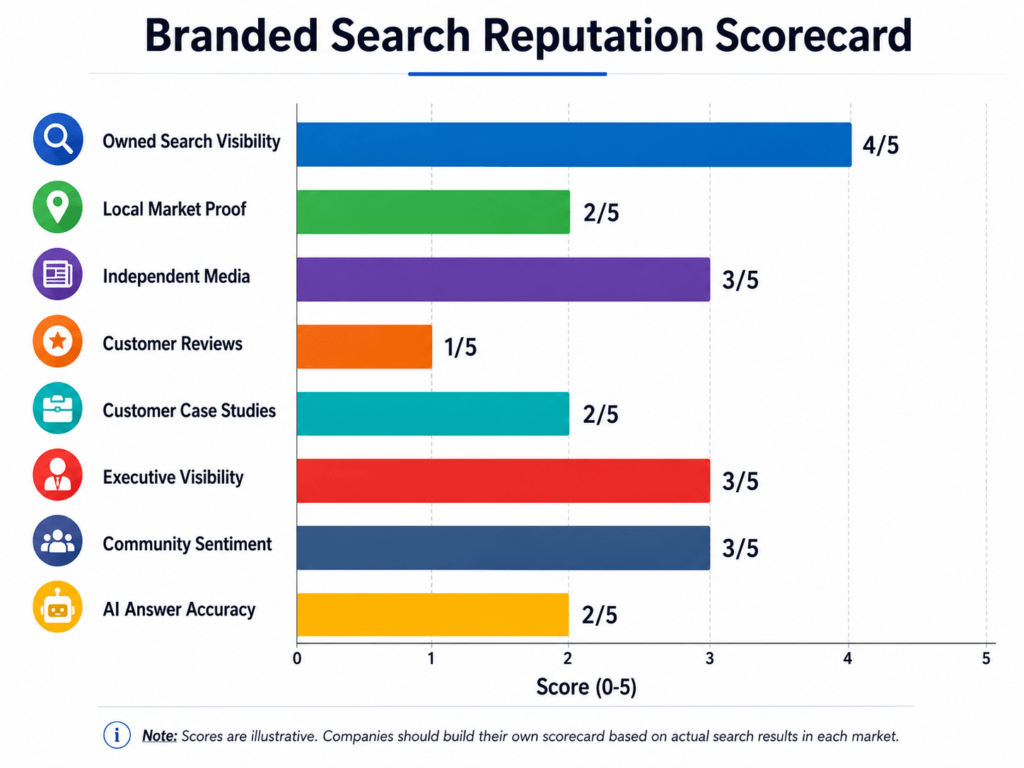
9. Search Results Are Your Unofficial Reputation Homepage
Companies carefully design their homepages. Customers may see Google first.
A branded search results page can contain:
- Your website
- Google Business information
- News articles
- YouTube
- Wikipedia
- Review platforms
- Distributors
- Marketplace listings
- Reddit discussions
- Competitor comparisons
The company does not fully control this page, yet it can strongly influence customer perception. This creates a useful reputation-management exercise.
The Branded Search Audit
Search:
- Your brand
- Your brand + reviews
- Your brand + Japan
- Your brand + complaints
- Your brand + Reddit
- Your brand + pricing
- Your brand + alternatives
- Your major products
- Your executives
Repeat this in each target country and target language.
Then ask:
- Does the first page look credible?
- Does it represent the current company?
- Are important local pages visible?
- Do outdated pages rank prominently?
- Are third-party results positive, negative or absent?
- Are customers finding the correct regional website?
- Are reviews visible?
- Is the company’s expertise independently confirmed?
10. Reputation SEO Is Not About Hiding Criticism
Online reputation management sometimes has a bad reputation of its own.
It can sound like:
How do we push negative results off page one?
That is too narrow. A healthy reputation strategy improves the overall quality and accuracy of information about the brand.
This includes:
- Publishing useful owned content
- Keeping company profiles accurate
- Generating authentic customer proof
- Earning relevant media coverage
- Answering legitimate criticism
- Correcting inaccurate information where possible
- Making expert employees visible
- Building category authority
The objective is not to create an artificially perfect search result.
In fact, a brand with only five-star praise can sometimes appear less credible than one with overwhelmingly positive feedback plus a small number of reasonable complaints that have been handled professionally.
The goal is credibility.
11. The Absence of Reputation Can Be a Reputation Problem
Negative information is not the only risk. Sometimes nothing appears. A customer discovers an unfamiliar overseas supplier and searches it.
They find almost no:
- Reviews
- News
- Customer examples
- Social activity
- Videos
- Leadership presence
- Independent discussion
That information vacuum forces the customer to make a judgment under uncertainty.
For established companies entering new markets, this is frustrating because the company may already possess enormous credibility at home. The solution is not to manufacture artificial reputation. It is to translate existing real-world credibility into evidence the new market can actually discover.
12. Local Landing Pages Should Connect Marketing Claims to Reputation Proof
A localized landing page should not operate independently from the rest of the company’s reputation.
If the page claims:
Trusted by Japanese enterprises.
provide evidence.
If the page claims:
Industry-leading customer satisfaction.
show where the claim comes from.
If the page claims:
Global support.
explain what that means for the local customer.
This is particularly relevant in Japan, where a translated page that lacks localized credibility signals can still feel foreign even when the language itself is correct.
See our guide to landing page localization for Japan for a deeper discussion of how trust, page structure, and conversion expectations change across markets.
13. Reputation Is Created After the Sale Too
A marketing department cannot permanently compensate for a poor customer experience. Customer experience eventually becomes public evidence.
The sequence can be positive:
Good Experience → Retention → Review → Referral → Case Study → Strong Reputation
Or negative:
Poor Experience → Complaint → Review → Social Discussion → Search Visibility → Lost Trust
This is why reputation management should involve more than the communications team.
It involves:
- Marketing
- Customer support
- Customer success
- Sales
- Product
- Operations
- HR
- PR
- Legal
- Leadership
A reputation problem often starts as an operational problem.
14. Reputation Risk Often Appears at the Handoffs
Cross-border businesses create additional handoffs:
- Global HQ → Local office
- Marketing → Distributor
- Distributor → Customer
- English support → Japanese support
- Sales → Implementation
- Global policy → Local practice
Each handoff creates the possibility of inconsistent expectations.
For example:
The global website promises 24-hour support.
The Japanese customer interprets that as accessible Japanese-language support.
The actual service provides an English ticket response from another time zone.
Technically, the company may believe it delivered what was promised.
The customer may believe otherwise.
The resulting complaint is not merely a customer-service issue.
It becomes a reputation issue because the original marketing claim and customer reality do not match.
15. How Complaint Behavior Can Differ Across Markets
One common cross-cultural mistake is assuming dissatisfaction will always be expressed in the same way. It will not.
Some customers complain immediately and publicly. Others raise concerns privately, reduce usage, stop replying, or simply do not renew.
Japanese companies entering Western markets can be surprised by how directly customers criticize a company through:
- Public reviews
- Social posts
- Industry communities
Western companies operating in Japan can make the opposite mistake: assuming that the absence of strong public criticism means the customer is satisfied.
Reputation monitoring should therefore combine:
- Public review monitoring
- Social listening
- Customer surveys
- Support data
- Account-manager feedback
- Renewal signals
- Usage behavior
- Direct customer interviews
16. How to Respond to a Negative Review
A bad review creates two audiences. The first is the person who wrote it. The second is everyone who will read it later. That second audience can be much larger.
A strong response usually does five things:
- Acknowledges the concern
- Avoids unnecessary defensiveness
- Clarifies facts where appropriate
- Provides a path toward resolution
- Shows future readers that the company takes problems seriously
A public response should rarely become a lengthy argument. Even when the customer is partly incorrect, winning the argument can lose the reputation battle.
| Weak Response | Better Principle |
|---|---|
| “This is not our fault.” | Clarify responsibility without sounding dismissive. |
| “Please delete this review.” | Resolve the underlying problem first. |
| A long public defense | Keep the public response concise and move detailed resolution to an appropriate channel. |
| No response | Respond when a meaningful customer concern deserves acknowledgement. |
| Generic copy-paste apology | Reference the specific issue sufficiently to show the complaint was read. |
17. Do Not Translate Reputation Responses Word for Word
This is another area where literal localization creates problems. A complaint response written for a US customer may sound unusually direct when translated literally into Japanese. A traditional Japanese apology translated directly into English can sometimes sound excessively formal, vague, or disproportionate to a Western reader. Localize the intention, not merely the sentence.
The response needs to preserve:
- Accountability
- Clarity
- Respect
- Appropriate tone
- A next step
But the way those elements are expressed should fit the audience.
18. Speed Matters, but So Does Accuracy
A reputation issue creates pressure to respond quickly. That does not mean the first response should contain speculation.
A useful model is:
Acknowledge → Investigate → Update → Resolve → Explain
For a serious incident:
Stage 1: Acknowledge
Confirm that the company is aware of the issue.
Stage 2: Investigate
Establish what is actually known.
Stage 3: Update
If investigation will take time, provide another update rather than disappearing.
Stage 4: Resolve
Explain what has been done.
Stage 5: Explain
For major incidents, explain prevention or follow-up where appropriate.
Silence creates an information vacuum. Someone else will usually fill it.
19. Build a Cross-Border Reputation Escalation Matrix Before You Need One
| Issue Level | Example | Owner | Typical Action |
|---|---|---|---|
| Level 1 | Routine negative review | Customer support / local marketing | Respond and resolve |
| Level 2 | Repeated complaint pattern | Customer success + operations + marketing | Investigate systemic cause |
| Level 3 | High-reach social criticism or media inquiry | PR + leadership + relevant operational team | Coordinate public response |
| Level 4 | Safety, legal, security or major trust incident | Executive leadership + legal + PR + specialists | Crisis-response process |
The exact structure depends on the organization. The important point is deciding responsibilities before a problem becomes urgent.
Cross-border businesses should additionally establish:
- Who can approve Japanese-language statements?
- Who can approve English-language statements?
- When does global HQ need to be involved?
- When can a local market team respond independently?
- Who monitors after-hours activity?
- Who owns marketplace reviews?
- Who owns social-platform responses?
20. Do Not Confuse Reputation Management With Review Manipulation
A healthy reputation program creates more opportunities for real customers to share real experiences. It should not manufacture consensus.
Avoid tactics such as:
- Fake customer reviews
- Employee-written customer reviews
- Undisclosed paid endorsements
- Fabricated testimonials
- Review suppression practices that misrepresent customer sentiment
- Fake community conversations
These tactics create legal, platform, ethical and reputational risk. They also become especially dangerous in international markets because a controversy about fabricated trust can reinforce exactly the concern a new entrant is trying to overcome:
Can this unfamiliar company be trusted?
21. Employee Reputation Has Become Part of Corporate Reputation
Customers increasingly research the people behind companies.
This is particularly visible in:
- Professional services
- Technology
- Consulting
- Startups
- Recruitment
- Executive-led businesses
They may inspect:
- LinkedIn profiles
- Conference appearances
- Author biographies
- Interviews
- Technical articles
- Public presentations
This creates an opportunity for Japanese companies entering Western markets.
A business that lacks Western brand recognition may still have:
- Highly experienced engineers
- Researchers
- Product specialists
- Executives
- Industry veterans
Making those experts visible can accelerate trust.
The company stops being an unfamiliar corporate logo and becomes a group of identifiable experts with demonstrated knowledge.
22. Digital PR Is a Reputation Tool, Not Just a Link-Building Tool
Digital PR is sometimes discussed mainly as an SEO tactic.
Earn media coverage.
Gain links.
Improve authority.
That is useful, but incomplete. Third-party coverage also changes what appears when someone verifies a company.
A prospect encountering:
- Industry interviews
- Trade publication coverage
- Expert commentary
- Research citations
- Conference appearances
receives independent evidence that the company participates in the market rather than merely selling into it. This can be particularly important for foreign entrants whose own websites are initially the primary source of information about them.
23. Original Research Can Build Reputation Faster Than Promotional Content
One of the most effective ways for an unfamiliar company to become credible is to become useful.
Instead of publishing another article saying:
Why our solution is the best
Publish information the market genuinely wants:
- Industry benchmarks
- Consumer surveys
- Technical research
- Market statistics
- Cross-country comparisons
- Original datasets
- Expert guides
Useful original information can generate:
- Links
- Press mentions
- Social sharing
- AI citations
- Expert recognition
Promotional messaging says:
Trust us.
Useful research gives people a reason to conclude: These people know what they are talking about.
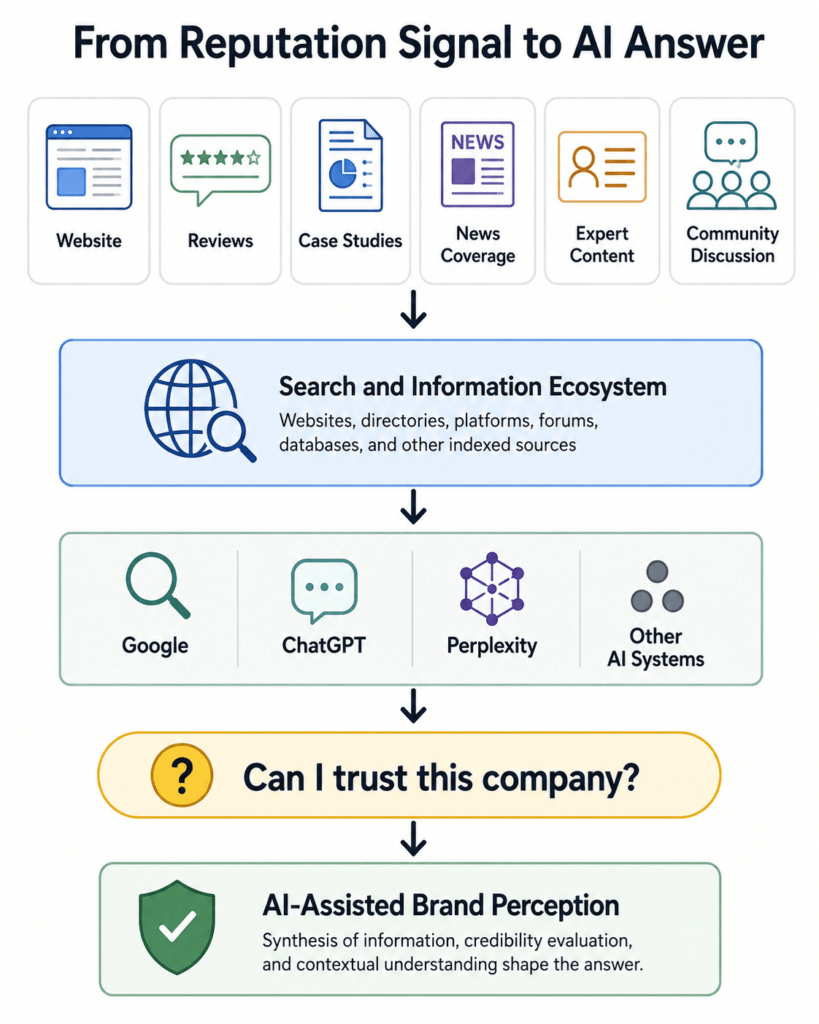
24. AI Search Creates a New Reputation Surface
A growing number of customers no longer begin every research journey with a conventional search-result page.
They may ask an AI system:
- What is the best provider of X?
- Is Company Y reliable?
- What are the pros and cons of Company Y?
- Which Japanese manufacturers make X?
- What are alternatives to Company Y?
The answer may synthesize information from multiple sources rather than directing the user immediately to the company’s website. This means reputation increasingly depends on what the broader information environment says about you.
Your company needs accurate and consistent information across:
- Your own website
- Third-party publications
- Industry websites
- Review platforms
- Customer evidence
- Authoritative profiles
This also connects reputation management directly to AIO, GEO and LLMO. A brand cannot directly dictate what an AI system says. It can improve the quality, clarity, consistency and authority of the evidence available about it.
25. Audit What AI Systems Say About Your Brand
As part of an international reputation audit, test common customer questions.
For example:
- What does [company] do?
- Is [company] reputable?
- Who are [company]’s competitors?
- What are the advantages of [company]?
- What are the disadvantages of [company]?
- Does [company] operate in Japan?
- Does [company] support Japanese customers?
Then compare the answers with reality.
Look for:
- Outdated information
- Missing market presence
- Incorrect product descriptions
- Weak understanding of brand differentiation
- Competitors receiving significantly stronger citations
You cannot fix every incorrect AI answer directly. But recurring inaccuracies can reveal an underlying information problem.
If authoritative online sources do not clearly explain your company, AI systems are unlikely to magically reconstruct the missing reputation.
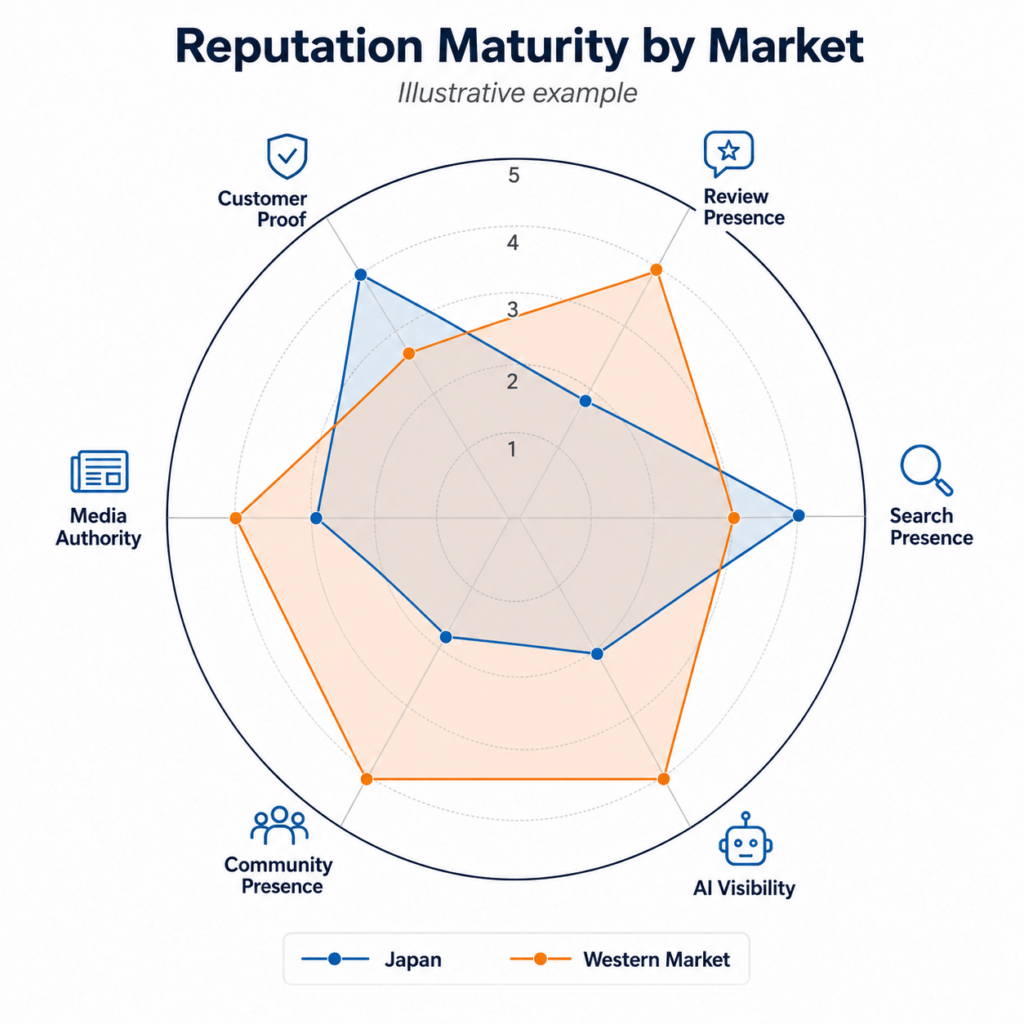
26. Reputation Should Be Measured Separately by Market
A global average hides local weakness.
Imagine a company with strong US recognition but weak Japanese visibility.
| Metric | US | Japan |
|---|---|---|
| Branded Search Visibility | Strong | Moderate |
| Independent Reviews | Strong | Weak |
| Local Case Studies | Strong | Weak |
| Media Coverage | Strong | Moderate |
| Local-Language Expert Content | N/A | Moderate |
| AI Brand Accuracy | Strong | Weak |
The organization does not have one reputation. It has multiple overlapping reputations. Measure them separately.
27. Core Cross-Border Reputation Metrics
Branded Search Demand
Are more people actively searching the company name?
Branded Search Sentiment
What appears around branded queries?
Review Volume
Are enough customers contributing credible feedback?
Review Quality
What themes repeatedly appear in positive and negative feedback?
Review Response Rate
Does the company appropriately engage when a response is warranted?
Case-Study Coverage
Are major customer segments represented?
Local Proof Coverage
Do target markets have market-specific success evidence?
Earned Media Mentions
Is the company being discussed by relevant third parties?
Share of Search
How visible is the brand relative to competitors?
AI Brand Accuracy
Do common AI-generated summaries describe the business correctly?
Reputation-to-Conversion Impact
Do visitors who interact with case studies, reviews, proof pages or branded search convert differently?
28. Build a Reputation Dashboard That Combines Marketing and Customer Experience
| Area | Possible KPI | Source |
|---|---|---|
| Search | Branded search impressions | Search Console / SEO platform |
| Reviews | Average rating and new review volume | Relevant review platforms |
| Customer Experience | Recurring complaint themes | Support / CRM |
| PR | Relevant earned mentions | Media monitoring |
| Case Studies | Published local customer stories | CMS / CRM |
| Social | Brand mentions and sentiment themes | Social monitoring |
| AI | Accuracy of key brand answers | Manual or structured monitoring |
| Business | Conversion from branded traffic | Analytics / CRM |
The important change is organizational. Reputation should not live exclusively in a PR spreadsheet. It should connect customer experience with acquisition performance.
29. A 90-Day Cross-Border Reputation Plan
Days 1–30: Audit
- Search your brand in each target market
- Audit branded query results
- Audit major review platforms
- Review customer sentiment
- Identify reputation gaps
- Compare competitors
- Check AI-generated brand answers
- Map existing customer proof
- Identify missing local-market evidence
Days 31–60: Build the Foundation
- Correct inaccurate corporate profiles
- Improve local About and company pages
- Publish missing customer stories
- Create review-request workflows
- Improve executive profiles
- Build local-language reputation content
- Establish complaint-response ownership
- Prepare escalation procedures
Days 61–90: Expand Independent Proof
- Begin digital PR
- Pitch original data or expertise
- Develop expert bylines
- Encourage appropriate customer advocacy
- Build relevant industry relationships
- Monitor branded search changes
- Track recurring review themes
- Recheck AI brand descriptions
This does not produce a finished reputation in 90 days. Reputation is cumulative. The objective is to establish the system that allows credibility to compound.
30. Cross-Border Reputation Readiness Checklist
Search
- Branded search has been audited in each target market
- Regional websites appear correctly
- Outdated pages have been identified
- Important branded queries are monitored
Customer Proof
- Relevant customer testimonials exist
- Local-market case studies exist where possible
- Case studies contain specific outcomes
- Customer permission is documented
- Anonymous evidence is used appropriately where naming is impossible
Reviews
- Important category-specific platforms have been identified
- Review-request processes exist
- Negative reviews are monitored
- Response ownership is clear
- Fake or manipulated review tactics are prohibited
Website
- Company identity is clear
- Local presence is explained
- Support availability is accurate
- Marketing claims have supporting evidence
- Customer proof is visible near conversion points
PR and Authority
- Target-market media has been mapped
- Experts are available for commentary
- Original research opportunities have been identified
- Important industry associations are understood
Customer Experience
- Complaint patterns are shared with marketing and operations
- Recurring service issues are investigated
- Customer success identifies future advocates
- Cancellation feedback is analyzed
Crisis Preparation
- Escalation responsibilities are documented
- Local and global approval processes are clear
- After-hours responsibilities are understood
- Legal, PR and operational owners can coordinate quickly
AI Reputation
- Common brand questions have been tested
- Major inaccuracies have been identified
- Authoritative source gaps are being addressed
- Competitor visibility has been benchmarked
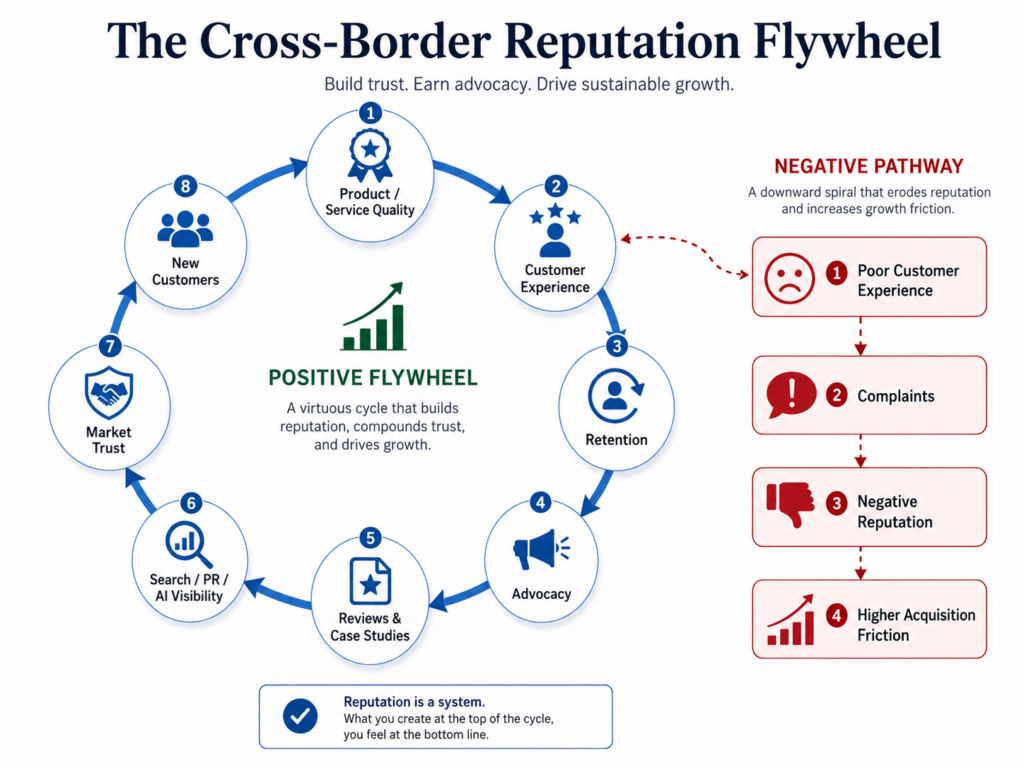
31. The Cross-Border Reputation Flywheel
The strongest reputation systems eventually become self-reinforcing.
Good Product or Service
↓
Strong Customer Experience
↓
Retention
↓
Reviews + Case Studies + Referrals
↓
Search + PR + Community + AI Visibility
↓
Higher Trust
↓
More Qualified Customers
↓
More Customer Success
32. Reputation Management for Western Companies Entering Japan
Western companies expanding into Japan should prioritize:
- Japanese-language branded search monitoring
- Locally relevant reviews
- Japanese customer proof
- Clear information about local support
- Visible evidence of long-term market commitment
- Professional Japanese complaint responses
- Local press and industry credibility
- Accurate Japanese corporate information
Do not assume that global recognition answers every local trust question.
A prospect may know that your company succeeds internationally and still need evidence that choosing you is safe in the Japanese operating environment.
This is consistent with the broader Japan market entry roadmap: sustainable entry depends not only on awareness and lead generation but on building credibility within the local ecosystem.
33. Reputation Management for Japanese Companies Entering Western Markets
Japanese companies should often prioritize:
- English-language customer stories
- More explicit outcome-based proof
- Relevant third-party reviews
- Visible executives and experts
- Active LinkedIn presence where appropriate
- Western trade-media coverage
- Original research
- Direct and timely complaint handling
- Clear English support information
Do not discard the credibility already built in Japan. Translate it into evidence that Western customers can evaluate. A 60-year operating history is valuable. A 60-year history plus clear customer outcomes, independent references, technical expertise, and visible leadership is considerably more persuasive to someone encountering the company for the first time.
34. The Goal Is Not to Look Local. It Is to Become Credible Locally.
International localization is sometimes reduced to cosmetic adaptation.
Use Japanese photography.
Change the language.
Create an English LinkedIn page.
Add the local office.
Those things may help, but reputation requires something deeper. You need evidence that the organization can operate successfully within the target market.
That evidence accumulates through:
- Customer experience
- Local results
- Visible expertise
- Independent validation
- Consistent communication
- Time
You cannot fully manufacture reputation at launch. But you can build the infrastructure that allows real credibility to become visible faster.
Summary
Cross-border reputation management is not simply about responding to negative reviews. It is the process of making real-world credibility visible, understandable and verifiable in a new market.
The core principles are:
- Your domestic reputation does not automatically transfer internationally.
- Different markets and categories rely on different trust signals.
- Strong reputation comes from multiple independent signals agreeing with each other.
- Customer advocacy creates valuable reputation assets.
- Reviews should be built on the platforms customers actually use, not the platforms your headquarters happens to know.
- Western companies entering Japan should create locally relevant proof.
- Japanese companies entering Western markets should make existing credibility more explicit and independently verifiable.
- Search results function as an unofficial reputation homepage.
- The absence of third-party information can create uncertainty even when nothing negative appears.
- Reputation management should improve the information environment, not manipulate it.
- Customer experience eventually becomes reputation.
- Complaint responses should be localized rather than translated mechanically.
- Digital PR and original research can strengthen both SEO and credibility.
- AI-generated answers are becoming a new reputation surface.
- Reputation should be measured separately by country and market.
- Marketing, sales, customer success, support, PR, and leadership should share responsibility for reputation.
A company entering another country begins with a reputation deficit.
- Customers know less about it.
- Search engines have less local evidence.
- Review ecosystems contain fewer signals.
- Journalists know the company less well.
- AI systems may have less context.
That deficit does not have to remain permanent.
- Each successful customer creates evidence.
- Each useful piece of content demonstrates expertise.
- Each independent mention increases verification.
- Each well-handled problem demonstrates reliability.
- Each local case study reduces uncertainty for the next customer.
Over time, those signals stop looking like isolated marketing assets. They become reputation. And once a reputation becomes established in the target market, international growth becomes easier because new customers no longer have to take the company’s credibility entirely on trust.
Frequently Asked Questions
What is cross-border reputation management?
Cross-border reputation management is the process of building, monitoring, and protecting a company’s credibility across different countries and languages. It includes search results, reviews, customer evidence, media coverage, social discussion, customer experience, and increasingly AI-generated information about the brand.
Why does a company need a separate reputation strategy for Japan?
A company’s global reputation may not fully answer the trust questions Japanese customers have. Local customer examples, Japanese-language information, local support, corporate transparency, and evidence that the company can operate successfully in Japan may all influence credibility.
Do Japanese companies need third-party reviews when entering Western markets?
It depends on the category, but third-party validation is frequently important. Software, consumer services, e-commerce, professional services, and other industries each have different review ecosystems. Companies should identify which platforms appear during real customer research rather than simply choosing the most famous global review website.
Should companies respond to every negative review?
Not necessarily. Spam, abuse, and clearly irrelevant commentary may require different handling. However, legitimate customer complaints that prospects are likely to see usually deserve an appropriate response. The response should focus on acknowledgement, clarification, and resolution rather than winning a public argument.
Can SEO improve brand reputation?
Yes, although reputation SEO should not be understood as merely suppressing criticism. SEO can improve the discoverability of accurate corporate information, expert content, case studies, media coverage, and other credible sources that help customers understand the company.
How are customer advocacy and reputation management different?
Customer advocacy creates proof through reviews, referrals, testimonials, case studies, and recommendations. Reputation management ensures those and other trust signals are visible, credible, appropriately distributed, and supported by the broader information environment around the brand.
How does AI search affect corporate reputation?
AI systems can summarize brands using information collected from websites, publications, reviews, and other accessible sources. Companies cannot fully control those answers, but they can improve the quality and consistency of authoritative information available about the business.
What should a company do first when auditing its international reputation?
Begin with the customer’s perspective. Search the brand, products, executives, reviews, complaints, and competitors in the target country’s language and search environment. Then identify what a potential customer would actually encounter before contacting the company.
Tokyo SEO Maker is a Tokyo-based digital marketing consultancy supporting companies with SEO, AIO, GEO, LLMO, and international market-entry strategies for Japan and Western markets. If your company is entering Japan or expanding from Japan into overseas markets, contact us to discuss your search, localization, and cross-border growth strategy.