

How Foreign Brands Convert Customers in Japan and Western Markets

A customer can spend half an hour researching an unfamiliar foreign brand, decide that its products appear credible, compare reviews, study its website, and still leave without buying. The final barrier to converting customers may appear only after the customer has already accepted the product, the brand, and even the price.
For companies expanding between Japan and Western markets, these details form a distinct stage of localization. Marketing creates interest, research creates confidence, and the transaction experience determines whether that confidence survives contact with the practical realities of buying across borders.
This matters well beyond conventional retail. Software subscriptions, travel services, education, paid memberships, digital products, specialist equipment, consumer electronics, cosmetics, fashion, professional services, and other higher-consideration purchases can all encounter the same problem. A prospective customer may believe the offer is valuable while remaining uncertain about the process required to become a customer.
This guide examines the final stretch between research and purchase: how foreign brands can localize price presentation, payments, checkout, delivery, returns, customer support, and post-purchase expectations for customers entering Japan and for Japanese companies expanding into Western markets.

1. Cross-Border Demand Is Already Substantial
International purchasing is no longer a niche behavior confined to travelers, collectors, or internationally minded early adopters. DHL’s 2026 cross-border research reports that 70% of global online shoppers buy from retailers outside their home country, while 45% do so at least once a month. Younger consumers are especially active, with 53% of Gen Z and Millennial shoppers buying internationally at least monthly.
Japan is participating in the same expansion. Japan’s Ministry of Economy, Trade and Industry reported that the country’s B2C e-commerce market reached ¥26.1 trillion in 2024, up 5.1% from the previous year. Japanese consumers purchased an estimated ¥441 billion through cross-border e-commerce in the METI survey’s Japan-U.S.-China comparison, an increase of 4.8% year over year.
These figures show that the opportunity exists before a foreign company builds a perfect local operation. They also reveal why conversion quality deserves attention. International customers have more overseas choices, more familiarity with cross-border purchasing, and more opportunities to abandon one foreign seller for another when the buying process becomes inconvenient.
| Indicator | Latest reported figure | Implication for market entry |
|---|---|---|
| Japan B2C e-commerce market | ¥26.1 trillion in 2024 | Digital purchasing is already embedded in the Japanese consumer economy. |
| Japanese cross-border EC purchases | ¥441 billion in 2024 within METI’s Japan-U.S.-China comparison | Japanese consumers are willing to buy internationally when the offer and transaction feel workable. |
| Global shoppers buying internationally | 70% in DHL’s 2026 study | Foreign origin alone does not prevent purchase, although it can introduce additional friction. |
| Global shoppers buying internationally monthly | 45% | Cross-border purchasing is becoming routine for a meaningful segment of online customers. |
Sources: Japan Ministry of Economy, Trade and Industry, FY2024 E-Commerce Market Survey; DHL, 2026 Cross-Border Buying Behavior Trends.
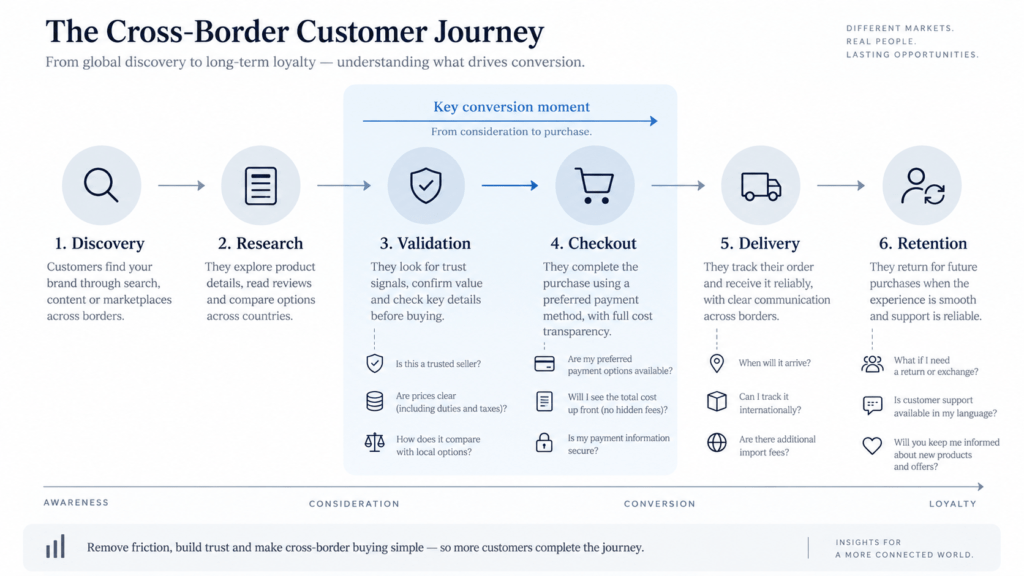
2. Research Confidence and Transaction Confidence Are Different
A customer researching a foreign company asks whether the brand appears credible, whether other people have had positive experiences, whether the product will meet expectations, and whether the company appears committed to the market. Those questions are covered earlier in the international buyer journey and connect closely with localized content, independent reviews, customer evidence, and brand reputation.
The questions change as purchase approaches. Customers begin asking how much they will pay in total, when the order will arrive, whether they can use a familiar payment method, what happens if the product is wrong, and whether someone will help if the transaction fails. The closer customers get to payment, the more operational details become part of brand perception.
This creates two layers of confidence that international brands need to earn.
| Research confidence | Transaction confidence |
|---|---|
| Does this company appear legitimate? | Can I pay without unnecessary difficulty? |
| Is the product suitable for me? | Do I understand the total cost? |
| What do customers say? | When will the product arrive? |
| Is there evidence behind the claims? | What happens if I need to return it? |
| Does the company understand my market? | Can I get support in my language and time zone? |
| Can I trust the brand? | Can I trust the transaction? |
Companies that have concentrated on the first column may see strong engagement without proportional sales. They can attract qualified visitors, build recognition, and produce convincing content while leaving conversion dependent on an international purchasing process designed around the company’s home market.
For Western brands entering Japan, this often means adapting systems that assume Western names, addresses, cards, delivery expectations, and support patterns. For Japanese brands moving into the United States, United Kingdom, Europe, Australia, or other Western markets, it can mean becoming more explicit about delivery, returns, pricing, subscriptions, warranties, and self-service purchasing.
The same principle appears in broader website localization. Our guide to Japanese localization for overseas companies explains why language is only one component of a localized customer experience, while our reverse localization guide for Japanese companies entering Western markets examines how the same issue operates in the opposite direction.
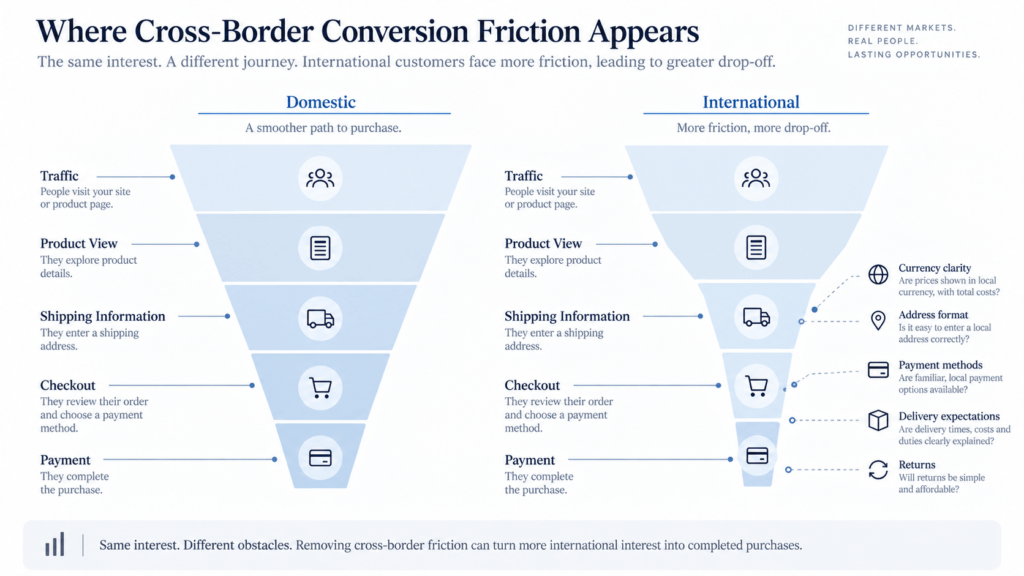
3. The Last Stage of the Funnel Contains Expensive Friction
Checkout abandonment data provides a useful view into the problems that remain after a shopper has expressed significant purchase intent. Baymard Institute’s current U.S. research separates shoppers who were only browsing from those who abandoned for more actionable reasons. Among the remaining group, high additional costs, slow delivery, payment security concerns, mandatory account creation, complicated checkout processes, return policies, and payment availability all contribute to abandonment.
Selected Reasons U.S. Online Shoppers Abandon Checkout
- Extra costs too high: 40%
- Delivery too slow: 20%
- Did not trust a site with card information: 19%
- Required account creation: 18%
- Checkout too long or complicated: 17%
- Unsatisfactory return policy: 13%
- Insufficient payment methods: 9%
Source: Baymard Institute checkout research. Figures refer to surveyed U.S. online shoppers and exclude respondents who abandoned because they were only browsing or were not ready to buy.
These figures should not be copied directly onto Japanese consumers as if customer behavior were identical across markets. Their value lies in showing how much conversion pressure appears after product consideration. Cross-border shopping adds another layer because the same customer must evaluate distance, customs, currency, delivery reliability, returns, communication, and unfamiliar merchant practices.
DHL’s 2026 research reinforces that logistical concerns remain central internationally. It reports that 67% of global shoppers have abandoned an online purchase because the delivery offering failed to meet expectations, while 58% have abandoned because of the returns offering. DHL also reports that free delivery would encourage 57% of surveyed shoppers to buy from international retailers, while free returns would encourage 43% and delivery by a trusted provider would encourage 31%.
4. Show the Customer the Real Price Early
Price localization starts with currency, but currency is only the visible layer. A foreign shopper wants to understand the economic commitment that will leave their account and whether another charge may appear after purchase.
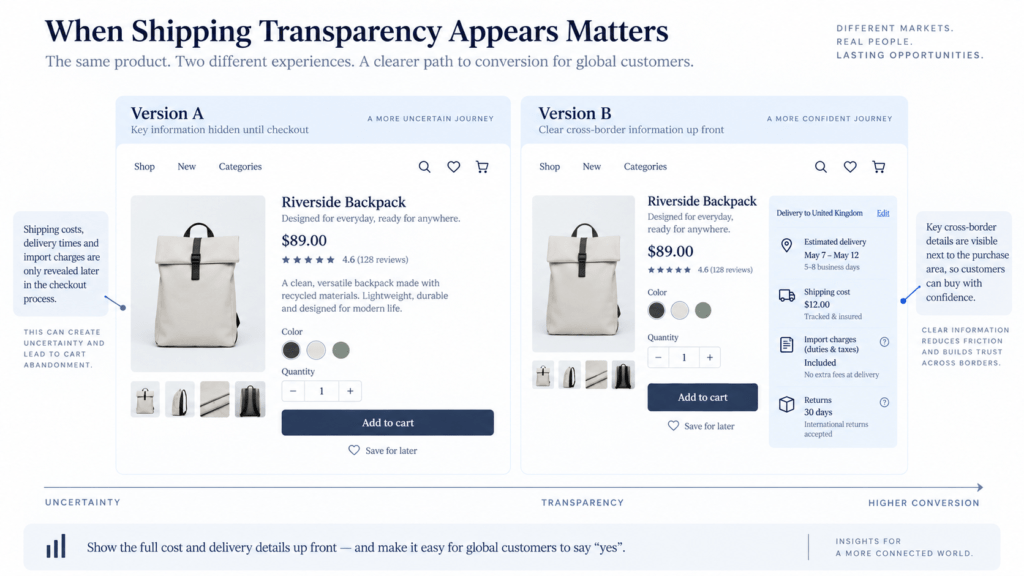
That distinction becomes especially important for cross-border orders involving international shipping, import duties, consumption tax or VAT, card conversion charges, and carrier handling fees. A customer who sees one price on the product page and a materially different total later in the process may interpret the difference as poor planning or poor transparency even when every fee is legitimate.
Western companies selling to Japan should consider whether prices are displayed in yen, whether Japanese consumption tax treatment is understandable, whether international shipping charges appear before the final checkout stage, and whether duties or carrier fees could be collected later. Japanese businesses entering Western markets face the same questions, with added variation across markets such as the United States, the United Kingdom, and the European Union.
A useful internal test is simple: before entering payment information, can a first-time customer explain how much the purchase will cost, what could change that amount, which currency will be charged, and whether additional charges may be collected after the order is placed? If the answer depends on reading multiple help pages, conversion friction is already present.
Companies should also avoid assuming that automatic currency conversion completes the job. Product pricing, psychological price points, shipping thresholds, discount structures, and tax presentation should be reviewed by market. A technically correct conversion from dollars into yen can produce prices that feel accidental or poorly maintained.
5. Local Payment Expectations Matter More at the Point of Commitment
Payment behavior continues to evolve rapidly in Japan. METI reported that cashless payments reached 58.0% of consumer payment value in 2025. Credit cards represented 82.7% of that cashless value, code payments 10.2%, electronic money 3.7%, and debit cards 3.4%.
Japan’s Cashless Payment Value by Method, 2025
- Credit cards: 82.7%
- Code payments: 10.2%
- Electronic money: 3.7%
- Debit cards: 3.4%
Source: METI, 2025 Ratio of Cashless Payment Among the Total Amount Paid by Consumers. Percentages show the composition of cashless payment value rather than the share of every consumer transaction.
The correct payment mix still depends on audience, category, order value, device, and sales channel. The lesson for foreign brands is to research the payment environment instead of assuming that the options available in the home market will cover every meaningful customer segment.
The reverse applies to Japanese brands selling overseas. Western markets may involve extensive use of cards and digital wallets, while buy-now-pay-later products, PayPal, local bank methods, or market-specific solutions can have greater importance in particular categories and countries. A single English checkout for every overseas market can therefore conceal significant differences within the broad label of “Western customers.”
Payment localization should also include the failure experience. Declined payments, authentication steps, billing-address mismatches, retry flows, and fraud checks deserve localized error messages that explain what the customer can do next. A generic technical error at the payment stage is especially costly because the customer has already invested time in reaching the final step.
6. Localize the Checkout Form
Translation can make every field readable while leaving the form structurally foreign. Names, postal codes, prefectures or states, telephone numbers, address order, required fields, character input, and validation rules differ across markets. Poor form design can therefore produce a strange situation in which the customer has supplied valid local information, and the website refuses to accept it.
Western companies entering Japan should test the complete purchase flow with Japanese names, Japanese addresses, local telephone formats, apartment and building names, postal codes, and Japanese-language input. Autofill should also be tested on common mobile browsers because mobile users may interact with fields differently from desktop shoppers.
Japanese companies targeting Western markets should test the reverse journey with real local formats from each priority market. U.S. states and ZIP codes, British postcodes, European diacritics, longer street addresses, apartment numbers, international telephone prefixes, and differing billing and shipping addresses can expose problems that remain invisible when testing only with Japanese corporate data.
Mandatory account creation deserves special attention. Baymard’s research reports that 18% of surveyed U.S. shoppers abandoned an order because the site wanted them to create an account. For consumer commerce, guest checkout can reduce commitment before the transaction, while account creation can be offered after purchase, when the customer already understands its value.
7. Delivery Information Belongs on the Product Journey
International delivery should be understandable before a shopper reaches the final checkout screen. A customer deciding between a domestic brand and a foreign one may treat delivery as part of the product itself because it determines when the product can be used and how much effort will be required to receive it.
A useful cross-border product experience should answer practical questions early. The site should explain whether the item ships to the customer’s location, provide an estimated delivery window, identify the carrier where useful, explain tracking, disclose shipping cost or the threshold for free shipping, clarify customs handling, and state what happens if the parcel cannot be delivered.
Japanese customers may be accustomed to high levels of domestic delivery reliability and detailed delivery communication. A foreign brand whose checkout offers only a broad estimate such as “7–21 business days” can create uncertainty even when the shipping service itself is acceptable. The company should look for ways to narrow the estimate, improve tracking, and explain the international process before asking for payment.
Japanese sellers moving into Western markets should also avoid treating “international shipping available” as a complete logistics proposition. U.S. customers may compare delivery speed with domestic e-commerce standards, while European customers may be particularly attentive to the process surrounding customs, returns, and cross-border charges. Expectations should be researched country by country rather than assigned to a single Western persona.
8. Returns Influence the Purchase Before a Return Ever Happens
A return policy appears to concern post-purchase service, yet customers use it to estimate pre-purchase risk. The less certain shoppers are about fit, compatibility, quality, color, sizing, performance, or suitability, the more important the escape route becomes.
This is particularly relevant when the seller is overseas. A customer may ask whether returns go to a domestic address or another country, who pays international postage, whether duties are refundable, how long refunds take, whether exchanges are available, and how support will handle damaged or incorrect products.
DHL’s current research reports that 43% of global shoppers say free returns would encourage them to buy from international retailers. The operational economics will prevent every brand from offering free international returns, especially for low-margin or bulky products. Transparency still matters when the policy cannot be generous.
| Weak cross-border return information | Stronger cross-border return information |
|---|---|
| “Returns accepted within 30 days.” | States the 30-day window, the date from which it is calculated, product eligibility, and condition requirements. |
| “Customer is responsible for shipping.” | Explains where the return must be sent, who pays, recommended service, and whether prepaid labels are available. |
| “Refunds processed after inspection.” | Explains expected inspection and refund timing and which payment method receives the refund. |
| No information about customs. | Explains how the company handles duties or taxes associated with a return where applicable. |
| Policy available only in the seller’s home language. | Provides the policy in the customer’s purchase language using terminology that matches the local market. |
After the purchase, these expectations continue into retention.
9. Support Presence Reduces the Perceived Distance Between Markets
A foreign purchase contains a simple psychological question: if something goes wrong, how difficult will it be to reach someone who can fix it? The answer is shaped before the customer ever contacts support.
A local-language help center, visible support hours, clear response expectations, local telephone or chat options where commercially practical, and understandable escalation procedures reduce uncertainty. A company can also display its international support model directly on product, shipping, and returns pages so customers do not have to search for evidence that help exists.
Western brands entering Japan should consider the gap created by time zones. An English-language email address answered the following North American business day may leave a Japanese customer waiting through a large portion of the next local day. Companies do not need a full Japanese call center on the first day of entry, but they should design expectations deliberately and tell customers when responses will arrive.
Japanese companies entering Western markets face a related problem when all support activities remain synchronized to Japan Standard Time. A customer in California, New York, London, or Paris may interpret a twelve-hour silence differently if the company has never explained its operating hours. Published response windows and asynchronous self-service content can reduce that friction while a local support operation is still developing.
10. Western Markets Should Be Segmented Instead of Treated as One Market
“The West” is useful shorthand when contrasting broad international expansion directions, but it is too large to serve as an operating market definition. A Japanese company may begin with an English-language website and still need separate conversion decisions for the United States, Canada, the United Kingdom, Australia, Germany, France, and other markets.
Language provides the clearest example. English reaches multiple markets but does not erase local currencies, taxes, consumer rules, payment habits, logistics networks, spelling conventions, sizing systems, warranties, or cultural expectations. The European Union adds another layer of regulatory and linguistic variation within a connected commercial region.
The practical approach is to prioritize markets and localize the transaction according to opportunity. A company can maintain shared infrastructure while changing the visible customer experience through geolocation, market selectors, local domains or subdirectories, currency settings, market-specific policies, and checkout configurations.
| Layer | Japan entry | Western-market entry |
|---|---|---|
| Language | Native Japanese customer-facing copy and support information | Market-appropriate English or local European language where required by strategy |
| Currency | JPY presentation where appropriate | USD, GBP, EUR, CAD, AUD or target-market currency |
| Payments | Research Japanese card, wallet, code-payment and category-specific expectations | Research each country’s preferred cards, wallets and alternative methods |
| Addresses | Japanese postal and address structure | Country-specific address and telephone formats |
| Delivery | Clear domestic destination handling and international-origin expectations | Country-specific carrier, delivery and customs expectations |
| Returns | Japanese-language process and practical return route | Policy aligned with each market’s logistics and applicable consumer framework |
| Support | JST-compatible and Japanese-language support plan | Time-zone and language coverage appropriate to priority countries |
11. Conversion Localization Should Start Before the Website Is Rebuilt
Companies sometimes discover transactional localization requirements late because website work begins before operational decisions are complete. Designers build the storefront, translators localize the interface, marketing prepares launch campaigns, and only then does the team discover that the payment processor, warehouse, returns process, tax setup, or customer-support model cannot deliver the experience being advertised.
A stronger market-entry sequence begins by mapping the entire transaction before implementation. The company identifies what customers will see, which systems must support it, and which operational limitations need to be disclosed rather than hidden.
| Stage | Questions to resolve |
|---|---|
| Product page | Can customers understand price, availability, compatibility, delivery, and returns before committing? |
| Cart | Are shipping thresholds, promotions, taxes, and estimated total costs clear? |
| Checkout | Do local addresses, payment methods, names, telephone numbers, and currencies work correctly? |
| Payment | Are authentication, declined payments, errors, retries, and fraud checks understandable? |
| Confirmation | Does the customer receive immediate confirmation in the purchase language with accurate order details? |
| Fulfilment | Can the customer track progress and understand delays, customs events, or failed delivery? |
| Returns | Can a customer initiate and complete a return without negotiating the process from scratch? |
| Support | Can customers obtain help during the hours and through the channels they are likely to need? |
12. Measure Cross-Border Friction Separately From Domestic Performance
A global conversion rate can hide the precise problem a market-entry team needs to solve. If domestic customers convert at a high rate while Japanese or overseas customers abandon at checkout, combining both groups into one number makes the weaker experience harder to diagnose.
International teams should segment analytics by market, language, currency, device, traffic source, checkout stage, payment method, delivery selection, and customer type where data volume permits. The goal is to see where the international customer journey diverges from the mature domestic journey.
Useful measurements include product-to-cart rate, cart-to-checkout rate, checkout completion, payment failure rate, delivery-option abandonment, support contacts before purchase, return-policy visits, return rate, refund time, and repeat purchase rate. Qualitative evidence should sit beside the numbers because a conversion funnel can identify where customers leave, while interviews, support logs, user tests, session recordings, and surveys help explain why.
Teams should also test with people who live in the target market rather than relying exclusively on headquarters staff switching the site language. A Japanese employee in Tokyo, a customer in London, and a shopper in California can encounter payment, address, mobile, delivery, and communication conditions that never appear during a headquarters test.
13. A Practical Cross-Border Conversion Audit
The following audit can be used before entering a market or applied to an existing international site that receives traffic without converting at the expected level. Each item should be tested from the perspective of a first-time customer using a real local device, address, payment environment, and delivery destination wherever possible.
| Area | Audit question | Priority if unresolved |
|---|---|---|
| Currency | Can the customer understand the amount that will be charged without doing their own conversion? | High |
| Taxes and duties | Can the customer understand whether additional charges may appear? | High |
| Payment | Are the important payment methods for this target segment supported and tested? | High |
| Address | Does checkout accept real local addresses, names, phone numbers, and characters? | High |
| Guest checkout | Can appropriate consumer purchases be completed without unnecessary account creation? | Medium to high |
| Delivery | Are cost, expected date, tracking, carrier information, and customs handling clear? | High |
| Returns | Can the customer understand eligibility, cost, destination, timing, and refund procedure? | High |
| Support | Can customers find help in an appropriate language and understand response times? | High |
| Confirmation | Are order confirmation and tracking communications localized? | Medium |
| Analytics | Can the team identify where target-market customers abandon the purchasing journey? | High |
14. The Goal Is a Purchase That Feels Predictable
Customers do not need a foreign company to conceal its origin. International products often attract customers because they are international: Japanese craftsmanship, European design, American technology, specialist manufacturing, unique cultural products, or access to something unavailable domestically can form part of the appeal.
What customers need is enough local clarity to understand what will happen when they buy. They need to know the cost, how payment works, when the order will arrive, what recourse exists if something goes wrong, and whether the company will remain reachable after receiving the money.
This creates an important distinction for international expansion. A brand can preserve the characteristics that make it foreign while localizing the uncertainty surrounding the transaction. The product can retain its origin while the purchasing process becomes familiar enough for the destination market.
That principle works in both directions. Western companies entering Japan should remove avoidable ambiguity from a transaction that Japanese customers may already perceive as geographically distant. Japanese companies entering Western markets should make long-established domestic reliability visible through transparent, self-service purchasing experiences that overseas customers can evaluate without prior knowledge of the company.
Once customers have researched the brand, the final task is to make the decision executable. Price, payments, checkout, delivery, returns, and support become part of the international value proposition because each one answers the customer’s final question: If I choose this foreign brand, do I know what happens next?
Summary
International market entry is often evaluated through visibility metrics: rankings, traffic, impressions, followers, media coverage, and leads. Those measures matter, but they describe only the beginning and middle of the customer journey. Revenue depends on whether interested customers can cross the final distance between confidence and commitment.
Japan’s expanding e-commerce market and the continuing growth of international shopping create significant opportunities for companies moving in both directions. The same growth gives customers more alternatives, allowing them to compare not only products but complete purchasing experiences.
Companies should therefore audit cross-border conversions as seriously as translation, SEO, advertising, and content. Local currency, understandable total pricing, suitable payment methods, valid local form structures, transparent delivery, workable returns, accessible support, and market-specific analytics combine to reduce the practical uncertainty attached to buying from abroad.
After the first purchase, the work continues. Retention creates repeat revenue, successful customers create evidence, and evidence can eventually become advocacy. Companies building that longer cycle can continue with our guides to customer retention in Japan and customer advocacy across Japan and Western markets.