
Conversion Rate Optimization: Why Your CRO Playbook Breaks at the Border and How to Fix It
A Western SaaS company spends three months localizing its Japanese website. The translation is accurate. The SEO is solid. Traffic arrives from the right keywords. And then almost nothing converts. Inquiry rates are a fraction of what the home market produces with comparable traffic volumes.
A Japanese manufacturer’s English-language site has the same problem in reverse. Western visitors land, spend time on the page, and leave without filling in the contact form — even though the product is genuinely competitive and the pricing is right.
In both cases, the diagnosis is usually the same: the conversion architecture was built for the home market and carried across the border unchanged. The keywords changed, the language changed, and the underlying logic of how users decide to take action did not.
Conversion rate optimization (CRO) is the discipline of systematically improving the percentage of visitors who complete a desired action — a form submission, a trial signup, a purchase, a download. It is widely understood that CRO is market-specific: what converts in one industry or demographic may not convert in another. Less widely understood is how deeply market-specific CRO becomes when the border in question is between Japan and the West. The differences in trust psychology, decision-making timeline, form preferences, CTA expectations, and social proof requirements are not minor calibration points. They are structural — and they require a genuinely different optimization approach, not just translated copy and a color swap.
This guide covers both directions. For Western companies whose Japan-facing pages are generating traffic but not inquiries, Sections 2 and 5 are the core reading. For Japanese companies whose English-facing pages are underperforming despite sound SEO, Sections 3 and 6 address the most common causes. Section 7 addresses what happens when you try to A/B test across these markets — and why standard testing assumptions need adjustment.

1. Why CRO Assumptions Break When You Cross Borders
Most CRO best practices were developed and validated in English-language Western markets — primarily the US, UK, and Western Europe. The heuristics that dominate the discipline — “simplify the form,” “reduce friction,” “one CTA per page,” “above-the-fold is critical,” “urgency drives action” — are based on observed behavior in those markets. They transfer imperfectly to Japan, and Japanese CRO institutions transfer imperfectly back to the West.
The root cause is not language. It is the underlying model each culture has of what a trustworthy business interaction looks like online.
In most Western markets — and most acutely in the US — the default digital commercial relationship is transactional and self-directed. A user expects to be able to evaluate a product or service on their own terms, understand pricing without initiating contact, begin a trial or low-stakes engagement without speaking to a salesperson, and decide independently. CRO in this context is primarily about removing obstacles to that self-directed process: shorter forms, clearer pricing, instant gratification through free trials and freemium tiers, and social proof from peer reviews.
In Japan, the default commercial relationship is consultative and trust-sequential. A user expects to gather enough information to determine whether a vendor is credible and relevant before initiating any contact. Initiating contact is itself a meaningful commitment — more so than in Western markets — and users are less willing to make it before they feel secure in the relationship. CRO in this context is primarily about providing enough information and trustworthy evidence at each stage of the evaluation to allow users to advance. Removing information to “reduce friction” often reduces conversion instead, because users who haven’t resolved their trust questions simply leave rather than push through.
Neither model is more sophisticated nor more correct. They reflect genuinely different expectations about how business relationships begin, and they require genuinely different CRO strategies.
2. How Japanese Users Convert: The Trust-First Journey
Understanding the Japanese conversion journey is a prerequisite for optimizing it. It does not follow the Western funnel shape — awareness, interest, desire, action — in the same sequence or at the same pace.
The Japanese conversion journey for a considered purchase or B2B inquiry typically moves through five distinct phases:
Phase 1 — Discovery
The user finds the brand through search, recommendations, or comparison platforms. At this stage, they have not formed any views of the brand. They are testing whether the page is worth their time.
Phase 2 — Credibility scan
Before reading substantive content, many Japanese users perform an immediate credibility check: Is there a physical address? A Japanese phone number? A clear company profile? Client logos? Awards or certifications? If these signals are absent, weak, or unconvincing, a significant share of users exit at this stage — not because they evaluated and rejected the offer, but because they could not confirm the vendor was legitimate.
Phase 3 — Information accumulation
Users who pass the credibility scan begin reading in depth. They want to understand the service scope, the process, the deliverables, the pricing structure or range, the team, and the likely outcome for their specific situation. This phase is longer in Japan than in equivalent Western buyer journeys and cannot be shortened by simplifying the page — it can only be made easier by organizing information more clearly.
Phase 4 — Risk assessment
Before any conversion action, Japanese users often explicitly consider what happens if things go wrong. What is the cancellation policy? What happens if the results are below expectations? Is there a trial or diagnostic option with no commitment? Content that addresses risk — explicitly, not through vague reassurance — reduces the friction at this phase materially.
Phase 5 — Low-commitment entry
Japanese users are more likely to convert on a low-commitment offer first: a free diagnosis, a consultation request, a downloadable resource, or a webinar registration. The “Contact Us” or “Request a Quote” button is not the first conversion point; it is often the last one, reached after several smaller engagements have built enough confidence.
The CRO implication: the conversion goal on a Japan-facing page is often not the inquiry form. It is the intermediate conversions — the free diagnosis request, the resource download, the webinar registration — that begin the trust-building sequence. Optimizing only the final inquiry form misses the entire architecture that makes that form reachable.
3. How Western Users Convert: The Self-Service Journey
The Western conversion journey, particularly in US B2B and SaaS markets, operates on different assumptions. Speed and self-sufficiency are the dominant values.
Discovery and immediate evaluation happen simultaneously
A Western user landing on a product page forms a purchase opinion within the first few seconds, not in a later credibility-scan phase. The headline, the visual design, and the presence of a clear CTA all contribute to an immediate “is this worth my time” judgment that is harder and faster than the Japanese equivalent.
Pricing transparency is a trust signal, not a risk
In Japan, many vendors deliberately obscure pricing to prompt consultation requests. In Western markets — particularly in SaaS, professional services, and DTC e-commerce — the absence of pricing information is itself a negative trust signal. Western buyers interpret “contact us for pricing” as either “it’s expensive and they know you won’t like it” or “this company doesn’t trust me to handle the information.” Transparent pricing, even if it includes ranges or starting from figures rather than exact prices, consistently improves conversion in Western markets.
Self-service evaluation is expected
A Western B2B buyer expects to be able to sign up for a free trial, access a demo, or download a substantive resource without speaking to a salesperson first. Gating all evaluations behind a consultation request or contact form is a significant conversion barrier that Japan-facing pages can often get away with, but Western-facing pages cannot.
Social proof from peers outweighs authority
Western buyers — especially in B2B SaaS — weigh peer review platforms (G2, Capterra, Trustpilot) more heavily than awards, certifications, or years in business. A page with a strong G2 rating and quoted customer reviews will frequently outconvert a page with impressive-looking awards and a long company history, holding everything else equal.
Urgency and scarcity work — carefully
“Limited offer,” “spots remaining,” and countdown timers move conversion needles in Western markets when they are credible. In Japan, the same tactics can feel high-pressure and undermine the consultative trust-building that the conversion journey depends on.
4. The 12 Highest-Impact CRO Differences
The following captures the most conversion-significant differences between Japan-facing and Western-facing page optimization. These are the variables that, if misaligned with the target market, most reliably suppress conversion regardless of traffic quality or content quality.
| CRO Element | Japan-Facing Optimization | Western-Facing Optimization |
|---|---|---|
| Primary CTA | Low-commitment first: free diagnosis, consultation, webinar | Self-service first: free trial, demo, transparent pricing |
| Number of CTAs per page | Multiple options calibrated to different readiness levels | One primary CTA per section; too many options create confusion |
| Pricing information | Range or “from” figure acceptable; contact-for-quote common | Full transparency expected; absence of pricing reduces trust |
| Form length | Moderate; company name, name, email, inquiry category, message | Minimal; name and email are sufficient for top-of-funnel offers |
| Form tone | Formal and consultative; explain what happens after submission | Action-oriented: reduce fields, confirm the immediate next step |
| Trust signals — position | Throughout the page, especially near CTAs and the form | Above the fold and near the CTA, less repetition is acceptable |
| Trust signals — type | Company history, certifications, physical address, and Japanese staff | Peer reviews, named case studies with metrics, team LinkedIn |
| Social proof format | Third-party evaluations, awards, media mentions | Customer review platform ratings, quotable testimonials |
| Content density | Higher users want full information before converting | Lower concision signals confidence; overlong copy deters action |
| Urgency tactics | Avoid or use very sparingly; perceived as pressure | Effective when credible; countdown, limited availability |
| Risk reduction copy | Explicitly describe what happens if the results disappoint | Implied by free trial / money-back guarantee; less needed |
| Mobile conversion | Critical: Japan’s mobile usage is very high, including for B2B | Important, but the desktop is still significant for B2B evaluation |
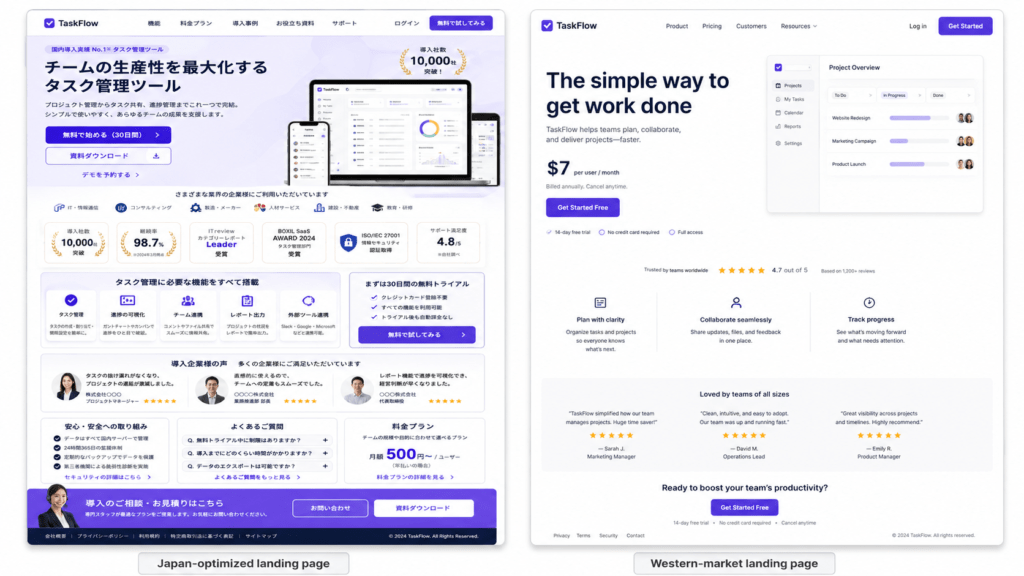
A side-by-side screenshot comparison of two landing pages: one optimized for Japan (multiple CTAs, dense trust signals, longer copy) and one for a Western market (single CTA, pricing visible, short copy, review badges)
5. Japan-Facing CRO: What to Test and Fix
For Western companies whose Japan-facing pages have traffic but low conversion rates, the following sequence addresses the most common causes in priority order.
Fix the credibility scan before optimizing anything else
If users are leaving in the first ten seconds without engaging with any content, the problem is rarely the CTA or the form — it is the credibility scan failure described in Section 2. The highest-priority Japan-facing CRO fixes are therefore:
- Add a Japanese phone number to the header (not just the contact page footer)
- Display a Japanese physical address, or clearly note the Japanese office or point of contact
- Put client logos above the fold — not at the bottom of the page
- Add a named Japanese team member (consultant, account manager, or support contact) to the first view or visible within one scroll
- Display any relevant certifications or awards from recognizable Japanese industry bodies
None of these are conversion optimizations in the traditional Western CRO sense. They are threshold requirements. Passing the credibility scan is the prerequisite; everything below is incremental optimization on top of it.
Add intermediate conversion points
The second most common Japan-facing CRO failure is having only one conversion path — a “Contact Us” form — for users who are at very different stages of readiness. Add at minimum:
- Free diagnosis or free audit CTA: the single highest-converting intermediate offer for B2B Japan-facing pages. Specify exactly what the diagnosis includes and what format the output takes.
- Downloadable resource: a checklist, guide, or checklist relevant to the user’s problem, gated by email. Positions the brand as a knowledge resource and creates a lead-nurturing entry point.
- Webinar registration: highly effective for complex service categories. Webinars in Japan signal investment in the relationship and allow expertise demonstration before any sales conversation.
Each of these should have its own CTA button, its own brief description, and its own post-submission confirmation flow that explains the next step. Leaving users at a generic “thank you” page after a resource download is a significant missed nurturing opportunity.
Optimize form length and tone for the right conversion point
Japan-facing inquiry forms for first contact often ask too much too early (requesting budget, timeline, and detailed project specifications from users who are not yet in active vendor selection) or too little (a single text field with no structure, which creates anxiety about whether the submission will be properly routed).
The optimal Japan-facing first-contact form typically includes: company name, full name, email, website URL, a dropdown for inquiry category (consultation request, free diagnosis, question, other), a budget range dropdown (optional but useful), and a free-text field for the specific challenge or question. This structure is detailed enough to feel professional and to route the inquiry correctly, but not so demanding that it requires users to decide they haven’t made yet.
Equally important: add a note immediately below or beside the submit button explaining what happens next and when. “Our Japan SEO consultant will review your website and respond within two business days” does measurable work in reducing form-abandonment anxiety on Japan-facing pages.
Use scroll depth and heatmap data before any A/B testing
Many teams jump to A/B testing before understanding why conversion is failing. On Japan-facing pages, scroll depth data is particularly diagnostic: if users are not scrolling past the first view, the credibility scan is failing. If users scroll deeply (past 70-80% of the page) but do not convert, the form or CTA is the problem. If users scroll to a middle section and stop, something in that section is creating a trust obstacle. Heatmap data showing where users click and where they stop shows the specific friction points before any hypothesis is formed. This diagnostic step avoids testing the wrong things.
6. West-Facing CRO: What to Test and Fix
For Japanese companies whose English-facing pages receive Western traffic without converting it, the failure modes are different but equally systematic.
Expose pricing before forcing contact
The highest-affected CRO change for the majority of Japanese companies entering Western B2B markets is adding pricing transparency to the site. This is a structural and sometimes cultural obstacle — many Japanese companies are accustomed to price being a negotiation that begins after initial contact, not information to be published openly. In Western markets, this approach actively suppresses conversions.
If publishing exact prices is not feasible (due to custom pricing, tiered engagements, or distributor structures), add: a starting-from figure, a typical project range, a pricing tier overview (basic/standard/enterprise), or a clear statement of what variables determine the price. Any of these performs substantially better than “contact us for pricing” on a Western-facing page.
Prioritize the review platform presence
Western buyers routinely check third-party review platforms before deciding to contact a vendor. A Japanese company with no G2 listing, no Trustpilot profile, and no Google Reviews presence for its Western-facing business is missing a trust signal that Western buyers are actively looking for — often before they reach the company website at all.
Building this presence takes time (review volume accumulates slowly), but the start should happen early. Even five to ten genuine reviews on the right platform meaningfully improve conversion on Western-facing pages, because the alternative — no reviews — reads as the company being too new, too small, or too unknown to have been used by anyone.
Shorten the path to self-evaluation
Western CRO orthodoxy around “reducing friction” exists for a reason: the more steps between a motivated visitor and their first meaningful interaction with the product or service, the more of them you lose. Common friction points on Japanese-company Western-facing pages:
- No free trial or freemium option for software products (common to Japan-domestic products converting to international markets)
- All evaluations are gated behind a consultation request form
- Demo request forms with six or more required fields
- No pricing, so users cannot self-qualify before reaching out
- No live chat or chat widget for immediate questions
Not all these apply to every category, but the general principle is that Western users expect to get further into the evaluation process independently before human contact becomes necessary. Each reduction in that gating meaningfully improves conversion.
Make the team visible and findable
On a Western-facing page, an anonymous corporate voice reduces trust. Add named, photographic profiles for the leadership team and for any client-facing consultants or account managers, with LinkedIn links. This serves two purposes: it signals that real, accountable humans are behind the product, and it gives Western buyers (who routinely research vendors on LinkedIn before initiating contact) a verification path for the company’s credibility.
A common mistake: publishing team photos and names on the Japanese-language site but omitting them from the English version, often because the English site was built as a minimal “international” variant without the same level of content investment as the domestic site. This is exactly backwards from what Western CRO requires.
7. What A/B Testing Looks Like Across Markets
A/B testing is the standard method for validating CRO hypotheses — showing two versions of a page to comparable traffic samples and measuring which converts better. Cross-border CRO complicates this in several ways that teams need to account for before running tests.
Traffic volume requirements are higher, and timelines are longer
Standard A/B testing requires statistical significance to produce reliable results — typically a minimum of several hundred conversions per variant, which requires meaningful traffic to each tested page. Japan-facing pages for Western companies frequently receive less traffic than home-market pages, which means tests that would reach significance in two weeks domestically may require two to three months in the Japanese market. Testing too many variables simultaneously and reading results before significance is reached are the two most common causes of incorrect optimization decisions on cross-border pages.
Do not import A/B test results across markets
A CTA color, button text, or form length that won an A/B test on a Western-market page is not a reliable guide to what will win on a Japan-facing page. The behaviors being optimized are structurally different. Teams that apply winning test results from one market to another without re-testing in the destination market regularly make conversions worse, not better.
Qualitative research is especially valuable for cross-border CRO
Because the behavioral differences between markets are structural rather than marginal, qualitative research — user interviews, usability testing with members of the target market, session recording review — often produces more actionable insight than quantitative A/B testing alone in early-stage cross-border CRO. Understanding why Japanese users abandon a form or why Western users don’t scroll to the case studies is more diagnostic than knowing that they do, because it reveals the trust or friction mechanism that needs to change.
Where possible, include native users of the target market in usability testing — not just bilingual team members, but actual members of the buyer population the page is targeting.
| Testing Element | Japan-Facing Considerations | Western-Facing Considerations |
|---|---|---|
| Minimum test duration | Longer due to lower traffic volume; aim for 95% significance | Standard: Use a significance calculator |
| Primary metric | Intermediate conversion (free diagnosis request, download) | Final conversion (trial signup, demo request, contact) |
| Most valuable test | Intermediate CTA vs. primary CTA order/prominence | Pricing page presence vs. “contact for pricing” |
| Highest-risk assumption | That “less is more” — simplifying often reduces conversion | That trust-signal repetition is necessary — often it’s clutter |
| Qualitative method priority | Session recordings + native-language user interviews | Review platform monitoring + chat transcript analysis |
8. CRO Audit Checklist
Use the following to audit a Japan-facing or Western-facing page before beginning any optimization or testing work.
Japan-Facing Page Audit
Credibility scan elements (check above the fold)
- Japanese phone number visible in the header
- Japanese physical address or a clear Japan office reference present
- Client logos visible without scrolling
- Named Japanese-speaking contact or team member present
- Certifications, awards, or media mentions from recognizable sources are visible
Conversion path architecture
- At least two intermediate CTAs present (free diagnosis and resource download as a minimum)
- Each intermediate offer has a dedicated description explaining what the user will receive
- Post-submission confirmation explains the next steps and timeline
- “Contact Us,” or the inquiry form, is not the only conversion option on the page
Form design
- Required fields include company name, full name, email, and inquiry category
- The optional budget or challenge field is present, but clearly marked as optional
- Post-submit messaging explains the response timeline and what happens next
- Mobile form experience tested on Japanese devices and browsers
Trust signal distribution
- Trust signals appear near every CTA, not only at the bottom of the page
- Case studies or client results are specific (named client or anonymized but specific industry, quantified outcome)
- Process explanation is present and step-numbered
- Risk reduction copy (cancellation policy, trial option, no-obligation note) present near the final inquiry form
Western-Facing Page Audit
Pricing and self-evaluation
- Pricing visible, or a starting-from figure, or a clear tier overview
- Free trial, demo video, or freemium access available without human contact requirements
- Demo request or contact form requires no more than four to five fields for a first contact
- A live chat or chat widget is present for immediate questions
Trust and social proof
- Company presence on at least one Western third-party review platform (G2, Capterra, or Trustpilot)
- Review platform rating visible on the page (badge or embedded widget)
- Named leadership team with photos and LinkedIn links
- Case studies with specific, quantified outcomes from named or specifically anonymized clients
- At least one Western trade press mention or third-party article linked
CTA architecture
- Single primary CTA per major page section (not multiple competing, equal-weight CTAs)
- Primary CTA is clearly visible above the fold without scrolling
- CTA button text is action-specific (“Start Free Trial,” “Book a Demo”), not generic (“Learn More,” “Contact Us”)
- Urgency elements, if used, are credible and specific
Mobile and speed
- Page loads in under three seconds on mobile
- CTA button size and form fields are mobile-tap-friendly
- Pricing and key social proof are visible without horizontal scrolling on mobile
Summary
CRO assumptions are market-specific. Tactics validated in Western markets can actively suppress conversions on Japan-facing pages, and vice versa — because the underlying model of how a trustworthy commercial interaction begins differs structurally between Japan and the West. The Japanese conversion journey is trust-sequential: users pass a credibility scan, accumulate information, assess risk, and enter through a low-commitment offer before reaching a final inquiry form. Optimizing only the form misses the entire architecture that makes it reachable. The Western conversion journey is self-directed: users expect to evaluate independently, see pricing, access a trial or demo, and read peer reviews — before initiating any human contact. Gating evaluation behind contact forms is the most common conversion barrier on Japanese companies’ Western-facing pages.
The twelve CRO differences in Section 4 cover the high-impact variables: CTA type, form structure, pricing visibility, trust signal type and placement, content density, urgency tactics, and social proof format. For Japan-facing pages: fix the credibility scan first, add intermediate conversion points second, optimize form structure and tone third. For Western-facing pages: add pricing transparency first, build third-party review platform presence second, shorten the path to self-evaluation third. A/B testing across borders requires longer timelines, lower traffic volume adjustments, market-specific significance standards, and qualitative research to understand why — not just that — users are not converting.
Frequently Asked Questions
What is the single highest-impact CRO change for a Japan-facing page?
For most Western companies entering Japan, adding a free SEO diagnosis or free consultation offer as an intermediate CTA — distinct from the main inquiry form — with a clear description of what the user will receive. This single change addresses the most common failure point: users who are interested but not yet ready for a full sales inquiry, who currently have no other conversion option, and therefore leave. The free diagnosis creates a lead-generation pathway for the majority of your traffic that was previously invisible to you.
Can we use the same CRO testing framework for both our Japanese and English pages?
The framework — hypothesis, variant, significance testing — applies in both markets. The specific hypotheses, the primary conversion metric, the minimum test duration, and the interpretation of results all require market-specific calibration. You should never assume test results from one market apply to the other without re-testing.
Our Japan-facing page has plenty of content. Why is conversion still low?
Content volume alone does not resolve trust obstacles; it is how the content is organized and what it contains that matters. Common causes of low conversion on content-rich Japan-facing pages: trust signals are not visible near the CTAs, the case studies are vague or lack specific outcomes, there is no intermediate conversion option, the form asks for too much too early, or the post-submission process is unclear. Run a scroll-depth and heatmap analysis first to identify where users stop engaging before forming any optimization hypotheses.
How long should we expect before cross-border CRO improvements show results?
Structural fixes — adding intermediate CTAs, adding a Japanese phone number, making team members visible on a Western-facing page — can produce measurable conversion improvements within two to four weeks on pages with reasonable traffic volume. Review platform presence builds over three to six months. A/B test significance on lower-traffic cross-border pages may require two to three months per test. Treat cross-border CRO as a six-to-twelve-month program, not a one-time launch fix.
Should we hire a local CRO specialist, or can we manage cross-border optimization in-house?
In-house teams can manage cross-border CRO effectively if they have access to native-language user research in the target market — either through user interviews with local buyers or a team member who is a genuine member of the target culture, not just fluent in the language. The qualitative gap — understanding why target-market users behave as they do — is the limiting factor, and translation alone can not reliably bridge it. A local CRO or UX specialist provides the most value during the qualitative research phase.
Tokyo SEO Maker is a web marketing consultancy based in Tokyo, Japan, specializing in SEO strategy and digital market entry for businesses entering and competing in both the Japanese and Western markets. Contact us for a free consultation.