1. Why Lead Nurturing Is Not Optional in Cross-Border Marketing
Key lead-nurturing benchmarks
| Benchmark |
Meaning |
| 2–5× |
Typical sessions before a Japanese B2B lead converts — versus 1–2 in Western markets |
| 50% |
More sales-ready leads generated by companies with strong nurturing programs vs. those without |
| 3 yrs |
Minimum period to retain consent records for email marketing under Japan’s Anti-Spam Act |
In a domestic market, a company that does not nurture leads is leaving money on the table. In a cross-border market entry context, a company that does not nurture leads is leaving most of its program’s value unrealized — because the timelines, trust requirements, and communication channels are all structurally longer and more demanding than at home.
The CRO guide in this series documented that Japanese B2B users typically complete two to five sessions and multiple micro-conversions before submitting a first inquiry. That multi-touch journey does not happen on its own. It happens because the company has built a communication sequence that stays present, useful, and trust-building between those sessions — following up on a diagnosis request, sending a relevant case study, inviting the lead to a webinar, and checking in before making a direct sales ask.
Without that sequence, most leads who download a checklist, register for a webinar, or request a free diagnosis simply do not return. The content did its job of attracting and qualifying them. The nurturing program’s job is to complete the introduction.
The failure mode runs in both directions. Japanese companies entering Western markets typically under-invest in email nurturing because their domestic market practice leans toward direct relationship-building through phone and in-person contact — channels that are structurally less available in international markets where the lead is thousands of miles away. Western companies entering Japan typically over-automate: they deploy the same rapid-cadence, short-sequence nurture flows that work in US or European SaaS markets, and find that Japanese leads treat the pace and tone as aggressive, unsubscribing or going cold before the trust-building has had any chance to work.
2. The Legal Foundation: What You Must Know Before Sending a Single Email
Email marketing law differs significantly between Japan and Western markets, and the differences are not minor — they affect whether you can legally contact your leads at all, what must be in every message, and how long you must keep records. This is not optional compliance overhead. Getting it wrong in Japan specifically is illegal, not merely inadvisable.
Email marketing legal requirements by market
| Requirement |
Japan |
United States (CAN-SPAM) |
European Union (GDPR + ePrivacy) |
United Kingdom (UK GDPR + PECR) |
| Primary law |
Act on the Regulation of Transmission of Specified Electronic Mail (Anti-Spam Act) + Act on Specified Commercial Transactions (ASCT) |
CAN-SPAM Act (2003) |
GDPR + ePrivacy Directive |
UK GDPR + Privacy and Electronic Communications Regulations (PECR) |
| Consent model |
Opt-in required — prior consent must be obtained before sending any commercial email. Applies to B2B and B2C equally. |
Opt-out permitted — consent not required before sending, but unsubscribe must be honored within 10 business days |
Opt-in required — explicit, freely given, specific, informed consent required for B2C. B2B: “soft opt-in” permissible in some member states for existing commercial relationships. |
Opt-in required for B2C. B2B: “soft opt-in” where there is an existing business relationship and the product/service is related. |
| What must appear in every email |
Sender name, sender email address or URL, functional unsubscribe mechanism |
Accurate From/To/Reply-To, non-deceptive subject line, physical postal address, clear unsubscribe link |
Sender identity, purpose, unsubscribe, data processing disclosure |
Sender identity, honest subject line, unsubscribe mechanism |
| Record-keeping |
Consent records must be retained for 3 years after the last email sent to that contact |
No specific statutory period; FTC audit readiness recommended |
Duration of processing + 1 year recommended; subject to Data Protection Authority guidance |
ICO guidance: as long as the relationship is active plus a reasonable retention period |
| Enforcement |
Ministry of Internal Affairs and Communications + Consumer Affairs Agency; administrative orders and criminal penalties |
|
|
|
| Penalty |
|
Up to $53,088 per email in violation (updated January 2025) |
Up to €20M or 4% of global annual turnover, whichever is higher |
Up to £17.5M or 4% of global annual turnover under UK GDPR |
Critical for Japan: Japan’s opt-in requirement applies equally to B2B and B2C. A Western company cannot rely on a CAN-SPAM-style opt-out approach when emailing Japanese recipients, even if those recipients are corporate addresses. Every contact on a Japan-facing email list must have explicitly consented to receive marketing communications, and evidence of that consent must be retained for three years. The form on your Japan-facing landing page must obtain this consent specifically — a generic “agree to terms” checkbox does not satisfy the requirement.
3. Channel Mix: Email Is Not the Only Nurturing Vehicle in Japan
In Western markets, email is the undisputed primary channel for B2B lead nurturing. In Japan, email remains important — but the channel mix includes LINE Official Account messaging, which operates as a more personal, higher-open-rate complement to email, particularly for leads who are in the consideration phase and respond better to conversational outreach than to formal email sequences.
Indicative lead-nurturing channel mix
| Market direction |
Channel |
Share |
Role |
| Japan-facing program |
Email |
55% |
Primary |
| Japan-facing program |
LINE OA |
25% |
High value |
| Japan-facing program |
Retargeting |
15% |
Supporting |
| Japan-facing program |
Webinar |
5% |
Supporting |
| Western-facing program |
Email |
70% |
Primary |
| Western-facing program |
Retargeting ads |
15% |
Supporting |
| Western-facing program |
LinkedIn |
10% |
B2B |
| Western-facing program |
In-app / chat |
5% |
Supporting |
LINE Official Account as a nurturing channel in Japan
LINE’s open rates for Official Account broadcast messages consistently outperform over 100 million active users use as a primary daily communication tool email. For Japan-facing nurture programs, integrating LINE OA alongside email serves two purposes: it meets leads on a channel they already check habitually, and it allows a lighter, more conversational tone than formal email sequences — which can feel more natural in the trust-building phase of the Japanese B2B journey.
LINE OA messages are subject to the same opt-in requirements as email under Japan’s Anti-Spam Act. Consent for LINE communications must be obtained separately from email consent — a single “agree to receive communications” checkbox is insufficient if both channels will be used. Build the consent collection into the original subscription or diagnosis-request form, with explicit channel-specific opt-in options.
4. Sequence Structure: How Japan and Western Nurture Flows Differ
The structure of an effective nurture sequence is not simply longer or shorter between markets — it is architecturally different, reflecting the different phases of the trust-building journey documented throughout this series.
Japan-facing and Western-facing nurture sequence principles
| Principle |
Japan-facing sequence principles |
Western-facing sequence principles |
| Total sequence |
Longer total sequence: 6–10 weeks before a direct sales ask |
Shorter total sequence: 2–4 weeks before a direct sales ask in most B2B categories |
| Cadence |
Lower cadence: every 5–8 days, not every 2–3 days |
Higher cadence: every 2–4 days is typical and expected |
| Subject lines |
Subject lines: specific and informational, not curiosity-baiting |
Subject lines: curiosity-driven, benefit-led, or question-based perform well |
| Tone |
Tone: professional and consultative throughout; familiarity increases gradually |
Tone: conversational and increasingly direct; familiarity expected relatively early |
| Content emphasis |
Content emphasis: case studies, process explanation, risk reduction, team credentials |
Content emphasis: social proof (reviews, case study metrics), demo/trial offer, objection handling |
| Calls to action |
CTAs: low-commitment at each stage — webinar invite, additional resource, consultation option |
CTAs: self-service first — trial, demo, pricing page; consultation offer comes later |
| Urgency language |
Urgency language: rare and only when genuinely credible (e.g. webinar registration close) |
Urgency language: effective when credible; limited-time offers move conversions measurably |
| Sales ask |
Sales ask: introduced gently, after substantive trust has been built over multiple touches |
Sales ask: can be introduced earlier, sometimes in email 3 or 4 of the sequence |
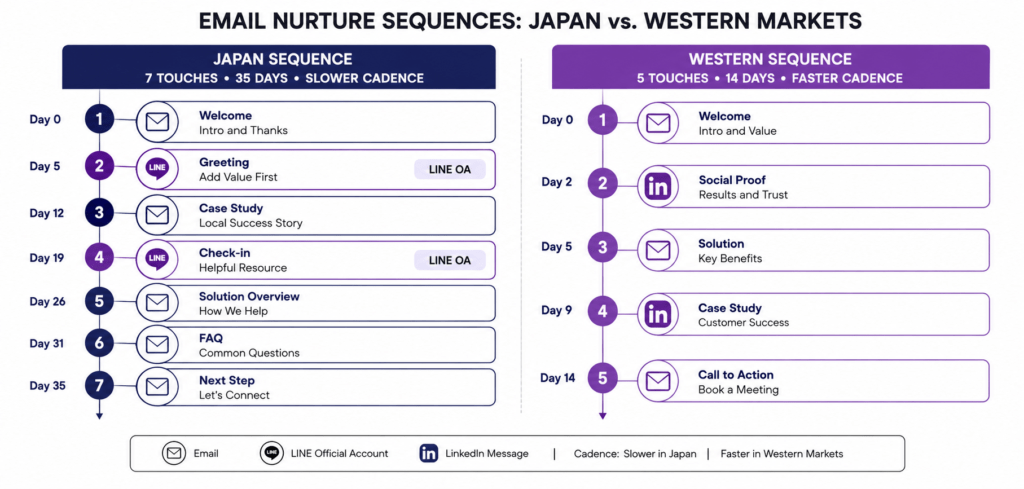
5. The Japan-Facing Nurture Sequence: A 7-Touch Framework
The following sequence is structured for a Japan-facing B2B lead who has completed a micro-conversion — specifically, who has requested a free SEO diagnosis or downloaded a resource. Adapt for other entry points as needed.
Japan-facing nurture sequence
| Touch |
Timing |
Purpose |
What to send |
Channel and example |
| 1 |
Immediately — within 1 hour of conversion |
Confirmation + delivery of promised resource |
Deliver exactly what was promised (diagnosis confirmation, download link, webinar details). Include a clear next-step statement — when they will hear from you, in what format. Keep it transactional and precise. Do not introduce sales language here. |
Channel: Email · Subject: 【受信確認】無料SEO診断のお申し込みありがとうございます |
| 2 |
Day 2–3 |
Relevant case study — the problem they have, solved |
Send a Japan-specific case study matching the lead’s apparent industry or challenge. Lead with the outcome, not the product. Include specific metrics and a brief explanation of the approach. End with a single low-commitment CTA: “See how we approached [challenge type]” linking to a related article. |
Channel: Email (primary) · Optional: LINE OA broadcast if subscribed |
| 3 |
Day 6–7 |
Educational content — the “why this is complex in Japan” email |
Send a short, high-value piece of content explaining a specific Japan market nuance relevant to the lead’s situation. This positions you as the expert who understands the market better than they do — the most important trust signal for a foreign company entering Japan. Link to a relevant article from the site’s content cluster. |
Channel: Email · Optional: LINE OA for shorter format version |
| 4 |
Day 10–12 |
Webinar or event invitation |
Invite to an upcoming webinar on a relevant Japan market topic, or share a recording of a recent one. In Japan, webinars signal commitment to education over selling — a meaningful trust differentiator. Frame it as an opportunity to learn, not as a sales event. Include the specific agenda and time investment required. |
Channel: Email (primary) · LINE OA (reminder) |
| 5 |
Day 16–18 |
Social proof — third-party validation |
Share a testimonial, media mention, or industry recognition from a credible Japanese source. In Japan, third-party validation carries more weight than direct brand claims. If available, include a recognized partner logo or certification reference. Avoid superlative self-promotion — let the external evidence speak. |
Channel: Email |
| 6 |
Day 22–25 |
Process transparency email |
Walk through exactly what happens if they engage — the step-by-step process, who they’ll speak with, what deliverables they’ll receive, and typical timelines. This directly addresses the risk assessment phase of the Japanese conversion journey. Include a “what happens if results disappoint” statement. End with a gentle consultation invitation — not a hard close. |
Channel: Email (primary) |
| 7 |
Day 30–35 |
Direct but respectful consultation invitation |
A short, personal-feeling email from a named consultant or account manager — not a templated marketing message — offering a specific time to talk. Reference something from their industry or situation to signal it is not a mass send. Include a calendar link or a simple “reply to this email to arrange a time” option. Do not push hard urgency. |
Channel: Email (direct send feel, not templated newsletter format) |
After the 7-touch sequence: Leads who have not converted after 35 days should move to a lower-cadence long-term nurture flow — one email per month with genuinely useful Japan market content. Japanese B2B sales cycles can extend to six months or more. Removing unconverted leads after a brief sequence is a common mistake that discards leads who are still evaluating.
6. The Western-Facing Nurture Sequence: A 5-Touch Framework
The following sequence is structured for a Western-facing B2B lead who has completed a micro-conversion — downloading a resource or requesting a consultation from a Japanese company’s English-language site. The sequence is shorter, more direct, and built around self-evaluation rather than gradual trust-building.
Western-facing nurture sequence
| Touch |
Timing |
Purpose |
What to send |
Channel and example |
| 1 |
Immediately — within 30 minutes |
Delivery + immediate next step |
Deliver the resource. Immediately follow with a specific, self-service next step: a link to a free trial, a demo booking calendar, or a pricing page. Western leads who have just expressed interest are at peak motivation in the first 30 minutes — a delayed or purely transactional confirmation email wastes that window. |
Channel: Email · Subject: Your [resource name] + one more thing → |
| 2 |
Day 2 |
Proof email — specific results from a comparable company |
Send a one-page case study featuring a named (or specifically anonymized) company of similar size and industry, with quantified results. Western leads evaluate vendors comparatively — show them what an outcome looks like for someone like them. Include a CTA for a demo or trial, not just “learn more.” |
Channel: Email · Optional: LinkedIn InMail if B2B account-based |
| 3 |
Day 5 |
Objection handling email |
Address the most common reason a lead in this segment might hesitate — cost, implementation time, team capacity, prior experience with a competitor. Frame it directly: “The most common question we hear at this stage is X. Here’s how we think about it.” This signals genuine understanding of their situation and often converts leads who are sitting on a specific unaddressed concern. |
Channel: Email |
| 4 |
Day 9–10 |
Social proof from peer platforms |
Share G2, Capterra, or Trustpilot review highlights, plus a brief “what customers say” compilation. Western B2B buyers weight peer review platform ratings heavily in final vendor selection — this email serves the “check the reviews” step of their evaluation for them, within the nurture sequence rather than hoping they’ll find it independently. |
Channel: Email · Optional: LinkedIn retargeting ad with same content |
| 5 |
Day 14 |
Direct ask — short, specific, easy to act on |
A brief, personal email with a single clear ask: a 20-minute call, a demo, or a proposal request. Use a specific subject line with their first name. Include one quantified outcome sentence from a similar customer. Make the response action as simple as possible — a Calendly link, a one-click reply, or a 2-question micro-survey that leads to a booking. Do not pad with additional content. |
Channel: Email (personal-send format) |
7. Email Copy Side-by-Side: What the Same Message Looks Like in Each Market
The following compares how the same functional message — “here is a case study relevant to your situation” — should be written for a Japan-facing lead versus a Western-facing lead. The subject matter is identical. The structure, tone, and CTA approach are not.
Example: Japan-facing email
件名:外資系SaaS企業様の導入事例をご紹介します
差出人:山田 太郎 | Tokyo SEO Maker
○○様
先日は無料SEO診断にお申し込みいただきありがとうございました。
今回は、先日ご登録いただいた業種に近い、外資系SaaSクライアント様の導入事例をご紹介させていただきます。
同社は日本語コンテンツの最適化と検索意図に合ったキーワード戦略を実施した結果、6ヶ月で日本語オーガニックトラフィックが340%増加、問い合わせ数が3.2倍になりました。
詳細な取り組み内容と成果をまとめた資料をご覧いただけます。
事例の詳細を見る
ご不明な点がございましたら、お気軽にご返信ください。
引き続きよろしくお願いいたします。
Japan-facing: formal opener, context before results, named sender, soft CTA
Example: Western-facing email
Subject: How [SaaS Co.] got 3× more Japan leads in 6 months
From: Admano | Tokyo SEO Maker
Hey [First Name],
Thought this might be useful while you’re evaluating Japan SEO options.
One of our B2B SaaS clients — similar size to your team — grew their Japanese organic traffic by 340% and tripled inbound inquiries in 6 months. The core fix: their keyword strategy was based on translated English terms, not how Japanese buyers actually search.
Full case study here (3-minute read) →
Read the case study
If you want to see if the same approach applies to your Japan program, I’m happy to do a quick 20-min review. Just reply, and we’ll find a time.
Western-facing: informal opener, lead with result, direct second CTA embedded
8. Lead Scoring Across Markets: Signals Are Not Universal
Lead scoring — assigning point values to behaviors to identify sales-ready leads — is standard practice in marketing automation. The behaviors that signal sales readiness differ by market in ways that make a single scoring model unreliable for a cross-border program.
Table 1. Lead scoring signal weight by market direction
| Behavior / Signal |
Japan-facing score weight |
Western-facing score weight |
| Free diagnosis / audit request |
Very High — primary intent signal |
High — strong intent |
| Inquiry form submission |
Highest — sales-ready |
Highest — sales-ready |
| Webinar registration |
High — active trust-building |
Moderate — awareness stage |
| Resource download (3rd) |
High — deep research behavior |
Moderate — early research |
| Pricing page view |
Low (pricing often not shown) |
High — strong purchase intent |
| Case study page view ×2+ |
High — evidence-seeking phase |
Moderate — evaluation stage |
| Email opened ×4+ in sequence |
Moderate — engaged but evaluating |
High — sustained interest |
| Review platform click (G2, etc.) |
Not applicable |
High — pre-decision verification |
| Phone number click (tel:) |
High — intent to contact |
Low — less common first step |
| LinkedIn profile view (team) |
Low — LinkedIn penetration lower in Japan |
High — pre-contact verification |
| Return visit within 7 days |
High — active consideration |
Moderate — healthy engagement |
| Demo request / trial signup |
Low relevance for most Japan B2B |
Highest — sales-ready |
The practical implication: do not use the same lead scoring model for Japan-facing and Western-facing segments within a single marketing automation instance. Build separate scoring rules per market, and define separate MQL (marketing-qualified lead) thresholds for each. A score of 80 in a Japan-facing model means something very different from a score of 80 in a Western model if the underlying signals were not market-calibrated from the start.
9. Technology Stack Considerations
The technical requirements for a cross-border email nurturing program differ from a domestic setup in several ways that should be addressed before campaigns launch.
Japanese character support and rendering
Confirm that the email service provider (ESP) used for Japan-facing sequences correctly renders Japanese characters — kanji, hiragana, katakana, and full-width punctuation — in subject lines, preview text, and email body across major Japanese email clients. The major Japanese email clients (Gmail Japan, Yahoo! Japan Mail, and corporate Microsoft 365 Japan deployments) render Japanese correctly in most cases, but subject line truncation behavior differs: Japanese characters occupy more visual width than their character count suggests in some clients, making effective subject line length shorter than in English.
Sender domain and IP reputation for Japan
Japan has a high spam sensitivity among major ISPs and email providers. Sending Japan-facing campaigns from a domain or IP with no prior Japan send history, or with poor sender reputation, will produce elevated spam placement rates even for fully consented lists. Warm up Japan-facing sends gradually — start with the most recently engaged subset of the list, confirm deliverability before full deployment, and monitor spam complaint rates separately from the home-market email program.
CRM integration for cross-border segmentation
The most common structural mistake in cross-border marketing automation setups is using a single lead record field — country or language — to drive all segmentation, while sharing nurture sequences, scoring models, and sales handoff thresholds across markets. At minimum, configure:
- Separate contact properties for market (Japan / West / other) and lead source market
- Separate lifecycle stage definitions per market if the MQL threshold differs
- Separate nurture enrollment triggers per market — Japan-facing micro-conversions should not enroll leads into Western-facing sequences and vice versa
- Sales notification templates translated into the receiving sales team’s language
10. Setup and Compliance Checklist
Japan-facing legal compliance
- Explicit opt-in consent obtained before adding any contact to Japan-facing email list
- Consent checkbox is separate from general terms acceptance — not bundled
- Consent records include date, IP address, and form version — retained for 3 years minimum
- Every email includes sender name, sender email address or URL, and functional unsubscribe link
- Unsubscribe requests are honored immediately (within one business day)
- LINE OA consent obtained separately from email consent if both channels are used
Western-facing legal compliance
- EU/UK contacts on opt-in lists (GDPR/UK GDPR applies even from Japan)
- US contacts: CAN-SPAM requirements met in every email (postal address, unsubscribe)
- Suppression list maintained — unsubscribes honored within 10 business days (CAN-SPAM)
- Subject lines are non-deceptive and accurately represent email content
- From/Reply-To identifies the actual sending organization
- Double opt-in implemented for EU contacts
Sequence and content
- Japan-facing sequence: minimum 7 touches over 30–35 days before primary sales ask
- Western-facing sequence: 5 touches over 14 days, demo/trial CTA from touch 1
- Separate sequences built per market — no shared nurture workflows across markets
- At least one Japan-specific case study with quantified results in Japan sequence
- At least one peer review platform proof element in Western sequence
- Post-sequence long-term nurture flow exists for unconverted Japan leads (monthly cadence)
Lead scoring and handoff
- Separate lead scoring models per market with market-calibrated signal weights
- MQL threshold defined separately for Japan and Western segments
- Sales notification email translated for receiving team’s language
- Japan-facing free diagnosis request triggers immediate personal follow-up from named consultant
- Western-facing demo request triggers immediate calendar confirmation and preparation email
- CRM records include market segment field to prevent cross-market sequence enrollment
Summary
- Lead nurturing is the layer that converts micro-conversions into qualified consultations — and it is structurally different between Japan and Western markets in cadence, tone, channel mix, sequence length, and legal requirements.
- Japan’s Anti-Spam Act requires explicit opt-in consent before any commercial email is sent, for both B2B and B2C recipients. Consent records must be kept for three years. This differs fundamentally from CAN-SPAM’s opt-out model and must be built into list collection from day one.
- Japan-facing nurture sequences should run 7 touches over 30–35 days, at a low cadence (every 5–8 days), with formal tone, case study and process-focused content, and a soft sales ask only after substantial trust-building. LINE Official Account is a valuable complement to email for this market.
- Western-facing nurture sequences (for Japanese companies entering Western markets) should run 5 touches over 14 days, at a faster cadence, with direct subject lines, peer review social proof, self-service CTAs (demo, trial), and a direct ask by touch 5.
- Lead scoring models must be built per market — the behaviors that signal sales readiness differ significantly, and a shared scoring model produces inaccurate MQL identification for at least one market.
- Do not share nurture workflows across markets. Japan-facing micro-conversions must enroll leads into Japan-specific sequences; Western-facing conversions into Western-specific sequences — with separate enrollment triggers, scoring rules, and sales handoff definitions in the CRM.
Frequently Asked Questions
Can we use our existing HubSpot or Marketo setup for Japan-facing nurturing?
Yes — both platforms support the multi-language, multi-market segmentation required for cross-border nurturing. The key requirement is building Japan-specific workflows, consent fields, and lead scoring models within the platform rather than reusing Western market configurations. Japanese character rendering in email templates requires testing on major Japanese email clients before full deployment, as template formatting behavior varies.
Is LINE Official Account required for Japan-facing nurturing, or is email sufficient?
Email alone can be effective for Japan-facing nurturing, particularly in B2B contexts where professional email is the expected channel. LINE OA adds meaningful value — higher open rates, a more personal feel, and reach on the platform Japanese users check most frequently — but the infrastructure requirement (LINE OA account setup, separate opt-in collection, message design for a conversational interface) is a real overhead. Prioritize getting the email sequence right first, then add LINE OA as a complement once the core flow is working.
How do we handle Japan-facing contacts who were collected before we had a proper opt-in process?
Do not email them for marketing purposes. Japan’s Anti-Spam Act does not have a retroactive exemption for legacy lists — sending marketing email to contacts who did not explicitly opt in is in violation regardless of how the contact was collected. The correct approach is to contact them through a non-email channel (LinkedIn, phone, in-person if applicable) to invite them to opt in to email communications, and to accept that some proportion of legacy contacts will not convert to compliant list members.
How long should we keep Japan-facing leads in a nurture sequence before removing them?
Do not remove unconverted Japan-facing leads after the primary 7-touch sequence. Japanese B2B sales cycles routinely extend to six months or longer, and a lead who received the initial sequence without converting may still be actively evaluating. Move them to a low-cadence, long-term nurture flow — one substantive email per month with genuinely useful Japan market content — and keep them on this flow for at least 6–12 months before making a final re-engagement attempt. The re-engagement email should ask directly whether they would like to remain on the list; those who do not respond should be suppressed to protect list health.
Our Western-facing nurture emails from Japan are getting low open rates. What is usually the cause?
The most common causes for Japanese companies’ Western-facing email underperformance are: subject lines that are too formal or too generic (“Information about our services”), a sender name that is unfamiliar to Western readers and appears as potential spam, slow or missing personalization, and email templates that look corporate rather than conversational. Western B2B nurture emails perform best when the sender is a named individual (not a company name), the subject line references a specific benefit or question relevant to the recipient, and the template reads more like a personal message than a newsletter. A/B test subject line format first — it typically produces the fastest measurable improvement.
Need a nurture sequence built for the Japanese or Western market?
Tokyo SEO Maker is a web marketing consultancy based in Tokyo, specializing in SEO, paid advertising, and digital market entry strategy for businesses entering and competing in both the Japanese and Western markets. Contact us for a free consultation.