
Paid Advertising: Google Ads, LY Ads, and PPC Strategy for Market Entry

Most guides on entering the Japanese market focus on organic search. SEO, content strategy, landing page localization — these are well-covered territory. What receives far less attention is the paid advertising layer that most serious market-entry programs depend on while organic rankings are still building: which platforms to use, how bidding behavior differs from Western markets, how ad copy must be adapted beyond translation, and — critically — what changed in April 2026 when LINE and Yahoo! JAPAN unified its advertising infrastructure into a single platform for the first time. This guide covers paid advertising strategy for both directions: Western companies entering Japan, and Japanese companies entering Western markets.

1. The Japanese Digital Advertising Landscape in 2026
Western companies planning paid advertising in Japan almost universally underestimate one thing: how different the platform stack is. The assumption — that Google Ads plus Meta, the combination that dominates Western paid media, will transfer to Japan — is wrong in ways that have immediate budget consequences.
Google’s market position in Japan
Google holds approximately 80% of Japan’s search market share on mobile, making it the primary search advertising channel and the correct starting point for any Japan-facing paid search campaign. Critically, Google Ads campaigns set up for other markets do not automatically serve in Japan without explicit geographic targeting — a basic configuration step that is frequently missed in hurried market entry setups.
The LY Ads unification: what changed in April 2026
What this means in practice: advertisers who previously ran LINE Ads and Yahoo! JAPAN Display Ads as separate campaigns, in separate platforms, with separate account structures and separate tracking, can now manage both through a single LY Ads interface. The unified platform reaches:
- LINE: 100 million monthly active users in Japan (as of December 2025)
- Yahoo! JAPAN: 54 million logged-in user IDs per month (as of March 2025)
The combined inventory represents the most dominant domestic digital ecosystem in Japan. For Western companies entering Japan, this simplifies the platform management burden substantially. For Japanese companies already running domestic campaigns, it requires active migration from the legacy LINE Ads setup to the new unified environment before LINE Ads ceases delivery in late 2026.
Japan’s platform landscape at a glance
Google Ads Japan
~80% mobile search share. Primary paid search channel for Japan. Runs independently of LY Ads — Google campaigns do not serve on Yahoo! JAPAN/LINE and vice versa.
- Search
- Display
- YouTube
- Shopping
LY Ads (LINE + Yahoo! JAPAN)
Unified since April 2026. Combines LINE’s 100M MAU messaging reach with Yahoo! JAPAN’s search/news/portal ecosystem. Single platform, single account. Essential for Japan display and social.
- Display
- Search (LY Ads Search)
- Messaging
Meta (Facebook / Instagram)
Used in Japan but carries a less dominant position than in Western markets. Instagram is stronger than Facebook for consumer categories (fashion, beauty, food). Relevant for B2C brand awareness, weaker for B2B Japan.
- B2C
- Brand awareness
Rakuten / Amazon Japan
Dominant for e-commerce advertising in Japan. Rakuten Advertising reaches loyalty-program audiences with deep purchase intent data. Essential for consumer product brands entering Japan via e-commerce.
- E-commerce
- Retail media
LinkedIn Ads
Used for B2B targeting in Japan, though penetration among Japanese professionals is lower than in Western markets. More relevant for Western companies targeting bilingual Japanese executives or Japan-based international teams.
- B2B
- Professional
TikTok / X (Twitter)
X (formerly Twitter) retains a stronger user base in Japan than in most Western markets. TikTok is growing fast in consumer categories. Both are awareness-stage tools rather than conversion drivers for most Japan market entry programs.
- Awareness
- Youth B2C
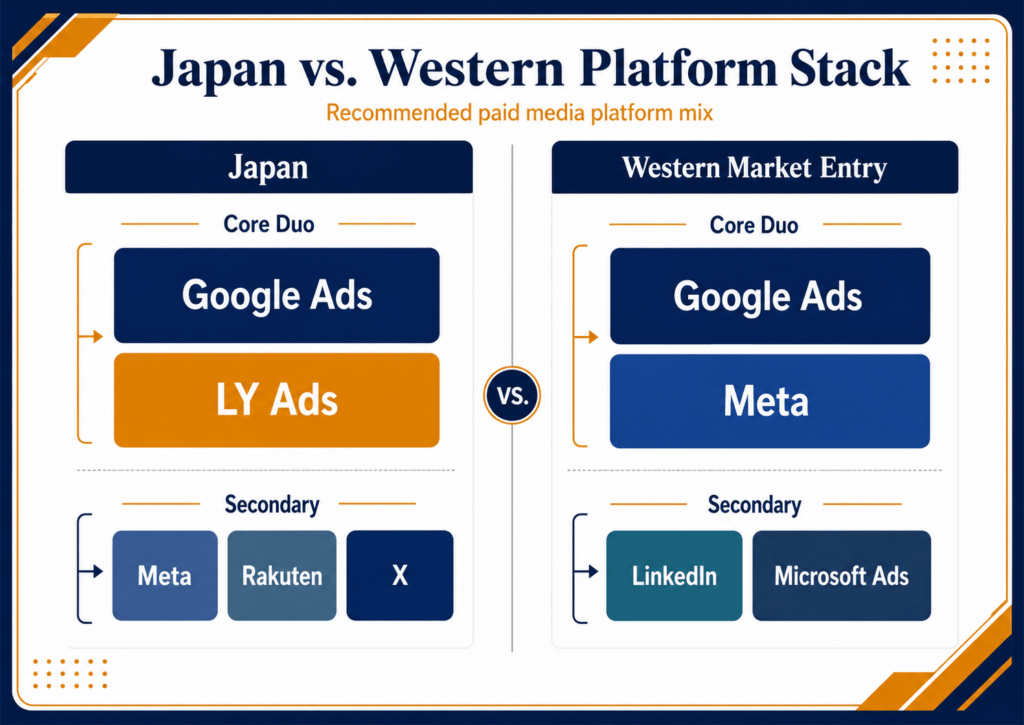
2. How to Allocate Paid Media Budget in Japan
A common mistake Western companies make when launching paid advertising in Japan is importing their home-market budget allocation ratios — typically Google-heavy with a significant Meta component — without adjusting for the Japanese platform landscape. The result is a program that is over-invested in Meta (which has lower organic penetration among Japanese users, particularly in B2B) and under-invested in LY Ads, which is the correct display and social vehicle for broad Japan reach.
The following illustrates recommended starting allocation ranges for two common Japan entry scenarios. These are directional — specific ratios should be calibrated based on industry, product type, and whether the goal is awareness or lead generation.
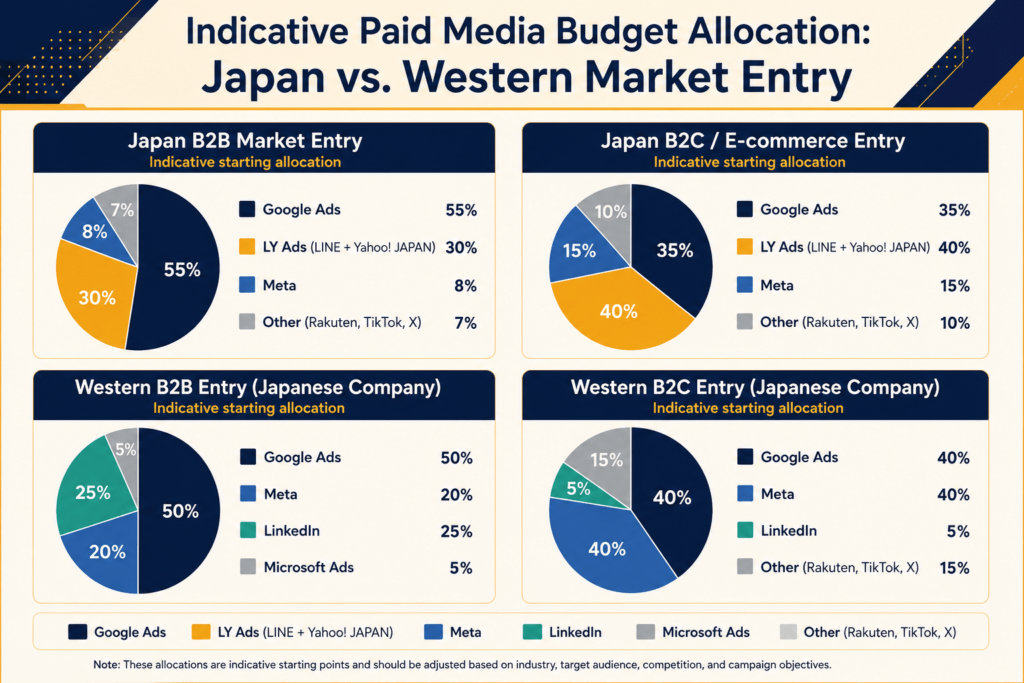
Indicative only. Allocations should be calibrated to industry, funnel stage, and audience profile before campaign launch.
3. Ad Copy and Creative: Where Translation Fails
Every principle from our Cross-Border Localization guides applies with equal force to paid advertising — but the stakes are higher and the failure mode is faster. A poorly localized landing page may take weeks to reveal its underperformance through organic traffic patterns. Poorly localized ad copy underperforms from the first impression and burns through budget immediately.
Japan-facing ad copy: what to change beyond translation
| Element | Typical Western approach | Japan-facing adaptation |
|---|---|---|
| Headline tone | Bold, benefit-first: “Grow Your Business 3× Faster” | Specific and credible: “外資系企業向けJapan SEO — 実績2,000社以上” |
| Urgency language | Common: “Limited spots,” “Act now” | Use sparingly — perceived as pressure; Japanese users are skeptical of hard urgency in B2B |
| CTA phrasing | “Get started,” “Try free” | Softer entry: “無料診断を申し込む” (Apply for free diagnosis) — matches lower-commitment preference |
| Social proof in copy | Review ratings, customer count | Specific client type and outcome: “導入企業2,000社以上・成果保証型SEO” |
| Price mention in ad | Often included to pre-qualify | Omit or soften; Japanese B2B buyers prefer to inquire before receiving pricing |
| Character limits | English copy often optimized to character limit | Japanese requires fewer characters for equivalent information; do not pad with unnecessary phrases |
| Landing page match | Ad promise → landing page headline match expected | Same principle applies, but the landing page must deliver the trust depth the ad implies |
Western-facing ad copy for Japanese companies: the most common gaps
| Element | Common Japanese company approach | Western-facing adaptation |
|---|---|---|
| Headline specificity | Abstract brand promise: “Quality and Innovation” | Specific value statement: “Japanese Precision Manufacturing — 0.02% Defect Rate, 30+ Years” |
| CTA | “Contact us for more information” | “Start free trial” or “Get a quote in 24 hours” — Western buyers expect an immediate, specific next step |
| Price in ad copy | Rarely included | Include where possible; “From $X/mo” in ad copy pre-qualifies and improves click quality in Western markets |
| Urgency / scarcity | Rarely used; perceived as undignified | Effective when credible; seasonal promotions, limited availability can drive CTR |
| Social proof | Awards and certifications (“ISO 9001 certified”) | Review counts and ratings (“Rated 4.8/5 on G2 by 127 users”) outperform credential badges in Western ad copy |
| Ad extensions | Often underused in Google Ads setup | Sitelinks, callouts, and structured snippets are standard practice in competitive Western markets and materially improve CTR |
4. Campaign Structure for Japan-Facing Programs
How you structure campaigns in Japan differs from Western market conventions in several practical ways that affect both performance and billing efficiency.
Google Ads — Japan Campaign Structure
- Separate Japan campaigns from global. Never include Japan in a global campaign with geographic targeting — bidding, ad copy, and landing pages need to be independently optimized, which is only possible in a Japan-dedicated campaign structure.
- Japanese and English keyword variants in separate ad groups. Some Japanese users, particularly in B2B tech and SaaS, search in English (“Japan SEO services”, “Tokyo marketing agency”). These require different ad copy and often convert differently — keep them separate.
- Match type use differs. Broad match in Japan can produce more off-intent traffic than in Western markets due to the complexity of Japanese search query variation across scripts. Phrase match is generally the safer starting point for Japan campaigns until query volume provides enough data to expand safely.
- Negative keyword lists need Japanese-language maintenance. Auto-generated Japanese negative keywords from English campaigns are not reliable — they require active review by someone who can read the search term reports in Japanese.
- Ad scheduling. Japanese business hours (JST) mean that a campaign running on Tokyo time optimizes very differently from one running on UTC or US time zones. Set ad scheduling explicitly for Japan Standard Time.
LY Ads Search Ads — Key Differences from Google Ads
- Separate platform, separate account. LY Ads Search Ads (formerly Yahoo! JAPAN Ads Search) runs entirely independently from Google Ads. A Google Ads campaign does not serve on Yahoo! JAPAN search results — you must create a dedicated LY Ads account.
- Skews older and PC-based. Yahoo! JAPAN’s search users, while smaller in aggregate, skew toward older demographics and higher PC usage than Japan’s Google search audience. For categories where this demographic is commercially valuable (insurance, finance, real estate, B2B professional services), LY Ads Search may deliver better cost-per-lead than Google for those specific audiences.
- Less automated optimization maturity. Google’s Smart Bidding and Performance Max have significantly more training data and algorithmic maturity than LY Ads’ equivalent automation features. Manual or target CPA bidding with more active human oversight is often more reliable on LY Ads in the early stages of a Japan campaign.
- Import from Google Ads is possible but imperfect. LY Ads supports importing Google Ads campaign structures, which saves time on initial setup. However, ad copy, extension settings, and keyword match type behavior differ — imported campaigns require active review and adjustment, not just a one-click sync.
LY Ads Display Ads — The Unified LINE + Yahoo! JAPAN Platform
- Audience targeting is the primary lever. Unlike search ads (where the keyword declares intent), LY Ads Display targeting depends heavily on audience definition: interest categories, behavioral segments, lookalike audiences based on existing customer lists, and retargeting against site visitors. For Japan market entry, audience-first thinking is more important on LY Ads than on Google Search.
- LINE’s messaging environment requires distinct creative. Ads served in the LINE messaging environment appear between conversations, a deeply personal context. Creative that feels intrusive or corporate underperforms significantly. Ads that feel native to the conversational environment (lighter, more personal, less corporate) perform better.
- Combined retargeting across LINE and Yahoo! JAPAN. The April 2026 unification means a user who visited your Japan-facing website can now be re-targeted across both LINE (their messaging app) and Yahoo! JAPAN (their portal, news, and email) from a single campaign — a capability that required two separate account setups before the merger. This significantly improves retargeting reach for visitors who don’t convert on first visit, which — as noted in our CRO guide — is the majority of Japan-facing site visitors.
5. The Paid Funnel Mapped to Each Market’s Conversion Journey
The structural difference in how Japanese and Western users convert — discussed extensively in our CRO guide — has direct implications for how paid advertising campaigns should be structured across the funnel. Using the same campaign-type-to-funnel-stage mapping for both markets consistently produces budget waste.
Japan-facing paid funnel
1: Awareness
Introduce the brand to an audience unfamiliar with the company
- LY Ads Display
- YouTube pre-roll
- X promoted posts
2: Consideration
Target users searching for the category or problem
- Google Ads Search
- LY Ads Search
3: Trust building
Retarget site visitors with case study or webinar ads
- LY Ads Display retargeting
- Google Display Network
4: Micro-conversion
Push free diagnosis, webinar, or resource download
- Google Search (branded + specific intent)
- LY Ads retargeting
5: Inquiry
Retarget micro-converters with consultation offer
- Google Search
- LY Ads (logged-in audience)
Western-facing paid funnel
1: Awareness
Reach cold audiences in target industry or role
- Meta
- YouTube
- Google Display
2: Intent capture
Target users searching the category or problem
- Google Ads Search
- Microsoft Ads
3: Consideration
Retarget with social proof or demo ad
- Meta retargeting
- LinkedIn retargeting
- Google Display
4: Conversion
Trial, demo, or contact form CTA
- Google Search (competitor + branded)
- LinkedIn (B2B)
6. Keyword Bidding Dynamics: Japan vs. Western Markets
Cost-per-click benchmarks and competitive bidding dynamics in Japan differ from Western markets in ways that affect both budget planning and keyword strategy.
| Dimension | Japan (Google Ads) | Western markets (Google Ads) |
|---|---|---|
| Average CPC in competitive B2B categories | Generally lower than US equivalents; mid-to-high CPCs in finance, legal, medical | Higher baseline CPCs; highly competitive in SaaS, legal, insurance, finance |
| Keyword competition from foreign companies | Lower — most Japan-market advertisers are domestic; foreign entrants often find less auction pressure | High international competition; foreign companies regularly compete in US/UK auctions |
| Brand search CPCs | Low for unknown foreign brands; opportunity to own branded terms cheaply early in market entry | Competitors may bid on your brand terms; branded CPCs higher in mature markets |
| Long-tail keyword value | High — Japanese users use specific multi-word queries; long-tail terms often have better commercial intent than head terms | High — well-established practice; more competitive in most categories |
| Quality Score factors | Landing page Japanese-language quality matters significantly; poor Japanese copy penalizes QS | Standard QS factors; CTR history and landing page relevance as expected |
| Auction insight benchmarks | Domestic Japanese competitors are usually the auction reference; foreign entrant benchmarks rarely apply | Mix of domestic and international competitors; benchmarks more transferable |
The practical implication for Western companies: Japan is often a lower CPC environment than the home market, but the quality score penalty from poor Japanese landing page copy can eliminate that CPC advantage entirely. A well-localized Japanese landing page is not just a conversion optimization — it directly affects paid search cost efficiency.
7. Measurement and Attribution for Cross-Border Paid Campaigns
The analytics framework covered in our Cross-Border Analytics guide applies directly to paid campaign measurement, with several paid-specific additions.
Conversion tracking setup requirements
Google Ads conversion tracking and LY Ads conversion tracking must be set up independently — they do not share data. For Japan campaigns, this means:
- Google Ads conversion tags deployed on all Japan-facing micro-conversion events (free diagnosis request, webinar registration, resource download, inquiry form) — not just the final form submission
- LY Ads conversion pixel deployed on the same events if running LY Ads campaigns — this is a separate pixel from the Google Ads tag
- View-through conversion windows adjusted for Japan’s multi-session journey — the default 1-day view-through window significantly undercounts LY Ads display impact in Japan, where users often encounter a display ad days before searching and converting on Google Search
The LINE attribution gap and LY Ads unified data
One benefit of the April 2026 LY Ads unification: by consolidating LINE display and Yahoo! JAPAN display delivery into a single platform, attribution across the LINE-to-Yahoo! path becomes significantly cleaner. Previously, a user who saw a LINE ad, visited the Yahoo! JAPAN homepage, clicked a display ad there, and then searched on Yahoo! JAPAN would generate attribution data split across three separate platforms. Under LY Ads, the display and messaging inventory is unified, making this path visible within a single reporting interface.
Paid and organic: separate reporting, coordinated strategy
A common structural mistake in Japan market entry programs is allowing paid and organic to operate in separate silos without coordination. Paid search data — specifically, which keywords generate high CTR and low cost-per-conversion in Google Ads Japan — is among the most reliable available signal for which organic keywords to prioritize next in the SEO program. The reverse is also true: organic keyword rankings that improve should trigger a review of whether paid spend on those terms can be reduced as organic takes over the click volume. Coordinate paid and organic measurement in a unified reporting view from the start.
8. Practical Launch Checklist
Before you launch — Japan
- Japan-specific Google Ads campaigns created (not added to global campaigns)
- LY Ads account opened separately — Japan billing address or authorized agency required
- Japanese landing pages are localized, not just translated (trust signals, phone number, address visible)
- Micro-conversion events (free diagnosis, download, webinar) set as conversion actions in Google Ads Japan
- LY Ads conversion pixel deployed on same micro-conversion events
- Ad copy reviewed by native Japanese speaker — not just translated by machine or agency without review
- Negative keyword list built in Japanese for Google Ads
- Ad scheduling set to Japan Standard Time (JST)
- Google Ads geographic targeting explicitly set to Japan only
Before you launch — Western markets
- English-language landing pages are localized for Western buyers — pricing visible, team named, review badges present
- Google Ads campaigns separated by target Western market (US, UK, EU — different copy and bidding where relevant)
- LinkedIn Ads account active for B2B targeting by job title, company size, and industry
- Meta Ads set up with lookalike audiences from any existing Western customer data
- Ad extensions fully built out: sitelinks, callouts, structured snippets, price extensions where applicable
- Conversion tracking deployed for trial signup, demo request, pricing page view, and contact form
- CTA in ads is self-service or specific (“Book a demo,” “Start free trial”) — not “Contact us”
- Review platform presence (G2, Capterra, or Trustpilot) established before paid traffic begins
Ongoing optimization — both markets
- Weekly search term report review — flag irrelevant queries for negative keyword addition
- Conversion tracking verified monthly — ensure tags are firing on all intended events
- Landing page quality score review quarterly — declining QS often signals landing page deterioration
- Paid and organic keyword performance compared monthly — reduce paid spend on organically ranking terms
- Audience list refresh — retargeting audiences updated as site traffic grows
- Ad copy A/B tests running continuously — test one variable at a time, market-specific hypotheses only
- Budget allocation reviewed quarterly against actual CPA by platform and campaign type
Summary
Japan’s paid media landscape differs fundamentally from Western markets: Google Ads and LY Ads (formerly Yahoo! JAPAN + LINE) are the core platform duo for Japan, replacing the Google + Meta default most Western companies bring from their home market.
As of April 2026, LINE Ads and Yahoo! JAPAN Display Ads have unified into a single platform — LY Ads Display Ads — operated by LY Corporation. This simplifies Japan display and social advertising significantly and enables retargeting across LINE’s 100M MAU and Yahoo! JAPAN’s 85M+ monthly users from a single account. Advertisers still on standalone LINE Ads must migrate before late October 2026.
Ad copy must be adapted for each market beyond translation: Japan-facing copy favors softer CTAs, specific credibility claims, and avoids hard urgency; Western-facing copy from Japanese companies needs specific value statements, self-service CTAs, and peer review social proof rather than certification badges.
The Japan paid funnel is one stage longer than a Western equivalent — the trust-building retargeting phase before micro-conversion has no direct Western parallel and cannot be skipped without significantly suppressing conversion rates.
Japan CPC environments are often lower than Western equivalents, but landing page localization quality directly affects Quality Score — a poorly localized Japanese page eliminates the CPC cost advantage and should be fixed before significant paid budgets are deployed.
Conversion tracking must be deployed independently on Google Ads Japan and LY Ads, and must cover micro-conversion events — not just inquiry forms — to reflect the actual Japan conversion journey in paid campaign performance data.
Japanese companies entering Western markets should prioritize LinkedIn Ads for B2B, build Meta competence for consumer categories, add pricing transparency and review platform badges to landing pages before starting paid campaigns, and use specific self-service CTAs in ad copy.
Frequently Asked Questions: Paid Advertising
Do I need a Japanese bank account or Japanese company to advertise on LY Ads?
Not necessarily. LY Corporation works with authorized overseas representatives and agencies who support foreign advertisers with account setup, billing, and campaign management on LY Ads without requiring a Japanese legal entity or Japanese bank account. This is one of the more practical barriers for Western companies entering Japan paid media — using an authorized Japan-market agency or media representative is the standard route for foreign advertisers without a Japan subsidiary.
Should we run Google Ads Japan and LY Ads Search simultaneously, or prioritize one?
For most Japan market entry programs with a limited initial budget, Google Ads Japan should be the priority first — it has the larger search volume, more mature optimization tools, and typically requires less setup complexity. Add LY Ads Search once Google Ads Japan is optimized and producing reliable conversion data. For B2C categories targeting older demographics, or for clients where Yahoo! JAPAN historically drives significant organic traffic, running both from day one is worth the added management overhead.
Our Google Ads Quality Scores in Japan are lower than on our home-market campaigns. Why?
The most common cause is a mismatch between the Japanese keywords being bid on and the Japanese landing page content. If the landing page was translated rather than localized — using vocabulary that does not match the terms Japanese users actually search, or missing the trust-signal depth Japanese users expect — Google’s Quality Score algorithm will detect low relevance and penalize the score. Fix the landing page localization first; QS improvements from copy work typically appear within two to four weeks of Google recrawling the page.
Is LinkedIn Ads worth using in Japan?
LinkedIn’s professional user penetration in Japan is lower than in the US or Europe — many Japanese business professionals do not maintain active LinkedIn profiles, and engagement rates on LinkedIn Ads in Japan are typically lower than for equivalent campaigns in Western markets. LinkedIn Ads in Japan is most effective for targeting bilingual Japanese professionals, international companies operating in Japan (who tend to have higher LinkedIn adoption), and English-language B2B products where the buyer is likely to have a LinkedIn presence. It is not the right primary channel for reaching Japanese-native decision-makers at domestic Japanese companies.
How should Japanese companies structure their Google Ads account when entering the US or UK?
Create dedicated campaigns per target Western market — separate US and UK campaigns even if the product and pricing are identical, because search behavior, terminology, and ad copy conventions differ between the two. Use all available ad extensions, which are frequently underused by Japanese companies relative to how aggressively Western competitors employ them. Set up Smart Bidding with target CPA once sufficient conversion data exists (typically 30+ conversions per month per campaign), and use Performance Max cautiously — it requires robust conversion signal quality to optimize effectively, and Western market conversion data takes time to accumulate.
Tokyo SEO Maker is a web marketing consultancy based in Tokyo, Japan, specializing in SEO strategy, paid advertising, and digital market entry for businesses entering and competing in both the Japanese and Western markets.